
Gmina Leżajsk: Culture, Brewing History and City Walks
Accommodation in Gmina Leżajsk
When planning a trip to Gmina Leżajsk, there are several themes to choose from: in the town of Leżajsk, the focus is on a tourist walking route, brewing history and religious culture. The wider Leżajsk destination also offers historic architecture and nature trails. When looking for a holiday apartment, consider whether you would prefer to spend time sightseeing in town and visiting museums, or exploring cultural and nature themes on tours.
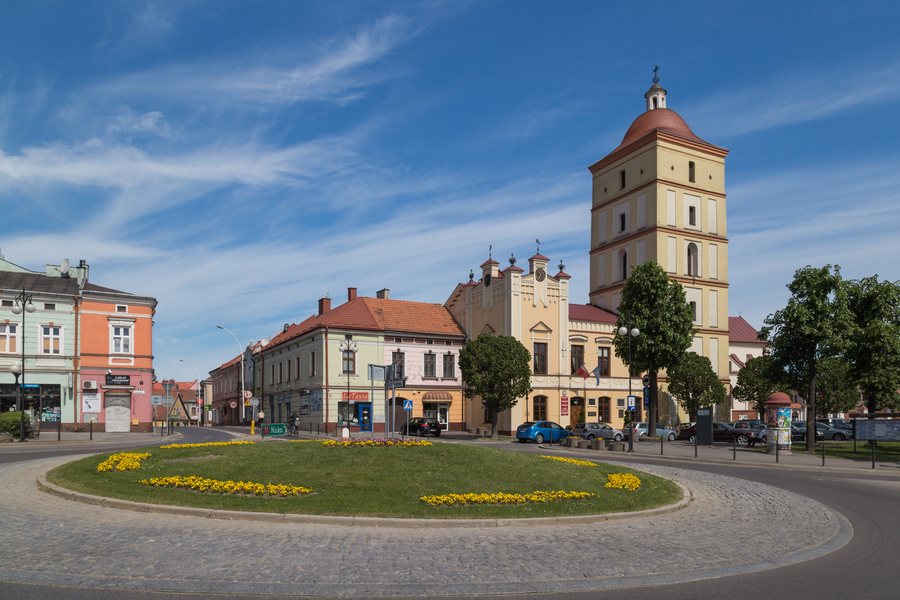 File:2018 Powiat leżajski, Leżajsk, Ratusz 01.jpg
Photo: Marcin Konsek via Wikimedia Commons, CC BY-SA 4.0
File:2018 Powiat leżajski, Leżajsk, Ratusz 01.jpg
Photo: Marcin Konsek via Wikimedia Commons, CC BY-SA 4.0
In the town of Leżajsk: walking route and brewing history
A tourist walking route leads from Leżajsk’s market square along Mickiewicza Street to Plac Mariacki, where the basilica and Bernardine monastery are located. The route is more than three kilometres long and offers a practical way to explore the town on foot.
The Ekspozycja Browarnicza at the Muzeum Ziemi Leżajskiej can be visited on a guided tour, which lasts about 40 minutes. The history of brewing beer in Leżajsk goes back further: in 1525, King Zygmunt I Stary granted the town the right to brew beer. At the same time, he prohibited the serving of beer and other alcoholic drinks within less than one mile of the town limits.
In the wider Leżajsk destination, visitors can taste the drink described there as the “golden drink” at the Ekspozycja Browarnicza. Check before your trip whether this tasting is available. Alongside learning about the history, visitors can therefore choose between the guided tour and, if available, a tasting.
Museums, historic spaces and views
At the Museum of the Bernardine Province in Leżajsk, you can visit vaulted rooms and uncovered fragments of 17th-century fortifications in historic underground spaces. The collection includes paintings, sculptures, church furnishings, liturgical vestments and vessels, Sarmatian portraits, funeral objects, and numerous everyday items belonging to the friars. The underground rooms and the collection offer different points of interest: historic architectural features on the one hand, and art and objects from monastic life on the other.
The landscaped grounds of the historic manor-house complex include a park with Leżajsk toys.
The Centrum Informacji Turystycznej i Kulturalnej in Leżajsk offers the opportunity to climb its tower and view the town from several levels. This lets you complement a visit to indoor spaces with a view from above.
Jewish history and monastic culture in Leżajsk
Every year around the turn of February and March, thousands of Hasidim visit the Jewish cemetery in Leżajsk to honour Elimelech of Leżajsk (1717–1787). In the wider Leżajsk destination, the Jewish cemetery is regarded as Poland’s most important Hasidic pilgrimage site. In the wider Leżajsk destination, the ohel of the tzaddik Elimelech contains a symbolic stone grave of Elimelech, as well as two matzevot leaning against the wall, belonging to his son Eleazar and grandson Naftali.
The construction history of the Bernardine complex also forms part of the cultural character of the wider Leżajsk destination. In the wider Leżajsk destination, the complex comprising the Bazylika pw. Zwiastowania NMP and the Klasztor OO. Bernardynów includes a church built between 1618 and 1628. In the wider Leżajsk destination, the monastery complex was granted the status of a historic monument in April 2005 and added to the Pomniki Historii list. In the wider Leżajsk destination, the Leżajsk organs are considered one of Europe’s most valuable monuments of instrument-making and ornamental art.
Routes and stories in the wider Leżajsk destination
For a walk with a historical theme, the walking guide “W Leżajsku na piasku, objawiła się przy lasku, Matka Boska Marya…” leads from the monastery to the market square and takes about 50 minutes. Other guides tell the stories of people and events from Leżajsk. “Los rzucony na stos” covers the story of Mielczarkowa, a woman from Leżajsk popularly known as the “Witch of Leżajsk”; the quest takes about 60 minutes.
The quest “Tajemnicze zabójstwo w biały dzień” is about Maria Jaroszówna, a young resident of Leżajsk and granddaughter of the well-known Leżajsk notary Alfred Josse. This quest also takes about 60 minutes. “Biłem Twoim sercem ziemio” tells the story of the life and work of Tadeusz Hollender, a poet born in Leżajsk who was shot by the Gestapo in the ruins of the Warsaw Ghetto in 1943; this quest is listed as taking about 50 minutes.
The stated durations make the options easy to compare: the guided tour of the brewing exhibition takes about 40 minutes, while the guides mentioned take around 50 or 60 minutes. The tourist walking route through the town, by contrast, is described as being more than three kilometres long. You can choose according to the themes and time slots that fit your stay.
Architecture and nature in the wider Leżajsk destination
The Proświta building in Leżajsk was built in 1913 to a design by local architect Lew Szelewicz. Its eclectic façade features neo-Romanesque windows. Leżajsk’s Neo-Renaissance town hall was built between 1869 and 1870. Both buildings offer different ways to explore the town’s architectural history.
If you would like to include nature as well as the history of the town and its buildings, the wider Leżajsk destination has a new walking and cycling route through the Las Klasztorny nature reserve. It offers close contact with nature and the opportunity to discover the area’s distinctive natural features.
Discover more destinations
Discover more destinations: Nowa Sarzyna.
Back to the wider travel overview: Leżajsk.

