
Brzóza Stadnicka: Old Routes and a Granary
Accommodation in Brzóza Stadnicka
The route and the historic granary offer different ways to explore Brzóza Stadnicka: through former paths and the architectural history of the Potocki estate. The landscape, shaped by fields, brings the place into focus through movement; the granary draws attention to architecture and history. Together, these themes give your stay concrete points of interest without promising the same kind of experience.
A circular route connected to former paths
The 9.5 km Starych Dróg Czar circular route runs from Żołynia Górna to Brzóza Stadnicka. It passes mainly through fields and along the skotnik and zagondwie paths. Its circular shape, endpoints and length make the route a specific option for planning; the stretches through fields describe the character of the route.
The route also includes a path that residents of Brzóza Stadnicka once used to get to church in Żołynia and to the centre. This former function adds a story of everyday life to the route: paths that today form part of a named circular route once served residents as links to religious and local destinations. If you enjoy noticing the history behind a path, this one offers a particularly concrete point of interest.
The granary and its architectural history
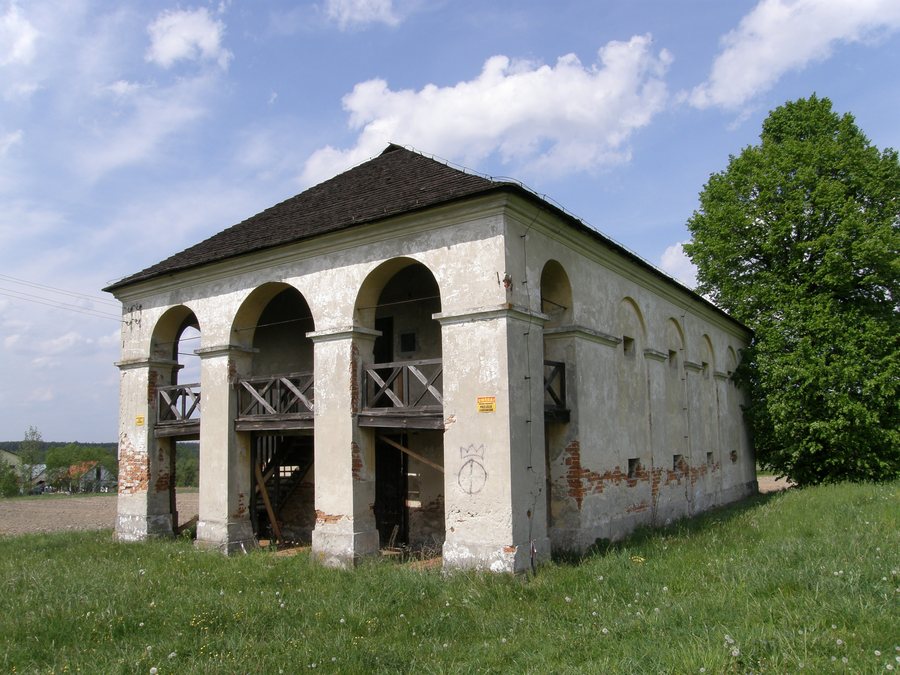
Brzóza Stadnicka is home to a historic distillery storage granary from the former Potocki estate. It was built in 1843–1845 to plans by draughtsman Jan Tokarski. The dates place its construction in the mid-19th century; the draughtsman’s name also provides a specific link to its design.
The granary is a two-storey, plastered brick building in the Neoclassical style, with a rectangular floor plan. These features describe different aspects of the building: the number of storeys tells you how many levels it has, while the floor plan describes its shape. Brick and plaster indicate the material and surface, while Neoclassicism identifies its stylistic classification. This makes it easier to understand the architecture in more detail, even without specialist knowledge, rather than seeing the granary simply as an old building.
When looking at the building, it helps to distinguish between material, form and style. This makes it clear why a brief description conveys more than just a date of construction: it explains how the building was designed and what elements make up its appearance. Together with its date and connection to the former estate, this provides a concrete way into the architectural history of the place.
Which focus suits your trip?
The circular route offers a clearly defined trail that runs mainly through fields and connects with former paths. The granary brings its period of construction, draughtsman and Neoclassical design into focus. Consider whether you would rather plan your stay around a walking route or around architectural and local history.
Discover more destinations
Discover more destinations: Łańcut, Czarna, Białobrzegi, Kraczkowa.
Go to the main travel overview: Łańcut.

.jpg)