
Discover Kombornia
Accommodation in Kombornia
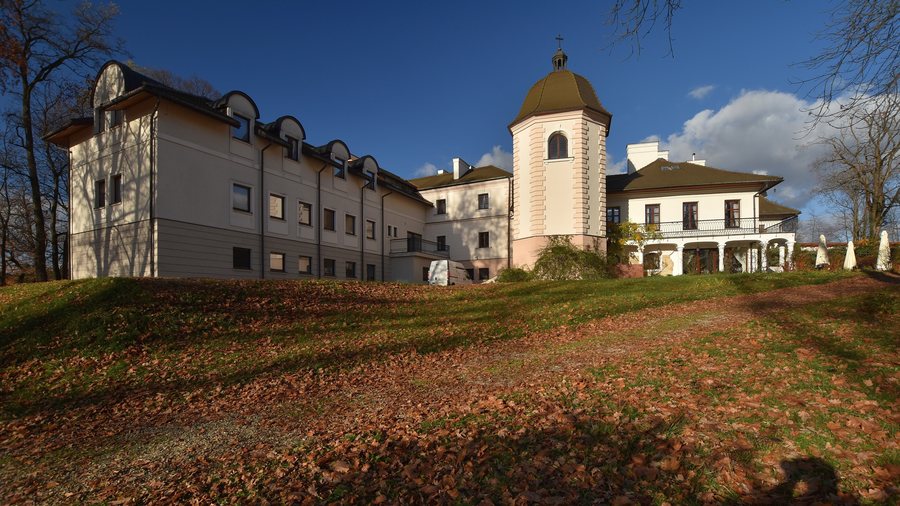
A sprawling park with ponds, a waterfall and a manor complex whose origins date back to the 15th century define Kombornia. The village is also home to an educational trail leading to the Bogumiła sulphur spring and the Church of Our Lady of Consolation, with its Baroque furnishings. The area offers a variety of things to discover: visitors wishing to explore nature and the landscape will find different points of interest from those particularly interested in the history of the manor or religious art.
Parkland and distinctive rock formations
The manor complex covers more than 12 hectares and is surrounded by a sprawling park with ponds. The manor garden is characterised by highly varied terrain and an extensive water parterre. Numerous natural monuments can be found among the trees. This mix of landscaped parkland and varied terrain makes the garden a distinctive feature of a stay in Kombornia.
Zaginione Skałki are also among the area’s natural features. One of the rock formations along the path in Kombornia is an outcrop of hard Ciężkowice sandstone. It is about 40 metres long and between 3 and 7 metres high. These approximate measurements give an idea of the rock’s size without assigning it a single fixed height.
Trails to the waterfall and sulphur spring
The nature trail to Trzy Wody waterfall runs through Kombornia-Granice Górne. The route is 940 metres long and has three stops with information boards. Steps and a viewing platform have been built at the waterfall to allow visitors to view it safely. Trzy Wody is about 5 metres high and 2 to 6 metres wide; the waterfall was designated a natural monument in 2008. The visit therefore includes a defined route and information along the trail.
Another short educational trail leads to the Bogumiła sulphur spring. The environmental and educational path is 42 metres long and 0.60 metres wide. Two themed information boards accompany it. Its length and stops set it apart from the 940-metre nature trail to Trzy Wody. Visitors wishing to explore the area can include these two trails as distinct points of interest in their day’s plans.
Manor history and church art
The origins of the manor complex date back to the 15th century; the protected historic complex dates from the mid-18th century. It is one of the largest and best-preserved manor complexes in the Subcarpathian region. This history sits alongside the features of the garden and park, making the complex a major cultural point of interest in Kombornia.
The Church of Our Lady of Consolation was consecrated in 1958. It is built in the Polish Vistula Gothic style from jointed bricks, has three naves and stands on a sandstone plinth. Inside, the high altar and image of the Virgin Mary are notable historical features: the high altar is Baroque and dates from before 1775. It houses a Baroque image of Our Lady of Consolation from the second half of the 17th century.
Traces of Saint John of Dukla
Kombornia is also associated with John of Dukla. Since 26 May 1999, his relics have been permanently housed in the village’s parish church, in the apse behind the high altar. There is also a spring dedicated to Saint John of Dukla beside the main road. According to tradition, he is said to have rested there; local people attribute healing properties to the spring. This tradition adds a distinct spiritual connection to the church art.
When choosing a holiday apartment, it may therefore be important to consider which side of Kombornia interests you most: the park and manor, the nature trails and their specific stops, or the church’s architecture and history. These different themes offer a range of ways to shape your stay in the village.
For the broader travel overview: Krasna.

.jpg)