
Discover Tworylne
Accommodation in Tworylne
Tworylne is uninhabited today, but its surviving architectural and landscape traces give the place a distinctive historical character. A brick bell tower ruin recalls the wooden Greek Catholic Church of St Nicholas, built in 1876. Other remains include a German border post built at the beginning of the Second World War and the ruins of a manor barn. These different traces make Tworylne interesting to travellers who want to discover local history through tangible buildings and landscape features.
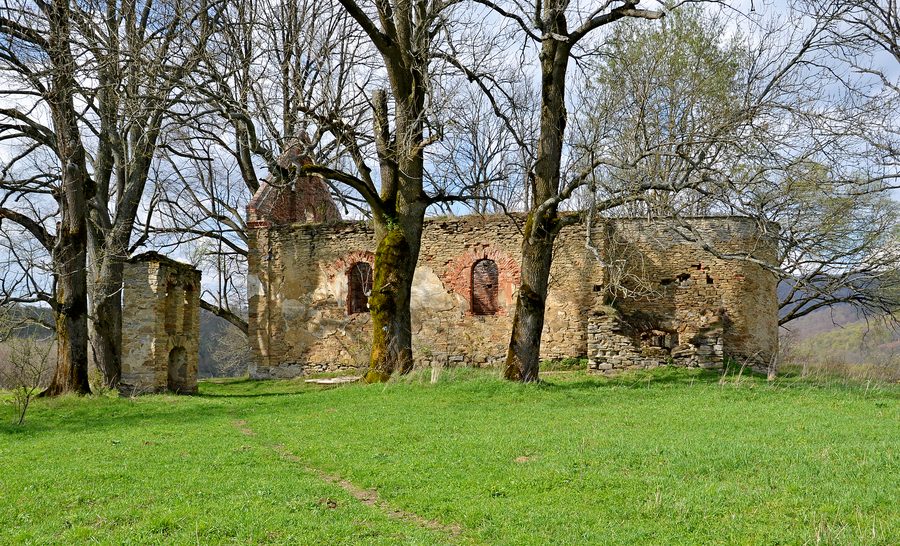 Ruins of the Saint Paraskeva church in Krywe near Tworylne.
Photo: Pudelek via Wikimedia Commons, CC BY-SA 4.0
Ruins of the Saint Paraskeva church in Krywe near Tworylne.
Photo: Pudelek via Wikimedia Commons, CC BY-SA 4.0
History in its buildings
The bell tower brings together two clearly distinct architectural details: the Greek Catholic Church of St Nicholas, built in 1876, was made of wood; the brick bell tower is a ruin. A historic church building and the tower that recalls it therefore stand as distinct architectural features. The ruins of a manor barn add another kind of built heritage to the history of the church. Remains of the border post have survived; it was built at the beginning of the Second World War. The chronology thus clearly distinguishes the 1876 church from the border post built at the beginning of the Second World War.
Cemetery and chapel crypt
The local cemetery is also a distinctive landscape feature: an old road divides it into two parts. The crypt of a former manor chapel is also located near Tworylne. Wincenty Łęcki endowed the chapel towards the end of the 19th century. The cemetery and crypt point to different aspects of local history: the road shapes the layout of the cemetery, while the crypt remains as a trace of the former chapel. The endowment towards the end of the 19th century adds another ecclesiastical trace from that century to the church building dated to 1876.
Hiking trails with different connections to the village
Several trails lead hikers to Tworylne or near it in different ways. The red-marked Zatwarnica–Hulskie–Krywe–Tworylne hiking trail leads to Tworylne, where there are ruins of various buildings and a cemetery. Check current trail conditions before your trip. An unmarked footpath also continues from the manor ruins in Krywe to Tworylne; navigating the terrain is required. The green-marked PTTK hiking trail runs near the now-uninhabited village, crossing the peaks of Bukowina and Żołobina, but does not pass through Tworylne. When choosing a route, its connection to the village and its markings are two separate considerations: does the route lead to Tworylne or run near it, and is the trail marked or unmarked?
Planning your trip and finding a holiday apartment
When looking for a holiday apartment, you can first decide what kind of trip you want: will your plans focus mainly on historical traces or on a particular hiking route? Tworylne offers specific points of interest for both, and for hiking, the route’s connection to the village, its markings, and the unmarked section are important distinctions. This lets you shape the rest of your travel plans around the discoveries you would most like to focus on.
Discover more destinations: Teleśnica Oszwarowa, Smolnik, Stuposiany, Ropienka, Dwernik, Muczne, Ustrzyki Dolne, Zatwarnica.
Return to the broader travel overview: Bieszczady.

_-_ruins_of_the_church.jpg)