
Dwernik: Village History and Nature Trail
Accommodation in Dwernik
Dwernik offers two distinct points of interest for planning your trip: historical traces of a former settlement and the Dwernik–Otryt–Chmiel nature and educational trail. The foundations of an Orthodox church provide a tangible connection to the village’s history; the route leads from Dwernik via Otryt to Chmiel. If you are considering whether Dwernik is right for your stay, you can weigh these themes according to your interests: local history or a named route with a focus on nature and education.
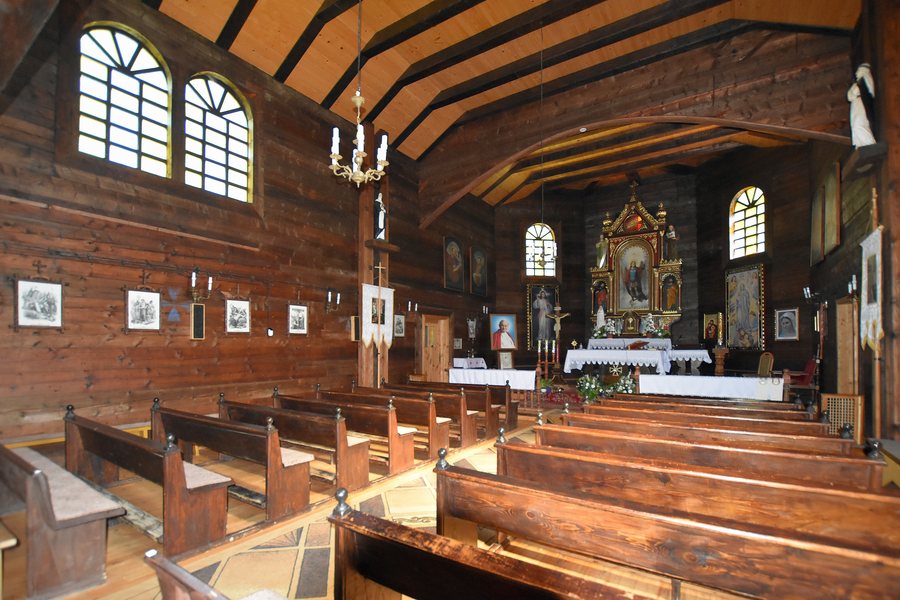 File:Dwernik, kościół św. Michała Archanioła (HB9).jpg
Photo: Henryk Bielamowicz via Wikimedia Commons, CC BY-SA 4.0
File:Dwernik, kościół św. Michała Archanioła (HB9).jpg
Photo: Henryk Bielamowicz via Wikimedia Commons, CC BY-SA 4.0
Historical traces of the former settlement
The foundations of the Orthodox Church of the Archangel Michael, built in 1785, have been preserved. Together with a village churchyard and several gravestones, they bear witness to the former settlement. The year and dedication give the foundations a specific historical context: they refer to a particular place of worship, not merely to an unidentified structural remnant. Only the western part of the cemetery in Dwernik, with 14 gravestones, has survived. The number makes this trace of the cemetery tangible, while the reference to the western part specifies which section has been preserved. For those interested in culture, a dated church building, its dedication and the gravestones are tangible themes at the heart of the village’s history. Those choosing a destination based on an interest in former settlements will find several specific points of connection in these traces. The church foundations and gravestones are different kinds of evidence; together, they point to the former settlement.
The nature and educational trail via Otryt
The Dwernik–Otryt–Chmiel nature and educational trail is about 6.4 kilometres long and has seven stops. It leads from Dwernik via Otryt to Chmiel and along the Otryt ridge to Chata Socjologa, a student hostel that was rebuilt after a fire. The length, number of stops and named places help you consider the route as a focus of your trip in its own right. The approximate distance is a useful guide when deciding how much of your day to set aside for a walk; the seven stops add another point of reference for the nature and educational trail alongside the distance. The route connects the three named places and also leads to a destination on the Otryt ridge. Chata Socjologa adds a named destination with its own historical connection, having been rebuilt after a fire. If you like to make a route a specific theme of your trip, its length and stops provide useful details for planning.
Choosing Dwernik based on your travel interests
The choice of location presents a straightforward comparison: the historical remains bring the former settlement to the fore, while the nature and educational trail focuses on its route, length and stops. Both are different reasons to consider Dwernik as a place to stay. Which theme matters more to you depends on what you want to include in your trip plans. If you are travelling together, different interests may tip the balance: for some, local history is the stronger point of interest, while others are more likely to plan around a route with named stops.
Discover more destinations: Polana, Krościenko, Arłamów, Procisne, Tworylne, Lutowiska, Brzegi Dolne, Ropienka
For the overarching travel guide: Bieszczady.

.jpg)