
Poniszowice: Wooden Church, Churchyard and Park
Accommodation in Poniszowice
Poniszowice combines historic buildings with a park and a marked hiking trail. The sequence of different traces of the past is particularly clear: the wooden church was built in 1499, the churchyard around it dates back to the 15th century, and the park of the manor and park complex is dated to 1830. Added to these are later structural alterations to the church, a stone cross from the 19th century and the completed revitalisation of the park. For your travel planning, this offers a choice between ecclesiastical architectural history, the park and a hiking route—without having to combine these different experiences into a single itinerary.
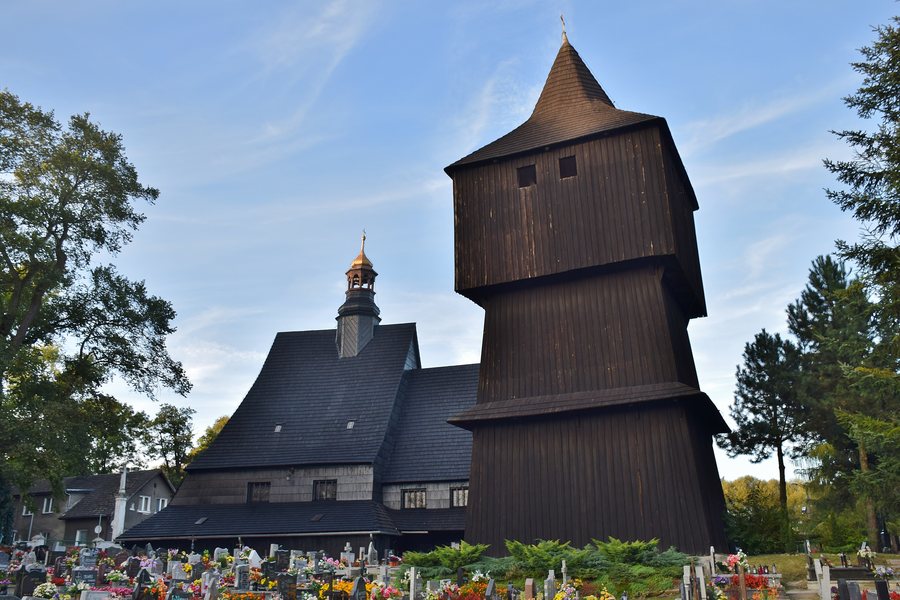
Wooden Church with Several Building Phases
The wooden church in Poniszowice was built in 1499. A side chapel was added in the 17th century, and the church was enlarged in the second half of the 18th century. It is dedicated to St John the Baptist and Our Lady of Częstochowa. The original construction, side chapel and enlargement represent several building phases. The church also has a free-standing bell tower dating from the 16th century. As a separate structure, the tower adds another point to the church’s chronology and predates the later changes of the 17th and 18th centuries. The wooden church is also part of the Silesian Wooden Architecture Trail. Anyone interested in wooden architecture can thus connect the history of a particular building with its place on this trail.
Churchyard and Park: Two Historical Perspectives
The churchyard around the Church of St John the Baptist dates back to the 15th century. Within its wall, on Cicha Street, stands a stone cross from 1844. Both are associated with the same church, but point to different historical layers: the churchyard dates back to the 15th century, while the cross is from a considerably later period. Together, they complement the architectural and local histories without implying that the two dates refer to the same event.
The park of the manor and park complex on Parkowa Street dates from 1830. This should be distinguished from the now-completed revitalisation of the park. It included maintenance work, tidying the grounds and installing new recreational facilities. The year 1830 places the park in its historical context; the revitalisation describes a later, completed development of the grounds. The park thus brings together a historical perspective and work carried out on the grounds.
Hiking Trail with Several Stops
The red-marked Szlak Ziemi Gliwickiej hiking trail runs from Poniszowice via Niewiesze and Rzeczyce to Gliwice-Łabędy. The focus here is on the sequence of named places: Poniszowice is the starting point, Niewiesze and Rzeczyce lie along the route described, and Gliwice-Łabędy is the destination. This sets the route apart from the historical themes in the village: rather than focusing on individual buildings, it centres travel planning on a trail with several stops. If you are deciding how to balance culture and activity, you can consider whether the hiking route or the architectural and park history should be the focus of your stay. When looking for a holiday apartment in Poniszowice, these interests can help guide your choice: decide which of the topics described you would like to include in your travel plans.
More Destinations
Discover more destinations: Rudziniec, Knurów, Niewiesze, Paniówki, Bojszów, Gliwice, Sośnicowice, Paczynka
Back to the main travel overview: Gliwice.

