
Leźno: Palace History and Church Art
Accommodation in Leźno
Leźno can be explored through two distinct cultural perspectives: the palace with its landscaped park, and the Church of St. Stanislaus the Bishop and Blessed Karolina Kózkówna, with a fresco covering an entire wall. Here, the history of a residence meets a religious image. As you plan your trip, you can decide whether to focus primarily on architectural history, designed landscapes or church art.
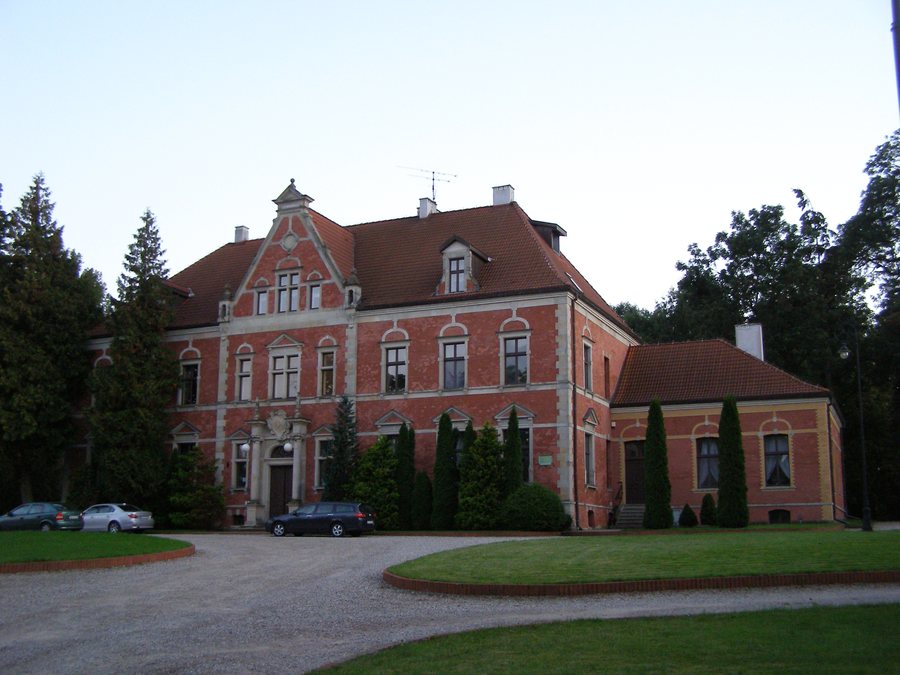
Palace and Park: A History in Several Phases
A palace was built in Leźno between 1720 and 1722, surrounded by a small landscaped park. In 1884, Georg Hoene had the 18th-century palace extensively remodeled. The landscaped park was also redesigned as part of this transformation. These dates mark distinct phases: the palace’s construction and a major change more than a century later. The park is therefore part of both the palace’s history and its 1884 transformation. Those interested in historic architecture can view the development of the palace and park as a connected history that unfolded in stages.
The park’s design offers another perspective. Illuminated paths lead to a dance floor, a gazebo and a barbecue area. This makes the park tangible not only through its historic connection to the palace, but also through its paths and specific destinations. Those interested in designed landscapes can consider its history and these different features as two sides of the same place.
Church and Large-Scale Fresco
The parish in Leźno was established in July 1982. The Church of St. Stanislaus the Bishop and Blessed Karolina Kózkówna was built between 1985 and 1992. These dates mark two distinct events: the establishment of the parish and the construction of the church. Together, they add a distinct historical focus to the town’s history alongside the much older story of the palace.
In the presbytery, the area around the altar, a fresco covers an entire wall; it depicts the martyrdom of Saint Stanislaus. As a wall painting, the fresco combines its large scale with a clearly identified religious subject. For travelers interested in sacred art, this combination offers a specific point of interest: the image covers an entire wall, and its subject is clearly identified.
Cultural Highlights to Help You Choose Where to Stay
When planning a trip together, you can consider whether palace history and park design or the fresco interest you more. These two areas of interest lead to different questions about Leźno: the palace and park offer points of interest in architectural and landscape history, while the church brings together its construction period and a particular image. This perspective can also help when looking for a holiday apartment in Leźno. Choose where to stay based on the themes you want to shape your vacation, and take different interests into account when planning.
Discover More Destinations
Discover more destinations: Kaliska, Kczewo, Kartuzy, Pierszczewo, Sianowo, Egiertowo, Brodnica Górna, Sianowska Huta.
For the main travel overview: Karthaus.

