
Suchy Dąb on the Motława: Routes and History
Accommodation in Suchy Dąb
Suchy Dąb brings together several clear travel interests: a kayak launch point and two routes that pass through the village sit alongside St. Anne’s Parish Church and a protected oak. This gives the village a profile that ranges from a stay by the Motława to historic buildings and nature. Which of these themes you choose to focus on can shape your choice of destination.
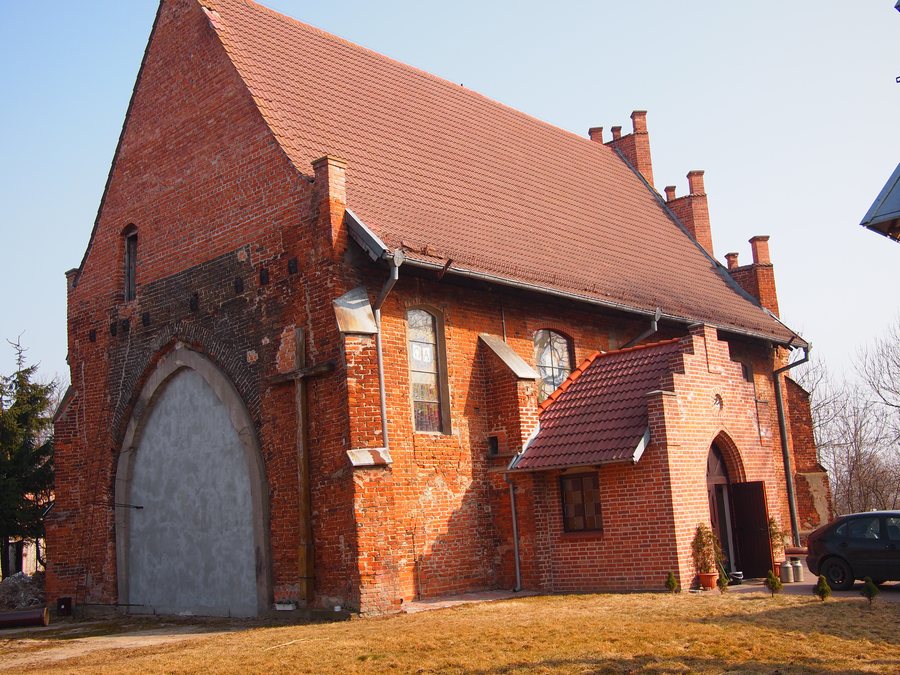 File:Church Kościół parafialny Św. Anny i św. Joachima - panoramio (1).jpg
Photo: t.przechlewski via Wikimedia Commons, CC BY 3.0
File:Church Kościół parafialny Św. Anny i św. Joachima - panoramio (1).jpg
Photo: t.przechlewski via Wikimedia Commons, CC BY 3.0
Paddling on the Motława
Suchy Dąb lies on both banks of the Motława. The kayak launch point makes it easier to access the river and is recommended as a starting or finishing point for paddling trips. The facilities described in 2024 include a floating wooden pier with an access ramp, a wooden shelter, a table with benches, kayak drying racks, waste bins, and a screen for a portable toilet. Its location on both banks places the village by the river; the launch point provides a distinct, tangible reference point for paddling.
Routes through the village
The Motławski Cycling Route passes through Suchy Dąb. The “Motławą przez Żuławy Gdańskie” hiking and cycling route also runs through the village. The names help you choose based on how you want to get around: cycling is the main focus of the Motławski Cycling Route, while the second route explicitly combines hiking and cycling. If you organise your travel ideas around the activity you want to pursue, these names can provide an initial guide.
Church, rectory, and bell
St. Anne’s Parish Church was built in the second half of the 14th century, burned down in 1945, and was later rebuilt. The rectory immediately beside the church dates from the second half of the 18th century. A Baroque bell from the second half of the 18th century is also located next to the church; it was loaned by the church in Trutnowy. The dates mark different historical layers: St. Anne’s has a building history spanning the 14th century, the disruption of 1945, and its rebuilding, while the rectory and bell date from the 18th century. The loan adds a specific connection to Trutnowy to these local buildings.
A natural monument in Kolonia Suchy Dąb
Another point of interest is in Kolonia Suchy Dąb: an oak there is protected as a natural monument. Its protected status complements the area’s river and architectural history with a distinctive natural feature. If you would like to include nature as well as activities when choosing a destination, this offers a distinct point of interest.
Choose a holiday apartment based on your travel priorities
When looking for a holiday apartment in Suchy Dąb, it helps to decide first what you want to focus on during your stay. If you are planning to paddle or take a route through the village, you can use river access and routes as criteria; if you are interested in historic buildings or nature, you can focus on other features of the village. Weighing up these options can help you decide whether Suchy Dąb suits your travel plans before you compare specific accommodation.
Discover more destinations: Koszwaly, Juszkowo, Swibno, Żukczyn, Ząbrsko Górne, Otomin, Pszczółki, Elganowo
For the main travel overview: Gdańsk.

.jpg)