
Olszyny between parish history and a landscape of peat bogs
Accommodation in Olszyny
Olszyny combines a specific historical turning point with a distinctive landscape in the surrounding area. The parish of the Most Holy Trinity was established in 1979; in the Łojewek River Valley Nature Reserve, spring-fed peat bogs and a pronounced layer of moss shape the landscape. The forts in Piątnica Poduchowna add another historical theme associated with the municipality. When planning your trip, you can explore local history, nature and fortress architecture as distinct themes.
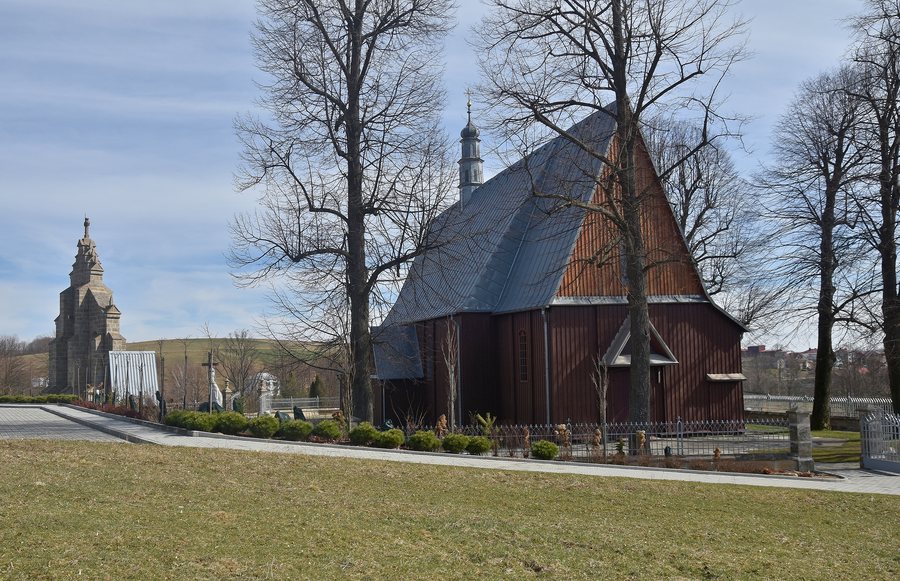 Olszyny, Church of the Exaltation of the Holy Cross
Photo: Henryk Bielamowicz via Source, CC BY-SA 4.0
Olszyny, Church of the Exaltation of the Holy Cross
Photo: Henryk Bielamowicz via Source, CC BY-SA 4.0
Parish history in a clear chronological sequence
The parish of the Most Holy Trinity in Olszyny was established on January 1, 1979, by Bishop Mikołaj Sasinowski of Łomża. It was created in an area where an independent pastoral centre had already been operating since 1974. The two dates mark a straightforward development: first there was the pastoral centre, and five years later the parish was established. The bishop’s name is also associated with this step. For anyone interested in the history of a place, this offers a tangible starting point: local history here can be traced to a specific church institution and a named historical figure.
Spring-fed peat bogs and moss in the Łojewek River Valley
A natural attraction awaits in the area around Olszyny. The Łojewek River Valley Nature Reserve has spring-fed peat bogs, especially near the villages of Wyłudzin, Olszyny and Taraskowo. Lush marsh and peat bog vegetation, along with a pronounced layer of moss, shape the reserve’s landscape. These details create a vivid picture: spring-fed peat bogs, vegetation and moss together define a damp, plant-rich landscape. Olszyny is named alongside Wyłudzin and Taraskowo as one of the villages near the reserve. This natural theme offers a different perspective from the parish’s history, complementing it with a landscape-focused one.
Forts and fortress history in Piątnica Poduchowna
Another historical theme associated with the municipality can be found in Piątnica Poduchowna, a place distinct from Olszyny. Its three forts are connected by ramparts and ditches to form the “Główna Osłona” complex. They are part of the 19th-century fortifications of the Łomża Fortress. The ramparts and ditches make the connection between the structures clear: these are not just individual buildings, but a connected part of the fortress’s defensive works.
Visitors can explore the above-ground parts. Underground passages lead to forward fighting positions that defended the ditch. A small exhibition of the Fort Museum is also housed in a shelter bunker. The forts thus offer several perspectives on the subject: the visible structures, the underground passages and the small exhibition. Unlike the spring-fed peat bogs, the focus here is on history and military architecture.
Which themes would you like to shape your stay?
When looking for a holiday apartment in Olszyny, these different themes can help you decide where to start. Consider whether you are most interested in the local parish history, the peat bog landscape nearby or the fortress complex in Piątnica Poduchowna. The forts are in Piątnica Poduchowna, another place in the municipality; the parish is in Olszyny, and the Łojewek River Valley Nature Reserve is nearby.
Discover more destinations: Łomża, Kisielnica, Nowogród, Nowosiedliny, Piątnica Poduchowna, Wizna, Drozdowo, Giełczyn.
Back to the broader travel overview: Łomżyński.

.jpg)