
Teresin: Palace History, Landscape and Culture
Accommodation in Teresin
In Teresin, palace architecture, an extensive landscape park and a railway station with a cultural function come together. These different features make the town interesting for anyone who wants to discover not only the landscape but also architectural and local history while travelling. Nearby, the landscape park at Teresin-Gaj and the Franciscan monastery of Niepokalanów add further topics to consider when planning a holiday.
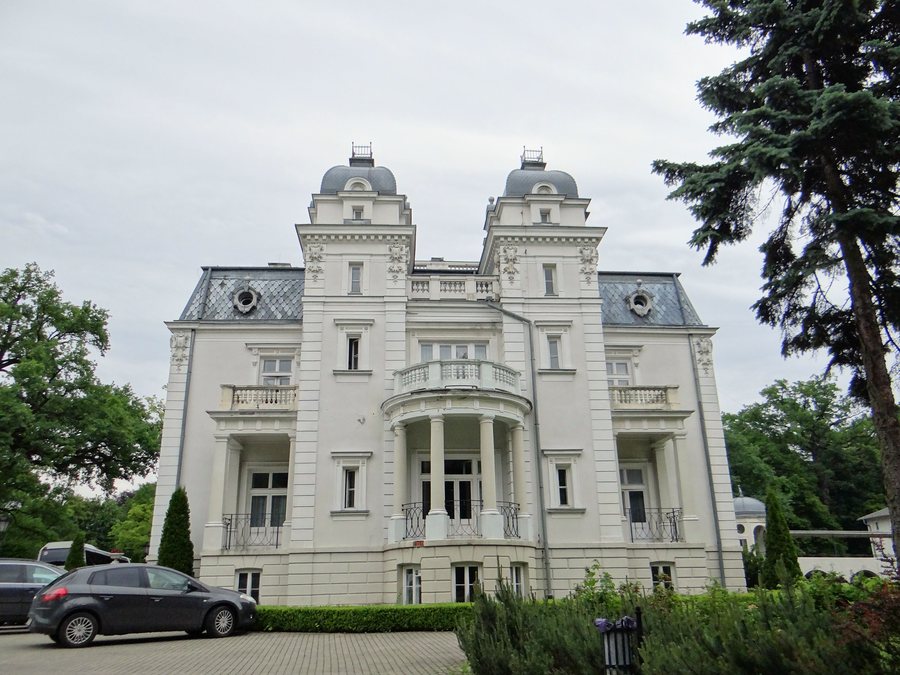
Palace, Architecture and Local History
The palace in Teresin was built between 1896 and 1899 to a design by the French architect François Arveuf. Its south façade features two three-storey towers with square ground plans and late Baroque cupolas. The combination of a clear basic form and distinctive roof shapes offers a tangible detail for anyone who also pays attention to architecture when choosing a travel destination.
The palace is set within an extensive landscape park with ancient oaks. The park has been listed in the register of monuments since 8 November 1978, under number 612/50. The place is therefore associated not only with a building from the late 19th century, but also with a historic landscape park listed in the register of monuments. Another connection to local history reaches further back: on 7 April 1913, the body of the murdered Prince Władysław Drucki-Lubecki was found in the palace park in Teresin. Alongside the architecture and history of the park, this event adds a distinct historical dimension.
Culture at Teresin Niepokalanów Railway Station
The Dworzec TO.Kultura! cultural station is located at Teresin Niepokalanów station. Following its completed renovation, it includes an event hall on the lowest floor and ancillary rooms. The layout extends further: the ground floor houses a ticket counter, a waiting room and a library point; two rooms in the attic are intended for international cooperation projects. The renovation also added a lift and adapted the station for use by people with disabilities. If accessibility is essential to your plans, check whether the lift is currently operational before your visit.
The station thus combines an everyday function with cultural use. Different interests can therefore be considered side by side when planning a trip: the palace and park offer architectural and local history, while Dworzec TO.Kultura! draws attention to a cultural venue in a renovated railway station building.
Landscape and Nearby Places
The landscape park at Teresin-Gaj is located near the destination. Many old trees grow there, including white horse-chestnuts, Norway spruces, poplars, aspens, small-leaved limes, maples, junipers and birches. Among the oldest are Scots pines aged 120–180 years, an 80-year-old American tulip tree, a 120-year-old Weymouth pine, and pedunculate oaks aged approximately 300–350 years. There is also a water feature in the northern part of the park, created by widening two streams. The tree species, age ranges and water feature offer several specific points of interest for nature lovers.
Niepokalanów is also nearby: the Franciscan monastery is in the village of Paprotnia and was founded in 1927 by Father Maksymilian Kolbe. Its history offers a different focus from Teresin’s palace and railway station themes. When planning a holiday together, you can weigh up whether architecture and local history, culture or landscape are of greatest interest. Your search for a holiday apartment in Teresin can be guided by these personal interests, without combining the different places into a single sightseeing itinerary.
Discover more destinations: Nowe Gnatowice, Sochaczew, Brochów, Rybno.
Go to the overarching travel overview: Sochaczewski.

