
Góra Kalwaria: Architecture, History and Jewish Heritage
Accommodation in Góra Kalwaria
Góra Kalwaria’s historical themes range from Neoclassical architecture and Jewish history to religious art and themed walks. You can focus your stay on one theme or explore several aspects. An arcaded town hall, a matzo oven and a wax Pietà offer different ways to discover architecture, religious life and art.
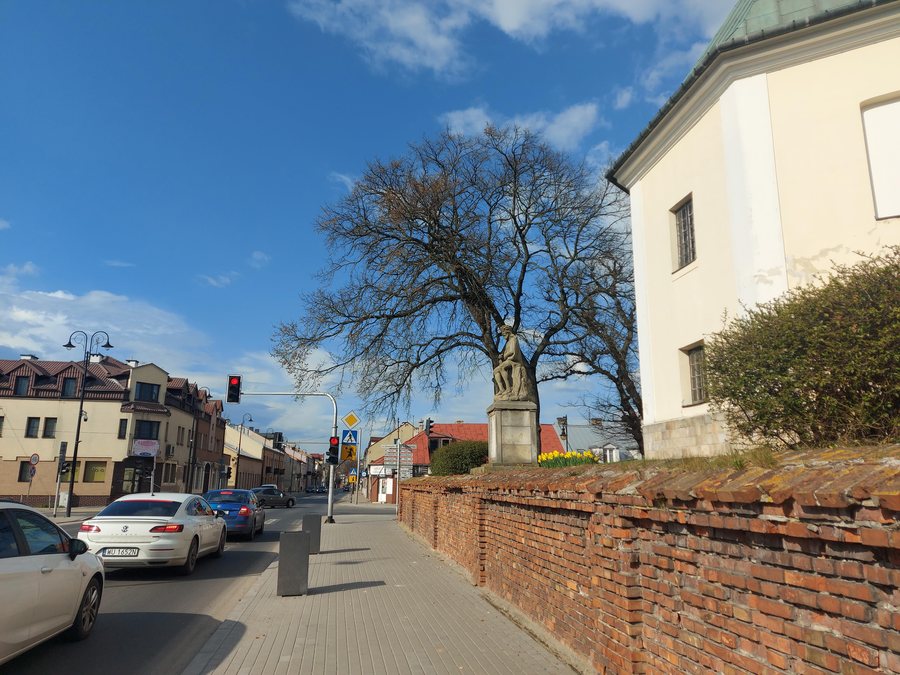 Church of the Exaltation of the Holy Cross in Góra Kalwaria (6)
Photo: Sylwia Botev via Wikimedia Commons, CC BY 3.0 pl
Church of the Exaltation of the Holy Cross in Góra Kalwaria (6)
Photo: Sylwia Botev via Wikimedia Commons, CC BY 3.0 pl
Four themed routes
A municipal notice from 2021 lists four themed routes available in Góra Kalwaria at the time: the Szlak Nowej Jeruzalem, the Szlak Kultury Żydowskiej, the Szlak Formacji Wojskowych and the Szlak Wielokulturowej Góry Kalwarii. Their themes range from historical sites to people, places and events. If you would like to follow them today, check the signs and route details locally.
Architecture and Jewish history
Góra Kalwaria’s town hall is a Neoclassical building with arcades; its construction was completed in 1834, and it was designed by Bonifacy Witkowski. Arcades are a series of arches that give the building a distinctive architectural feature. Its style, completion date and designer offer different starting points for considering design and urban history together. Neoclassical architecture draws on clear, balanced forms, while the arcades add a striking accent.
The Alter family’s prayer house was built in 1903 as a place for religious study and was intended for Jews visiting the Tzaddik. Among the features that have been preserved are round windows with Stars of David and an oven for baking matzo. The building is not open to visitors.
The former synagogue was built in the early 20th century and is now used as a shopping gallery; this use may change. The Jewish cemetery was established in 1802. About 400 gravestones remain there; this number may change. The cemetery dates back further than the two buildings, which both date from the early 20th century.
Religious art in the market square
The Church of the Exaltation of the Holy Cross is located in the market square and is commonly known as “Na Górce”. It houses a wax Pietà depicting Mary with the dead Christ on her lap. The sculpture is considered Poland’s most valuable wax sculpture. Its name, material and subject each give this work of art a distinct connection to the church.
Ideas for your stay
If you’re travelling with children, asking specific questions can help you explore the different themes together: What are arcades? What was the prayer house used for? And what does a Pietà depict? This way, architecture, religious history and visual art each get a turn, rather than limiting your stay to a single perspective.
Then compare the location of a specific accommodation option with your planned itinerary.
Discover more destinations
Discover more destinations: Kiełbaska, Tomice, Kamionka, Jeziórko, Głosków, Łęg, Bobrowiec, Chyliczki
Back to the regional travel overview: Piaseczyński.

.jpg)