
Szkwa – Kurpie Tradition by the River
Accommodation in Szkwa
Szkwa brings together the river of the same name, Kurpie architectural heritage and sites commemorating 20th-century history. In the 17th century, the village was known for its agricultural character and its location on the Szkwa. A Kurpie folk-style farmhouse, a First World War soldiers’ cemetery and a cross dating from the early 20th century provide tangible points of reference for the village’s history. There is also a route with a shelter, as well as activities in the Lelis municipality.
Kurpie Architectural Heritage and Local History
Farmhouse No. 59 in Szkwa is built of wood, designed in the Kurpie folk style and included in the heritage register. It is a specific example of wooden construction and the regional Kurpie style. The regional perspective extends beyond this individual house: traditional wooden Kurpie folk architecture, including Kurpie farmhouses, has been preserved in the northeastern part of the Lelis municipality. This makes it possible to distinguish a named building in Szkwa from the broader architectural tradition across the municipality.
The soldiers’ cemetery in Szkwa was established in 1915 for German soldiers of the First World War. It is 15 metres long and 12 metres wide. Szkwa is also home to a cross dating from the early 20th century. The cemetery is therefore tied to a specific year, while the cross is dated more generally. Together with the farmhouse, these sites offer different ways to explore the history and culture of the village: regional architecture, a First World War memorial site and a historically dated cross.
River, Route and Activities
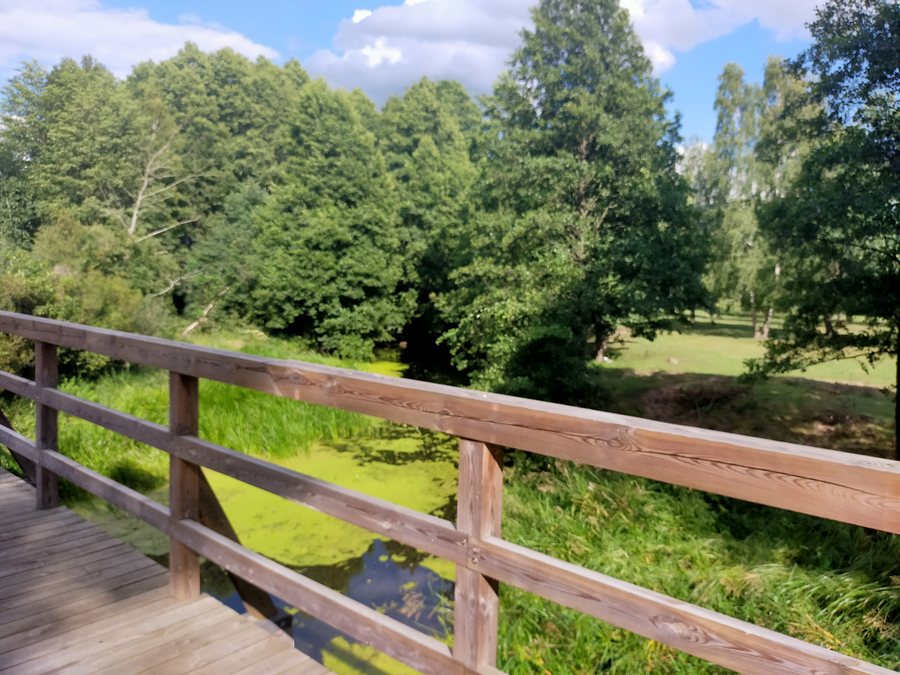
The Szkwa is one of five rivers in the Lelis municipality. It is also the only one of the last Kurpie rivers that has not yet been regulated. This adds a perspective on the river and its place in the municipality to the village’s history. If you would like to take river landscapes and regional features into account when planning your trip, this offers a specific point of reference.
The “Ostrołęka – Szkwa – Dąbrówka – Lelis” route passes through Szkwa. There is a shelter along the route in the village, where you can take a short break. The named places provide clear orientation along the route, and the shelter marks a rest stop in Szkwa. Guests of Przystań Zdrowia can also go Nordic walking along the Szkwa. Nordic walking poles are available to borrow from the host.
For fishing and mushroom picking, the Lelis municipality lists its extensive forests and the Narew, Szkwa and Rozoga rivers as suitable areas. These activities are associated with the municipality as a whole; Nordic walking, by contrast, is specifically described as taking place along the Szkwa. The activities therefore differ in their geographical scope.
A Community Tradition
A Marzanna tradition was observed in Szkwa. Participants decorated a straw effigy together, then a colourful procession made its way to a river before everyone gathered around a bonfire. Decorating the effigy, the procession and the gathering are the described elements of this tradition, adding a community custom to the village’s architectural and local history.
When looking for a holiday apartment in Szkwa, you can first consider what kind of trip you have in mind: one focused on Kurpie architectural heritage and local history, or more on routes and activities in the municipality. These different themes provide a specific basis for deciding what you want your stay to be like.
For the broader travel overview: Lelis.

