
Skrzeszew: History and Two Routes
Accommodation in Skrzeszew
History at the crossroads and church
Skrzeszew combines historical themes with routes that pass through the town. The roadside chapel founded by the Kuska family in 1922 and the story of the oak cross offer different points of interest; in addition, there is a 15 km trail and a 32 km cycling route. This brings local history and route planning together. If you are looking for a holiday apartment or holiday home, these themes can help you decide what to focus on during your trip: are you interested in the town’s history, or would you rather plan your trip around a route? The Green Central Trail (Szlak Zielony Centralny) runs for 15 km through Skrzeszew. The Pułtuska-Czarna Route also passes through the town; at 32 km, it is a designated cycling route. It is therefore 17 km longer than the Green Central Trail. The route description characterizes it more broadly within the region as easy and focused on scenery and nature, and notes that it uses paved roads. The easy rating adds a difficulty level to the distance figure; the note about paved roads refers to the road surface. According to the route description, the cycling route passes through the Lasy Legionowskie and Lasy Serockie forests; both are said to lie on sandy terrain. The distance is a measure of the route and, on its own, does not indicate how long an individual will need to ride it. For planning your day, it can help you compare the length of the routes; the actual time required also depends on your pace and breaks.
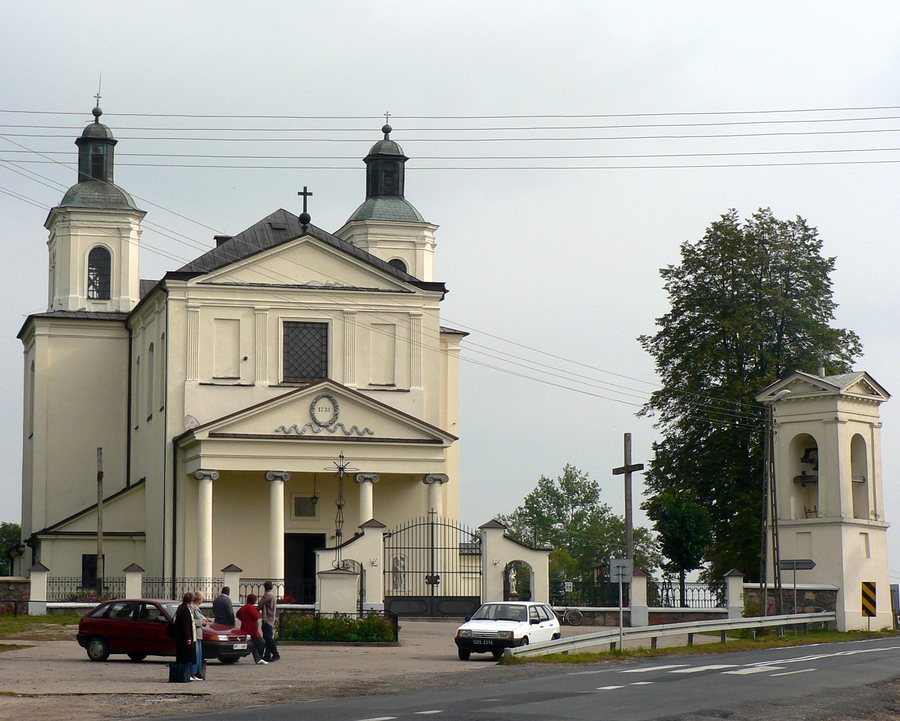
In 1922, the Kuska family founded a roadside chapel at the intersection of Dolna and Kościelna streets in Skrzeszew. The location ties the foundation to a precise point; the year and the family name give it a clear historical context. Three points of reference come together in this detail: the founders, the year, and the named streets. For those interested in culture, this connection makes the story tangible by linking a historical foundation to a specific place in the road network.
Another historical account begins with the great flood of 1908. An oak cross of unknown origin was washed ashore at the time; it was later taken to the church in Skrzeszew and attached to the wall there with a wooden plaque. The plaque reads “ŚWIADEK WIARY NASZYCH PRZODKÓW”—in English, “Witness to the faith of our ancestors.” The story thus moves from flooding to religious remembrance: the inscription turns attention to the faith of earlier generations. In contrast to the account of the 1922 foundation, the cross follows a different sequence—being washed ashore, taken to the church, and mounted on the wall. A family foundation and the story of an object whose journey began with the flood thus stand side by side as distinct historical themes. There are 14 years between the 1908 flood and the founding of the roadside chapel in 1922.
Go to the broader travel overview: Legionowski.
More destinations
More places in the same destination:

