
Dluzek: Village History and Historic Buildings
Accommodation in Dluzek
Dluzek offers a glimpse into village history, reflected in its church, castle and historic residential buildings. The Church of the Nativity of the Blessed Virgin Mary, Dłużek Castle and several farm buildings represent different construction periods and architectural forms. If you are interested in historic architecture, the village offers points of interest ranging from the 14th century to residential buildings from the 19th century.
Church of the Nativity of the Blessed Virgin Mary: Building history spanning several centuries
The filial Church of the Nativity of the Blessed Virgin Mary in Dłużek is a Gothic church dating from the 14th century. It is oriented east, has a single nave, and is built of stone and brick. Its later history was also shaped by specific changes: after two walls of the presbytery collapsed in 1752, the church underwent extensive reconstruction. Thus, its medieval classification and the reconstruction following this event belong to different chapters of its building history.
From the Reformation until 1945, the church belonged to the Protestants. During the renovation of the church tower and its dome in 1999, documents were discovered describing life in Dłużek from the 17th century through the 1920s. The church thus connects architectural history with written accounts of life in the village. It offers a tangible way to explore several historical periods, without reducing them to a single phase of construction.
Dłużek Castle and its architectural details
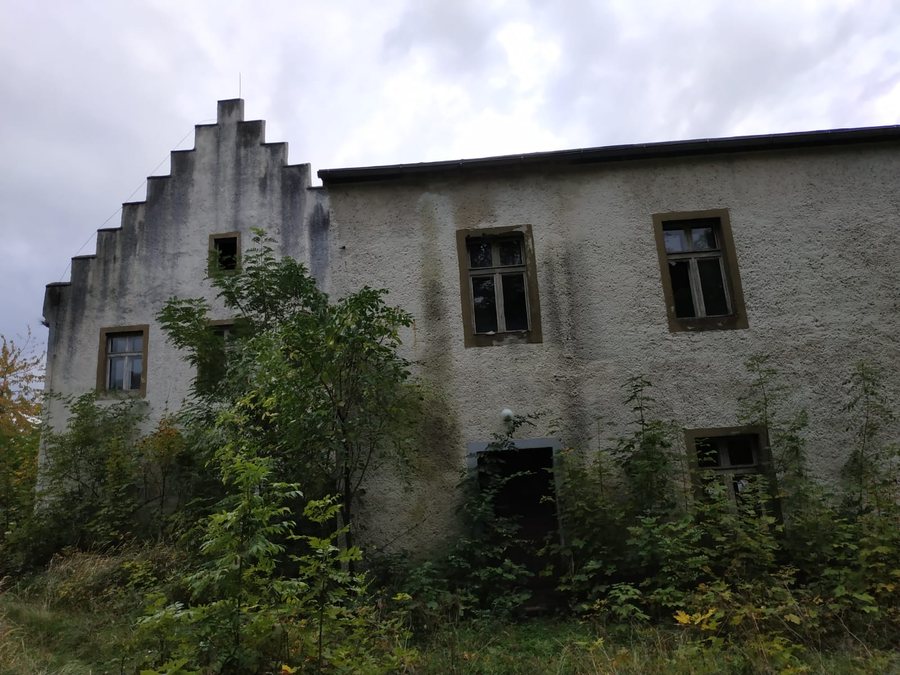
Dłużek Castle was built in the 17th century and stands on the edge of a landscape park dating from the 18th and 19th centuries. The castle and park therefore reflect different centuries. Cross vaults and barrel vaults with lunettes have been preserved in the castle’s oldest ground-floor rooms. These vault forms provide a more precise architectural detail in the description of the building than a date alone.
Augusta Viktoria has a distinct historical connection to the manor house in Dłużek: she was born there on 22 October 1858. Her father was the reigning Duke Friedrich Christian August of Schleswig-Holstein. Augusta Viktoria later became the wife of Wilhelm II, the German Emperor. Her life story adds a specific biographical connection to the place alongside its architectural history.
Farm buildings and residential houses in the village
The farm buildings also feature a variety of roof types. Buildings dating from the early 19th century include a barn with a mansard roof, a stable with a gabled roof, and a granary, also covered with a gabled roof. The farmyard also contains a lamus dating from the late 19th century. These specific building types illustrate the architectural variety of the historic farm complex, without attributing all the buildings to the same period.
The village’s residential building stock includes more than 30 houses dating from the 19th century; some were built as early as the beginning of that century. Dłużek is also home to a single-storey, brick-built four-family house from the mid-19th century. The information thus ranges from one building with a described construction style to a larger group of historic residential houses. If established village architecture is especially important to you when choosing a holiday destination, it offers a clear focus for planning your trip.
Choose Dluzek as a holiday destination
The historic buildings and the village’s connections spanning several centuries give you reason to consider Dluzek as a destination for a trip focused on history and architecture. When choosing a holiday apartment, you can consider how important such discoveries will be to your stay. The topics described range from the church and castle to farm and residential buildings, offering different ways to explore the history of the village.
You can also visit the pages for Dobrzyń, Chlebice, Łęknica, Lipinki Łużyckie, Brzostowa, Lubsko, Żary and Sieniawa Żarska.
For the broader travel overview: Sorau.

