
Schwiebus: City History Between the Market Square and City Wall
Accommodation in Schwiebus
Schwiebus (Świebodzin) combines an almost unchanged medieval street plan with buildings from several centuries. At its center is a rectangular market square, with streets running at right angles to it. The town hall, churches, and traces of the fortifications offer tangible points of reference for the city’s history. If you are looking for a holiday apartment, you can consider Schwiebus as a destination for exploring its townscape, architectural history, and regional culture.
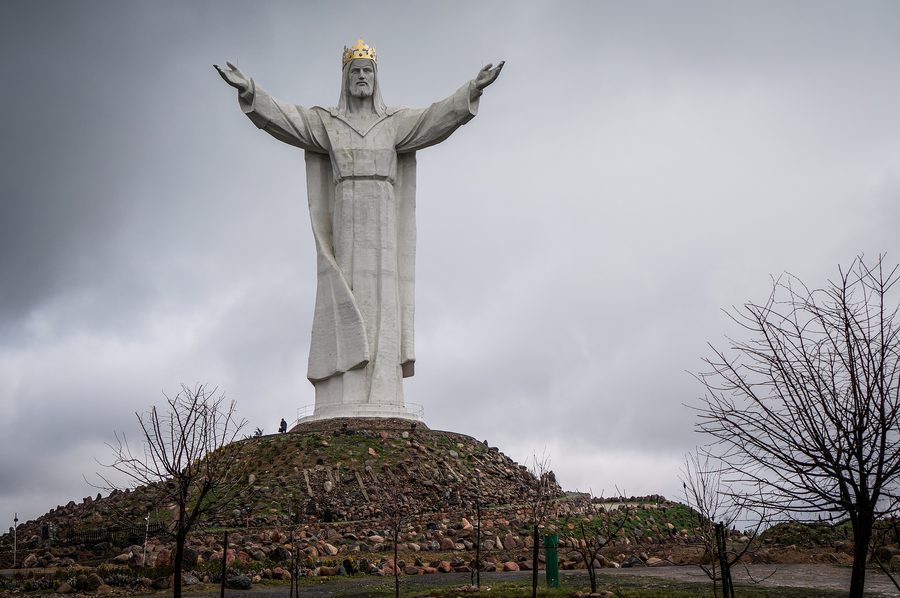 Das markante Christus-König-Denkmal gehört zu den mit Świebodzin verbundenen Wahrzeichen.
Photo: This photo was taken by Arkadiusz Zarzecki Autorem zdjęcia jest Arkadiusz Zarzecki via Source, CC BY-SA 3.0
Das markante Christus-König-Denkmal gehört zu den mit Świebodzin verbundenen Wahrzeichen.
Photo: This photo was taken by Arkadiusz Zarzecki Autorem zdjęcia jest Arkadiusz Zarzecki via Source, CC BY-SA 3.0
Market Square and Medieval Urban Structure
The market square is the natural starting point for understanding the distinctive layout of the historic center: streets branch off at right angles from the central rectangle. This largely preserved layout can be read as an urban plan, rather than tracing the history only through individual buildings. The church pw. św. Michała Archanioła stands at the northeastern corner of the square. It was built largely in the second half of the 15th century as a three-aisled hall church with a pentagonal presbytery. Its location and architectural form make it a striking part of the historic town center.
The town hall is also one of the important witnesses to the town’s past. It was probably built in the second half of the 14th century; stone barrel vaults from that period have been preserved in its cellars. The date is reported as probable. Those interested in medieval architectural forms will find not only the visible town hall building here, but also evidence of the architecture preserved beneath it.
City Fortifications and Historic Route
The city fortifications began to be built in the 14th century. In the 16th century, Schwiebus was surrounded by a defensive wall with twelve towers and three city gates, as well as a wide moat. The castle was built in the 16th century as part of these fortifications. Two ruined wings remain of the building, which has been altered by numerous renovations. The wall, gates, moat, and castle thus tell different parts of a shared city history, though each feature is not preserved to the same extent.
The municipal route “Szlakiem murów miejskich” leads along Plac Jana Pawła II, ul. Wałowa, ul. Okrężna, ul. Bramkowa, ul. Szpitalna, Park Chopina, and ul. Kilińskiego. This sequence gives you a clear guide to the route’s stops. If city history is your main interest, you can combine this route with a closer look at the medieval street plan and the surviving parts of the fortifications.
Churches, Museum, and Regional Perspectives
The church NMP Królowej Polski offers a different chapter in the history of architecture. It was built between 1698 and 1900 in the Neo-Gothic style, on the site of two earlier Protestant churches. Together with the church on the market square, it offers a glimpse of different periods of construction and religious traditions in Schwiebus.
The Regional Museum complements the architecture with the history of the area. Its permanent exhibition “Historia miasta i regionu” presents the multicultural traditions of the Świebodzin area and the town’s links to the history of the Silesian–Greater Poland borderland. A second permanent exhibition, “Przyroda Ziemi Lubuskiej,” explores the landscape of the Lubusz Region: forests, lakes, meadows, and peat bogs, as well as numerous examples of flora and fauna and designated protected species and areas. City history and nature thus offer distinct ways of exploring the region.
The monumental statue of Jesus Christ, King of the Universe, also shapes the image of Schwiebus. Construction lasted from 2005 to 2010; the statue was blessed on November 21, 2010. It welcomes pilgrims arriving individually or in organized groups from Poland and various parts of the world. This gives you a clear choice when planning your trip: focus on the historic town center, regional museum topics, or a pilgrimage destination.
If you would like to explore other destinations near your search area: Zawisze, Niedźwiedź, Szczaniec, Zbąszynek, Łagów, Lubrza, Mostki and Rokitnica.
For the broader travel overview: Świebodziński.

