
Brójce: Cycling Route, Market Square and History
Accommodation in Brójce
Brójce combines a preserved medieval town layout with a cycling route and traces of a layered history. The blue Cycling Route II runs through the town and continues to Łagowiec and Panowice. The market square, historic buildings and memorial sites also tell of different chapters in the town’s history. You can shape your stay around either cycling the route or exploring the town’s historical heritage.
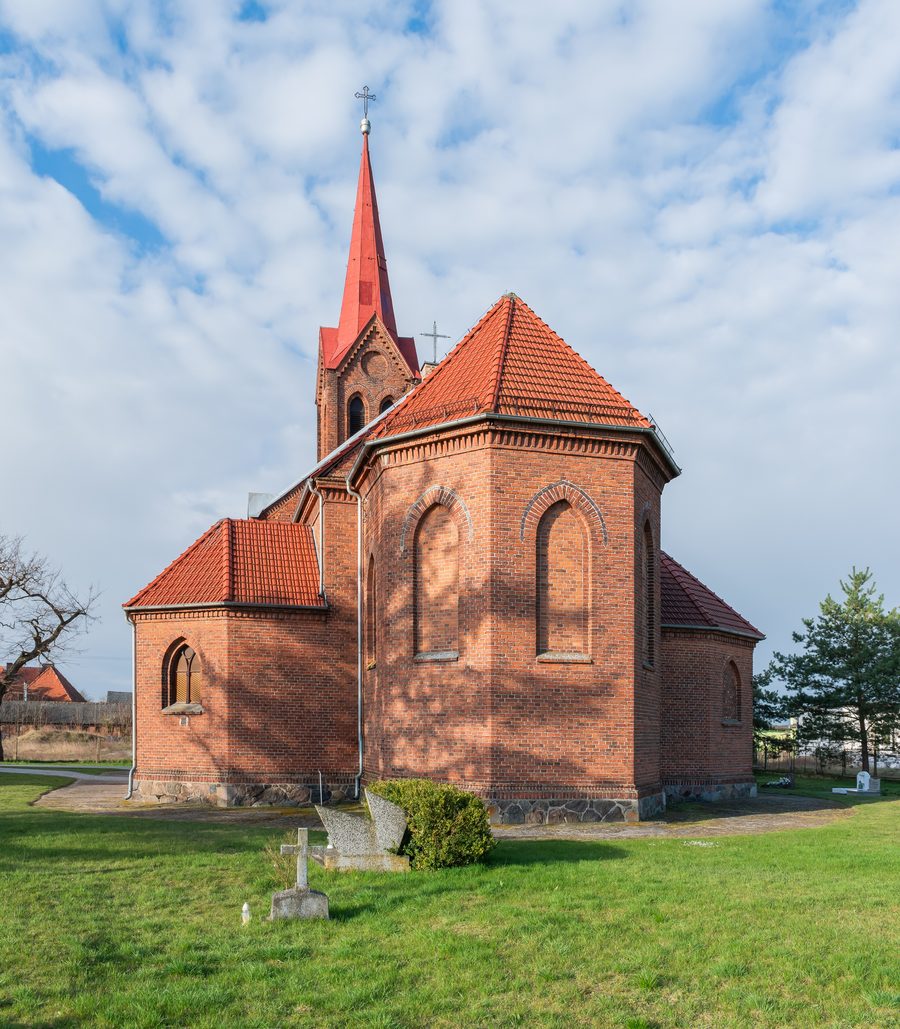 Holy Name of Mary church in Brójce, Lubusz Voivodeship, Poland
Photo: Krzysztof Golik via Wikimedia Commons, CC BY-SA 4.0
Holy Name of Mary church in Brójce, Lubusz Voivodeship, Poland
Photo: Krzysztof Golik via Wikimedia Commons, CC BY-SA 4.0
Cycling Route and Countryside Around Brójce
The blue Cycling Route II runs through Brójce and continues to Łagowiec and Panowice. If cycling is part of your travel plans, this route offers a concrete point of reference when choosing your destination. Check local route information before setting out. The route is a distinct attraction alongside the historical traces within the town.
The Czarna Droga nature reserve is also nearby, to the northwest of Brójce. A description from 2011 mentions a large oak there with a trunk circumference of more than seven metres.
A road runs through the middle of the nature reserve. Long ago, it was surfaced with black gravel, which gave the area its name. The oak and the story behind the name offer two different perspectives on Czarna Droga: a striking tree and an explanation linked to the road’s former surface.
Market Square and Local History
Brójce has retained its original town layout, with two main streets and a large rectangular market square at its centre. The layout gives the town a clear historical structure. King Władysław Jagiełło founded the medieval town in 1428 under Magdeburg law. Those interested in the development of old towns will find both a recorded date of foundation and a surviving arrangement of the main streets and square.
The town’s economic history extends beyond its founding and encompasses a range of activities: agriculture, crafts, markets and fairs were among its foundations. Clothmaking developed in the 17th century and remained the most important occupation of the local population until the Partitions of Poland.
Buildings and Memorial Sites
The parish church of the Name of the Most Blessed Virgin Mary in Brójce dates from 1860. Another historic building is the mikveh at 64 Poznańska Street. The Jewish community built it as a single-storey masonry structure with a pitched roof. After 1945, the building was used as a house; it currently stands empty.
For centuries, Poles, Germans and Jews lived side by side in Brójce. Traces of this history include the remains of a Protestant cemetery and a Jewish cemetery, as well as a surviving synagogue building that has lost its former features. North of Brójce, outside the town, a relocated matzevah remains in the Jewish cemetery; a few fragments of other gravestones also survive.
At the entrance to the Jewish cemetery north of Brójce, outside the town, the Foundation for the Preservation of Jewish Heritage unveiled a memorial plaque in 2014 to the Jews buried there. Its inscriptions are in Polish, Hebrew and German. The date, location of the plaque and three languages give the memorial its own historical significance. Together with the surviving traces of the cemetery and the former synagogue building, it paints a layered picture of Jewish life in Brójce and its surroundings.
Considering Brójce as a Holiday Destination
When choosing a holiday apartment in Brójce, consider which focus you would like to shape your stay: the blue cycling route or the historic town layout, with its buildings and memorial sites. The route runs through Brójce and continues to Łagowiec and Panowice, while the market square and town layout are within the town itself. This distinction can help you weigh your interests when choosing a destination, without assuming a set itinerary for your stay.
Discover More Destinations
Porabka, Rokitno, Skwierzyna, Murzynowo, Trzciel, Miedzyrzecz, Przytoczna, Lubikowo
Back to the main travel overview: Międzyrzecki.

.jpg)