
Santoczno between the lake, the river and industrial history
Accommodation in Santoczno
Santoczno brings together a distinctive waterscape and traces of its industrial history. The village lies by the glacial channel of Lake Mrowinko, which covers 22.5 ha, and by the Santoczna, which flows out of the lake. There are also historic buildings, remnants of the former ironworks, and routes for cycling and hiking. Those considering Santoczno as a holiday destination can therefore choose between nature, local history, and outdoor activities as the focus of their stay.
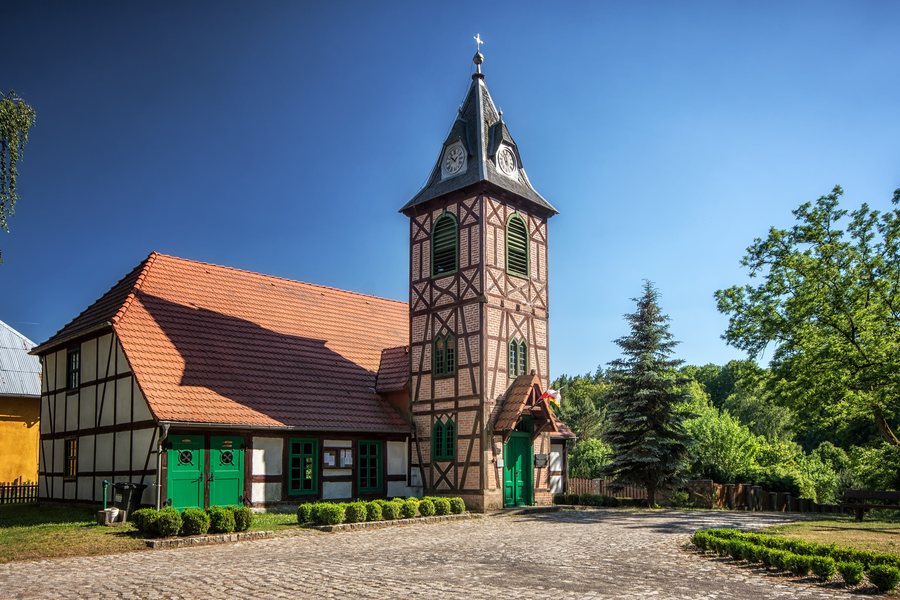 File:SM Santoczno Kościół Przemienienia Pańskiego 2020 (5).jpg
Photo: Sławomir Milejski via Wikimedia Commons, CC BY 3.0
File:SM Santoczno Kościół Przemienienia Pańskiego 2020 (5).jpg
Photo: Sławomir Milejski via Wikimedia Commons, CC BY 3.0
Lake, river and a remarkable tree
Mrowinko and the Santoczna give the village a clear connection to the landscape of lake and river. Another notable natural feature is a beech tree protected as a natural monument in Santoczno. Its trunk circumference is more than 4 metres, and its age is estimated at around 200 years. This approximate age remains an estimate. Together with the waterscape, the tree offers another point of interest to those who want to discover natural features as well as local history during their trip.
Industrial history in the village landscape
The former ironworks are present not only in the form of ruins: the remains of a former ironworks or iron forge can be found in Santoczno. Wire, nails and bar iron were produced there. The church also bears witness to the area’s industrial history. The single-nave half-timbered church, with galleries, was created by converting a former ironworks warehouse dating from 1767. A tower was added in 1819, and it contains two bells from a Berlin bell foundry.
A boulder placed in the square in front of the church in 2005 commemorates the former ironworks. It is accompanied by a cast of a plaque depicting a model of the first German steam engine. The church and memorial stone offer different perspectives: here, the conversion of a former building meets a reminder of the village’s technological history. The ruins of a former water mill are also visible traces of earlier use.
Another historic building is the Neoclassical former vicarage, dating from the 19th century. It was extended with a wing in the 20th century and has a half-hipped roof. A small lapidarium made up of gravestones from a former German cemetery is also located near the bridge and waterfall on the Santoczna. These sites represent different aspects of local history and are distinct from the remains of former production facilities.
Cycling and hiking trails as a focus of your trip
A blue-marked cycle route runs from Gorzów Wlkp. via Czechów, Santok, Brzezinka and Górki Noteckie to Santoczno; it is 32 km long. The Santoczno–Santok section passes through the picturesque valley of the Santoczna. When planning a trip, both the route of the cycle path and its section described as scenic may be of interest. The green Górki Noteckie–Zdroisko–Santoczno hiking trail is 7.9 km (12.3 km) long. Those wishing to include a route in their plans can consider these two trails by activity and stated distance, without treating them as the same route.
Choose the right focus for your stay
When looking for a holiday apartment or holiday home in Santoczno, it helps to first decide what kind of trip you want: would you like to focus on the waterscape, are you primarily interested in the history of the ironworks, or would you like to include a cycling or hiking trail in your plans? Santoczno brings these themes together in one place.
Discover other places: Witnica, Küstrin, Zdroisko, Rybakowo, Kłodawa, Wojcieszyce, Deszczno and Landsberg An Der Warthe.
Return to the main travel overview: Landsberg An Der Warthe.

.jpg)