
Kamieniec Ząbkowicki
Accommodation in Kamieniec Ząbkowicki
Kamieniec Ząbkowicki is a destination for anyone interested in architecture and cultural history while travelling. The architectural and landscape ensemble, the Neo-Gothic palace and a post-Cistercian hall church unique in Poland give the town a distinctive character. For your holiday planning, this means that discovering historic architecture is the main focus here.
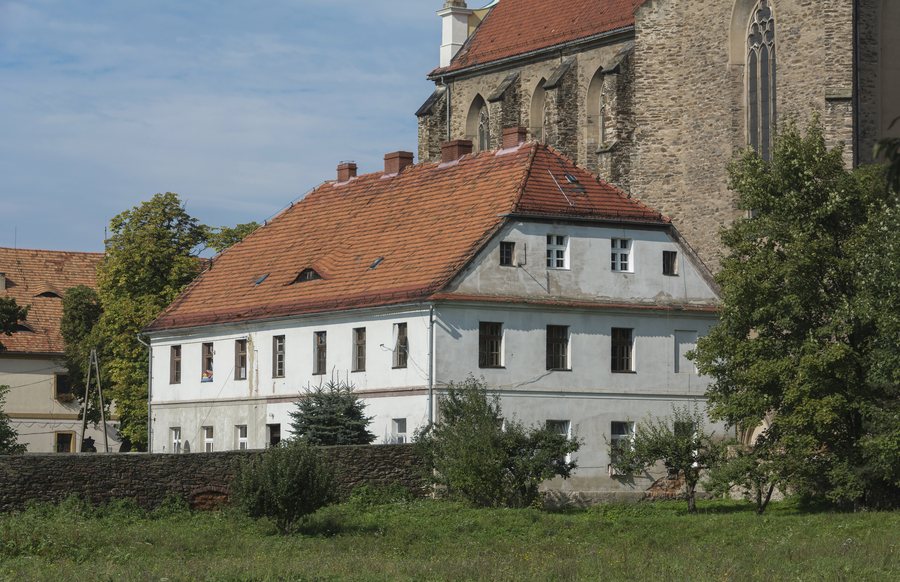 File:2014 Kamieniec Ząbkowicki, pl. Kościelny 7, 03.JPG
Photo: Jacek Halicki via Wikimedia Commons, CC BY-SA 3.0 pl
File:2014 Kamieniec Ząbkowicki, pl. Kościelny 7, 03.JPG
Photo: Jacek Halicki via Wikimedia Commons, CC BY-SA 3.0 pl
Palace and gardens as a designed ensemble
The architectural and landscape ensemble of Kamieniec Ząbkowicki was recognised as a Monument of History by a regulation of the President of the Republic of Poland dated 6 March 2024. It is also considered a designed landscape ensemble of 19th-century Historicism that is unique in Poland. Architecture and landscape are therefore both part of the historical story that you can discover as you explore the town.
The overall concept for the palace and gardens was created by architect Carl Friedrich Schinkel between 1838 and 1841. The patron was Princess Marianna Orańska (1810–1883), owner of the Kamieniec estate. The names, dates and specific connection to the patron make the history of its creation tangible: the grounds were planned as a unified concept, not merely as a single building. If you are travelling with your family, you can use these historical connections as a talking point and focus on the relationship between architecture and the designed landscape.
The palace itself is a Neo-Gothic residence of the Princes of Prussia, located on Castle Hill (Góra Zamkowa). Its Neo-Gothic design and its location on the hill are two distinct features that help describe the building. When planning your trip, you may therefore want to consider Kamieniec Ząbkowicki especially if a historic residence and its origins are among your interests.
Church, mausoleum and visiting hours
The parish Church of the Assumption of Mary also stands out for a special distinction: it is the only post-Cistercian hall church in Poland. For those interested in culture, this unique national feature is a reason in its own right to explore the town’s sacred architectural history. Together with the Historicist landscape ensemble and the Neo-Gothic residence, it shows that Kamieniec Ząbkowicki’s cultural heritage encompasses different architectural forms.
The mausoleum is open to visitors Monday through Sunday from 10:00 a.m. to 6:00 p.m. It also hosted a digital exhibition about mausoleums around the world and the history of the Kamieniec mausoleum. In this way, it combined an international perspective on mausoleums with the history of the local building. This makes it easy to fit a visit to the mausoleum into your day.
Planning your trip
Kamieniec Ząbkowicki railway station has four covered platforms. If you are planning to travel by train, this is a specific feature of the local station.
A holiday apartment in Kamieniec Ząbkowicki is worth considering if you want to focus your stay on the town’s historic architecture and cultural character. When choosing your holiday destination, consider whether the palace and its history, the distinctive church or a visit to the mausoleum is your priority.
Nearby places: Frankenstein, Budzów, Bardo, Złoty Stok, Srebrna Góra.
Back to the main travel overview: Frankenstein.

