
Miedzygorze: Waterfall, Pilgrimage Route and Distinctive Wooden Architecture
Accommodation in Miedzygorze
Międzygórze combines a protected waterfall landscape, marked hiking trails and a village centre with striking wooden architecture. This makes it an interesting destination for a trip that brings nature and culture together: you can make the Wilczki Waterfall the focus, follow a pilgrimage route or explore the history of the buildings. When choosing a holiday apartment in Miedzygorze, it helps to first consider which of these aspects of the village you want to shape your trip.
Waterfall and protected landscape
The Wodospad Wilczki nature reserve covers 2.75 hectares. Together with the gorge of the Wilczka stream, it protects the highest waterfall in the Sudetes. The area lies within both the Śnieżnicki Park Krajobrazowy landscape park and the Góry Bialskie i Grupa Śnieżnika Natura 2000 site (PLH020016). The waterfall and gorge give this natural area its distinctive character, while the protected areas also place it within a wider landscape.
The dam on the Wilczka is also one of the village’s notable structures. The flood-control reservoir was built at the beginning of the 20th century farther along the river, below the waterfall and gorge. The stone dam is more than 29 metres high and 108 metres long. A metal walkway runs along the dam at a height of 30 metres, offering views of the mountains. From there, a green hiking trail continues to Igliczna.
Hikes with different stages
For a shorter hike towards Igliczna, the red trail is a good option: it is 3 kilometres long and takes about an hour. The route passes above Wodospad Wilczki and then by the Baszta rock formation to a mountain shelter below Igliczna. This trail links the waterfall, rock formation and a named rest stop in a clearly defined stage.
The Way of St. James, marked in 2013, connects Międzygórze with Krzeszów, the starting point of the Sudeten Way of St. James. One section, about 20 kilometres long, runs from Międzygórze via Igliczna, Marianówka and Pławnica to Bystrzyca Kłodzka; it is listed as taking about 4.5 to 5 hours. If you are planning a longer hike, you can use this information to help plan your day.
Another route from Międzygórze follows blue markings at first and then green markings, passing through Smrekowiec and Mariańskie Skały on the way to Śnieżnik. The journey to the destination is listed as taking about 3 hours and 30 minutes one way. The routes therefore differ in their stated stages and destinations, from the roughly one-hour red trail to the longer Way of St. James section or the hike to Śnieżnik.
Fairy-tale figures and local history
Ogród Bajek is situated at an altitude of 780 metres between the mountains Toczek and Igliczna, on the yellow hiking trail from Międzygórze to Maria Śnieżna. At 0.23 hectares, it is a small landscape of its own. Visitors can view fairy-tale figures and spend time among the trees, shrubs and flowers. The garden was created after the First World War by forester Izydor Kriesten, who made figures from tree roots, cones and bark. For families looking to include a range of interests in their travel plans, it offers a different focus from the hiking trails and waterfall landscape.
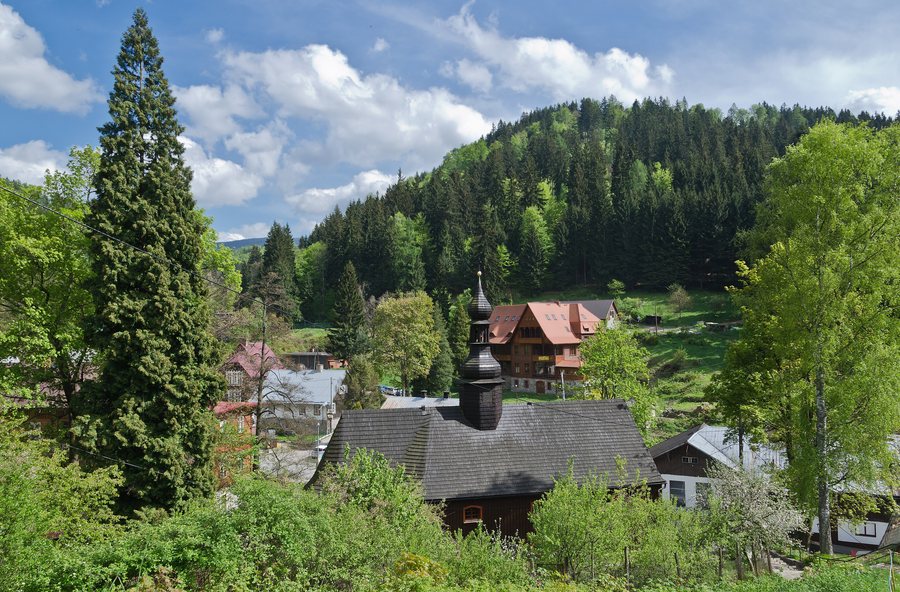
Międzygórze’s village centre combines features of a 19th-century spa resort with regional Sudetian architecture. The wooden spa and guesthouse buildings were built from the mid-19th century onwards in the Swiss and Tyrolean styles, with pronounced Scandinavian elements. One notable example is the “Gigant” building: it is one of the largest wooden buildings of its kind in Europe and is distinguished by elaborately decorated façades and spacious interiors.
The Church of Saint Joseph, the Betrothed of the Blessed Virgin Mary, also preserves remarkable furnishings: a Baroque altar and pulpit, sculptures by Michał Ignacy Klahr the Younger, and late Baroque polychrome decorations. Those interested in sacred art and the village’s architectural history, as well as its landscape and hiking, will find another cultural highlight here.
More places to discover: Lewin Kłodzki, Bystrzyca Kłodzka, Raszków, Ludwikowice Kłodzkie, Polanica-Zdrój, Kletno, Trzebieszowice and Kudowa-Zdrój.
For the broader travel overview: Kłodzki.

