
Leszczyniec – Lime Kiln, Churches and Hiking Trails
Accommodation in Leszczyniec
Leszczyniec combines a setting between two streams and contrasting mountain ranges with distinctive themes from the village’s history. The lime kiln and the Rudawy Janowickie are highlights of the upper part of the village, while the Baroque parish church of St Bartholomew is in the lower part. There are also two routes connecting different destinations. When planning your holiday, you can decide whether to focus more on historic buildings, the landscape or a hiking route.
Landscape in the Upper Part of the Village
Leszczyniec lies on the Świdnik and Wilczyniec streams, between the Rudawy Janowickie and the Wzgórza Bramy Lubawskiej. This geographical location places the village between two distinct landscape areas, without reducing it to a single excursion destination. At the foot of the Rudawy Janowickie, near Rozdroże pod Bobrzakiem and on the forest edge in the upper part of Leszczyniec, stands the lime kiln. Dating from the 19th century, it is a shaft kiln used for the industrial production of lime.
The lime kiln’s construction also makes it a tangible link to the village’s history: the structure is made of fieldstone. Its function and material give the building two distinct aspects: it can be viewed both as a lime-burning kiln and as a fieldstone structure. Those interested in the history of work and building styles will find a different subject here than in the village’s religious architecture.
Two Churches, Each with Its Own History
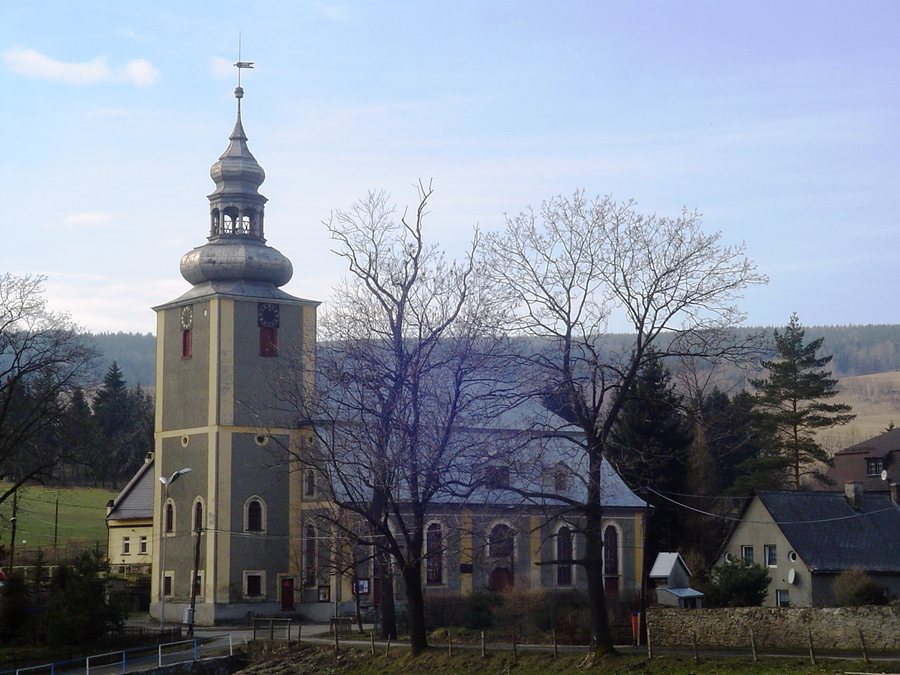
The cemetery chapel in Leszczyniec was formerly the parish church. The building was erected in 1593 and altered in the 18th and 19th centuries. The Baroque parish church of St Bartholomew has a different history: it was originally Protestant, was built between 1751 and 1754, and was renovated in the 20th century. It is located in the lower part of Leszczyniec.
Hiking Trails and Different Destinations
A black hiking trail connects Leszczyniec and Pisarzowice over a distance of 7.2 km. In addition, a black connecting trail leads from Leszczyniec to the major hiking trail junction at Przełęcz pod Bobrzakiem. The route descriptions differ mainly in their stated destinations: one gives Pisarzowice as the endpoint, while the other leads to the hiking trail junction at Przełęcz pod Bobrzakiem. When planning your day, you can choose according to which destination best suits your plans. The 7.2 km distance applies specifically to the trail between Leszczyniec and Pisarzowice.
The village’s history and hiking trails also offer different planning options for families who want to combine various interests during a trip. If you are looking for a holiday apartment in Leszczyniec, you can first consider whether churches and architectural history or hiking are more important to your stay. The route destinations and historic buildings provide specific themes to explore, without prescribing any particular order for your stay.
Discover More Places
If you would like to include more places in your travel plans, you can find Szarocin, Ciechanowice, Kamienna Góra, Chełmsko Śląskie, Lubawka, Marciszów and Czarnów here.
For the wider travel overview: Kamiennogórski.

