
Stara Kamienica: Castle, Church and Trails
Accommodation in Stara Kamienica
Stara Kamienica brings together distinctive examples of architectural history and two trails with different routes. The ruins of a castle, the Baroque Hercules Gate and the parish church of the Beheading of John the Baptist give the town a strong historical character. This gives you a concrete choice when planning your holiday: would you like to focus on architectural history or include one of the described routes in your stay?
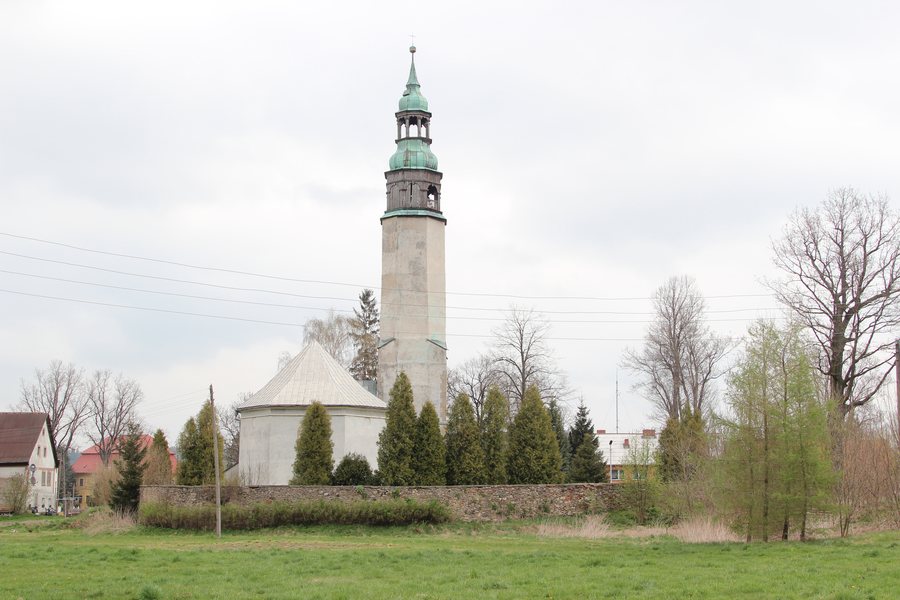 File:Stara Kamienica church of Saint John the Baptist 2015 P02.JPG
Photo: Pnapora via Wikimedia Commons, CC BY-SA 4.0
File:Stara Kamienica church of Saint John the Baptist 2015 P02.JPG
Photo: Pnapora via Wikimedia Commons, CC BY-SA 4.0
The castle ruin: surviving features and a long history
The ruins of a castle, first mentioned in 1242, stand in the centre of Stara Kamienica. The castle has been associated with the Schaffgotsch family since its construction. The surviving parts of the complex include barrel-vaulted cellars, short sections of the curtain wall, a moat and a bridge. The tower also survives up to the third storey; traces of sgraffito decoration can be seen on it. Together, these features offer different points of reference for understanding the castle complex: the cellars, wall, moat, bridge and tower can be viewed as separate elements, rather than seeing the ruin simply as a single mass of masonry.
A barrel vault is a longitudinal, arched ceiling. Sgraffito is a type of wall decoration in which parts of the upper layers of plaster are removed. These terms help identify the surviving features more precisely: the vault indicates the shape of the cellars, while the sgraffito refers to a decorative detail on the tower. If you are interested in architecture, the castle offers more than a date: its various features and their state of preservation also shape the impression of the complex.
The Hercules Gate and parish church
The Baroque Hercules Gate dates from 1705. Its image depicts Hercules fighting a lion, offering a different point of interest from the castle’s fortifications. The parish church of the Beheading of John the Baptist was first mentioned in 1370. It acquired its present form through numerous alterations, particularly in the 17th and 18th centuries. The church also houses a sandstone baptismal font dating from 1562. Stara Kamienica thus brings together different kinds of historical detail: a named gate with a mythological image, the church’s architectural history and a precisely dated furnishing.
Two trails, two routes
The blue trail, 48 kilometres long, runs from Mirsk via Stara Kamienica to Świeradów-Zdrój. The yellow trail starts in Stara Kamienica, with its starting point listed as kilometre 0.0. From there, it runs 18.8 kilometres to Rozdroże Izerskie. The comparison is straightforward: the blue trail passes through the town and connects two named destinations, while the yellow trail starts here and covers the shorter distance. You can weigh up the information by length and route without associating the trails with an activity type that is not specified. If you plan to take the blue trail, check the current trail conditions before setting out.
Choose a focus for your holiday apartment search
The castle, Hercules Gate and church offer different ways to explore history and architecture; the two trails provide concrete points of comparison in terms of length, starting point and route. So consider whether you would like to focus your stay on the historic buildings or include one of the routes in your plans.
Discover more destinations: Kowary, Karpniki, Trzcińsko, Szklarska Poręba, Karpacz, Przesieka, Bukowiec, Janowice Wielkie.
For the broader travel overview: Jeleniogórski.

