
Kopaniec: Views, Hiking Trails and History
Accommodation in Kopaniec
Kopaniec combines scenic heights with a rich historical and cultural heritage. Peaks and rocks, trails of varying lengths, and traces from several centuries offer different ways to explore the area. Your interests can therefore guide your choice of holiday apartment: would you like to explore hiking trails, discover landscapes, or learn about Kopaniec’s history?
Views Between the Village and the Mountains
Kozia Szyja is a viewpoint at 748 metres above sea level, rising above Kopaniec in the eastern part of the Kamienicki Ridge. The 530-metre-high Popiel also lies above the church in the village. From there, the view stretches across the village, the Kamienicki Ridge and parts of the Karkonosze Mountains.
Far-reaching views also define the meadows near Kozia Szyja and the upper sections of the asphalt road. To the south, the panorama takes in the High Ridge of the Izera Mountains, including Wysoki Kamień and Izerskie Garby, as well as the Karkonosze Mountains from Śnieżka to Szrenica. To the north, the view extends across the Izera foothills, including the Stara Kamienica and Kopaniec depression, the Kaczawskie Mountains and Jelenia Góra. This northern panorama is almost 180 degrees wide and extends for more than 50 kilometres.
Młyniec offers a different view: this granite gneiss rock, several metres high, lies on the northeastern slope of Popiel, on the banks of the Kamionka. This is where Kopaniec begins. From the rock, you can look over the valley and the highest part of the village, especially in winter. This view complements the far-reaching vistas around Kozia Szyja with a look at Kopaniec itself.
Hiking Trails of Varying Lengths
An approximately 13-kilometre trail leads from Zimna Przełęcz via Bobrowe Skały, Polana Czarownic, Kopaniec, Kozia Szyja and Jastrzębiec to Rozdroże Izerskie; along the way, the route passes the ruins of Leopoldsbaude. Check current trail conditions before setting out.
Two long-distance routes also pass through the village: the blue trail from Mirsk to Świeradów-Zdrój and the 104-kilometre green circular trail, “Obwodnica jeleniogórska”. Kopaniec can thus be part of a shorter hike or a much longer circular route.
Church and Historical Traces
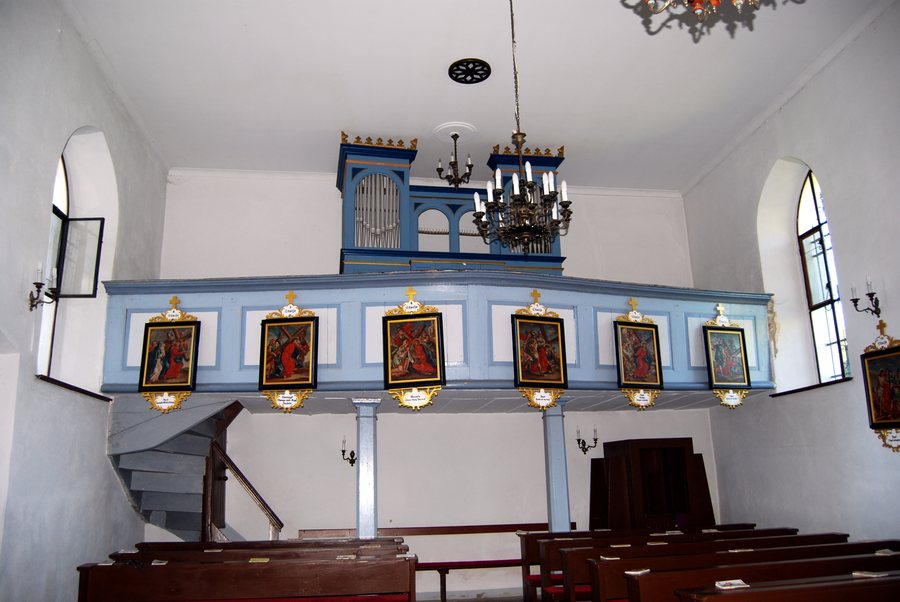
The first church in Kopaniec was mentioned in 1399; the present-day Church of St Anthony was built in the early 16th century. It is a parish church and is closed. Its exterior facade features 18th-century Baroque epitaphs for the Menzel, Geyers and Hartmann families. The chancel has a star vault with sandstone ribs. The mausoleum of Jan Samuel Braun, Kopaniec’s first Protestant pastor, stands at the southwestern part of the church.
Other historical details can be found throughout the village: the cemetery contains the burial chapel of J. S. Brenna, and a medieval ceramic kiln is located at Kopaniec 145. Three historic advertising columns are also among the village’s listed features. Kamienne Wały is a mysterious archaeological site that requires further research.
Kopaniec’s past as a summer spa resort is also part of its history: at the end of the 19th century, the village developed into a summer resort that used radon-rich springs. The “Caspar” oak is also designated a natural monument.
Discover more destinations: Wojanów, Miedzianka, Sosnówka K Jeleniej Góry, Zachełmie, Jelenia Góra, Stara Kamienica, Gruszków, Dziwiszów.
Go to the main travel overview: Jeleniogórski.

