
Paszkówka: Church Art and a Baroque Palace Park
Accommodation in Paszkówka
Paszkówka brings together art history, a distinctive park landscape and routes that appeal to a range of interests. In the Church of the Transfiguration of the Lord, historic furnishings meet elaborate interior decoration. The palace park offers a different emphasis: its Baroque geometry and old trees make it a destination in its own right for exploring the village. There is also a cycling loop to Sosnowice and a Way of the Cross between the two villages.
Church Art from Several Periods
The furnishings of the Church of the Transfiguration of the Lord include a figure of an apostle from the 14th century and an image of the Virgin Mary with the Christ Child from the 16th century. Baroque sculptures depict Saint Anne and Saint Joachim; a stone baptismal font dates from the second half of the 17th century. The different dates span several periods, so the furnishings are not limited to a single era.
The interior walls and vaults also have their own artistic character: they are decorated with Secessionist polychrome painting. The design is by Jan Matejko, and the decoration was executed by his student Antoni Gramatyka. The historic individual pieces and the extensive decoration of the church interior thus stand side by side as different forms of sacred art. Visitors interested in art and architecture will find more than a single historical point of interest in Paszkówka.
Palace and Palace Park: Two Historic Highlights
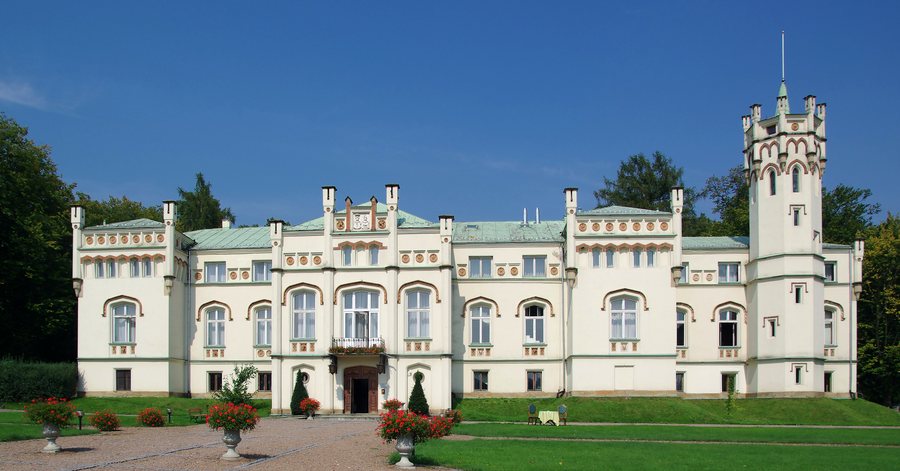
The palace in Paszkówka was built between 1865 and 1870 by Leonard and Ludwika Wężyk. Its Neo-Gothic architecture offers a different historical focus from the palace park, which was laid out in the second half of the 18th century. The park has a Baroque, geometric design. Paszkówka thus brings together a 19th-century palace and a formally designed park with an older history as distinct points of interest.
The trees also shape the character of the park. Some have reached monumental proportions and are estimated to be 200 to 300 years old. The species mentioned include lime trees, oaks, maples and ash trees. A hornbeam avenue has also been preserved. The geometric layout and the trees’ estimated ages draw attention to two different aspects of the park landscape: its deliberate design and the growth of its trees over a long period.
Cycling Tour and Way of the Cross to Sosnowice
An approximately seven-kilometre cycling loop starts at the “Pod Dębem” fishing pond in Paszkówka and leads to the historic wooden church in Sosnowice. Its approximate length provides a useful reference when planning a cycling tour. Before setting out, it is a good idea to check the route and local conditions for the latest information.
Another connection is the Way of the Cross from the church in Sosnowice to the parish church in Paszkówka. The individual stations are marked by birch crosses. This gives the route a distinctly different character from the cycling loop. Depending on whether you are more interested in cycling, sacred sites or historic architecture, Paszkówka offers a choice of different themes to explore.
Choose a Suitable Base for Your Discoveries
When looking for a holiday apartment in Paszkówka, you can first consider which of these themes you would like to shape your trip. Art-historical interests call for different day plans than a cycling tour, while the geometrically designed palace park offers another focus. If you would like to combine several themes, you can include the respective destinations in your plans rather than limiting your stay to just one type of outing. When comparing specific accommodation, you can check its address against your plans. This lets you choose a base that suits the experiences that matter to you, without turning the different routes into a single combined itinerary.
For the broader travel overview: Bęczyn.
Compare hotels and holiday rentals in Paszkówka by price and availability for your travel dates.
Advertisement · We may receive a commission if you book.
