
Discover Zubrzyk: Rock formations and church
Accommodation in Zubrzyk
Zubrzyk offers several distinct points of interest to consider when planning your trip: sandstone formations in the surrounding area, the former Greek Catholic Church of St. Luke in the village, and a fissure cave on the slopes of Wierch Zubrzy. This brings together landscapes and church history alongside a cave with specific details about its location and dimensions. When choosing a holiday apartment, you can consider which of these themes will shape your days: rock formations and forest, the church complex, or the cave.
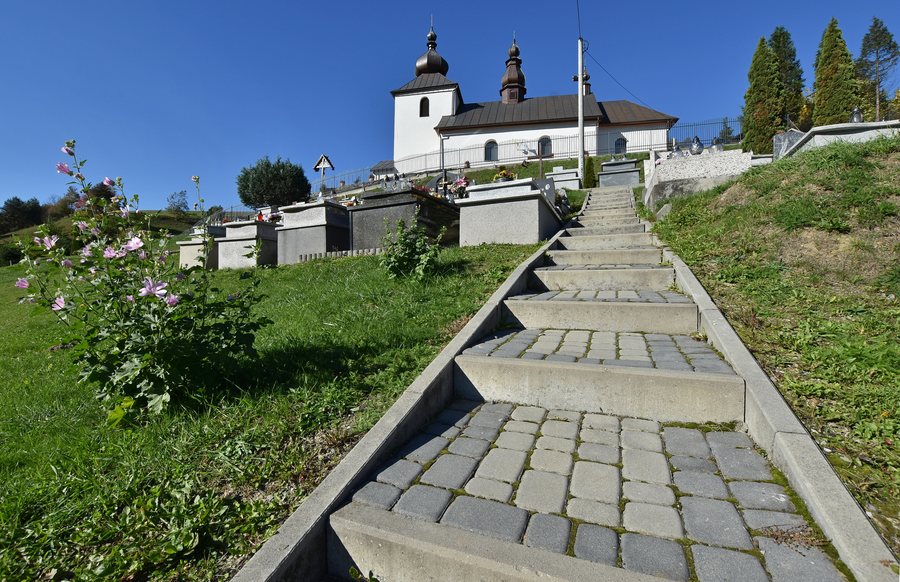 File:Zubrzyk, cerkiew św. Łukasza (HB9).jpg
Photo: Henryk Bielamowicz via Wikimedia Commons, CC BY-SA 4.0
File:Zubrzyk, cerkiew św. Łukasza (HB9).jpg
Photo: Henryk Bielamowicz via Wikimedia Commons, CC BY-SA 4.0
Sandstone rocks in various forms
The “Pusta Wielka I” rocks consist of natural rock steps and small rocky ledges amid a largely undisturbed forest. Together, they cover about 3 ha. The steps and small, pulpit-like rocky areas describe a varied rock landscape; the approximate area gives a sense of its scale. Both details help you picture the sandstone formations as more than a single rock: several natural features shape the landscape here, set within the forest.
“Pusta Wielka II” has a different structure. There, a rocky ridge with rock outcrops and faults forms its characteristic shape; the ridge is covered by trees with features of a natural forest. Rock outcrops are places where bedrock is visible, while faults are fractures or shifts in the rock. In contrast to the rock steps and small ledges of “Pusta Wielka I,” the focus here is on the ridge, outcrops and faults. Those interested in different rock formations will find two clearly distinct features in the area around Zubrzyk.
A church complex in Zubrzyk
The former Greek Catholic Church of St. Luke stands in Zubrzyk and now serves as a branch church of the Exaltation of the Holy Cross. The protected historic complex also includes the cemetery grounds, the surrounding wall and the trees. Its current religious function and former dedication give the building two links to different periods, while the cemetery, wall and trees describe the spatial context of the complex. For your trip planning, this is a different focus from the natural features: here, a specific site with church history takes center stage, rather than geology or forest.
Smerczynowa Dziura fissure cave
Another natural feature is the Smerczynowa Dziura fissure cave on the wild southeastern slopes of Wierch Zubrzy. It is difficult to find, but quite large: it is 17 m long and 3 m deep. From Zubrzyk, an indistinct, unmarked path leads southwest to the cave. Its location, dimensions and the description of the path together give a clear picture of the cave, without reducing its significance to its measurements. The cave is therefore a distinct point of interest alongside the sandstone rocks: it is a cavity on the hillside, reached in the direction indicated by the path, while the rocks are characterized by steps, a ridge, outcrops and forest.
What would you like to shape your choice of destination?
When choosing a holiday apartment in Zubrzyk, you can base your decision on the interests you want to prioritize during your trip. The rock formations offer a range of geological features to explore, the church complex adds a cultural and historical dimension, and Smerczynowa Dziura adds a cave to the descriptions of the natural landscape. These features are not interchangeable: you can decide which aspect of the destination matters most to your trip planning. This way, your accommodation search is tied to a clear idea of what you would like to discover in Zubrzyk.
Discover more destinations: Wierchomla Wielka, Zawadka, Wierchomla Mała, Barcice, Podegrodzie, Florynka, Tylicz, Żeleźnikowa Wielka.
Go to the main travel overview: Nowy Sącz.

.jpg)