
Podsarnie: Bell Tower, Votive Figure and Walking Route
Accommodation in Podsarnie
Podsarnie offers several specific points of interest for a stay: a wooden bell tower from the 17th century, a stone votive figure on the main road, a masonry roadside chapel, and a walking and cycling route with panoramic views of the Tatras, Babia Góra, the Policy Mountains, and Luboń Wielki. These features combine local religious history with an active outdoor route. When planning your trip, you can decide whether to focus on cultural history or on walking and cycling.
Religious Buildings and Their Stories
The wooden bell tower in Podsarnie dates from the 17th century. In 1924, it was donated by compatriots from the USA; it is called the “Bell of Saint Isidore.” This brings together two dates: the building’s age and the considerably later donation. The name refers to Saint Isidore, while the origin of the donation highlights a connection with compatriots in the USA. For visitors interested in culture, the combination of the century, donation year, and name provides a specific point of reference for understanding the bell tower’s history.
The stone figure of Saint John of Nepomuk also tells the story of a donation made for a stated reason. It stands on the main road in Podsarnie. In 1874, Katarzyna and Jan Kapuściak donated it as a votive offering of thanks for their rescue from a flood. A votive offering of thanks links a religious symbol with a specific reason for giving thanks. For this figure, the material, location, year, and story of the rescue are all connected. Krystyna and Piotr Antoniak restored it in 1998. Its history therefore includes both its donation in the 19th century and a later restoration.
Another sign of religious history is the masonry roadside chapel with a figure of the Coronation of Mary. It dates from the 1960s, stands independently, and is surrounded by a brown-painted metal fence. Before the present-day church was built, services were held there. The chapel can therefore be understood both by its appearance and its former function: the masonry and metal fence are among its structural features, while the services are part of its history. Together, the bell tower, votive figure, and chapel illustrate different aspects of local religious history.
Walking and Cycling Route from Harkabuz to Podsarnie
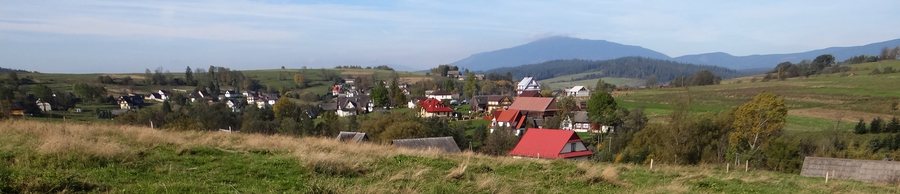
The walking and cycling route starts at a car park at the entrance to Harkabuz and ends at the far end of Podsarnie. Both the starting point and destination are therefore clearly specified. When planning your trip, you can take these endpoints into account if you want to include the route in your stay. The route follows the boundary between Orawa and Podhale. Along the way, it offers panoramic views of the Tatras, Babia Góra, the Policy Mountains, and the summit of Luboń Wielki. The route thus links two specified locations and offers views of several mountain ranges and peaks. Route details can change, so check the latest description before setting out.
The historic buildings and the walking and cycling route offer different points of interest: the buildings highlight donations, religious connections, and former uses, while the route is about its course, endpoints, and panoramic views. When looking for a holiday apartment, you can put your preferred focus for the stay first. Consider whether you mainly want to explore the cultural and historical details or include walking and cycling in your plans.
Discover More Destinations
Discover more destinations: Ochotnica Górna, Tylmanowa, Waksmund, Szczawnica, Zubrzyca Górna, Tylka, Rokiciny Podhalańskie, Dursztyn.
Back to the main travel guide: Nowotarski.

