
Łapsze Niżne: Routes and Architectural History
Accommodation in Łapsze Niżne
Łapsze Niżne appeals to travelers who want to combine outdoor activity with nature and culture. The Pętla Spiska runs through the Polish-Slovak border region as a major hiking and cycling route, passing through the village, among other places. Other attractions include an interactive nature exhibition about Spisz in the historic Dom Ludowy and the history of the Church of Saint Quirinus. When looking for a holiday apartment, you can use these interests as a starting point: Will hiking and cycling shape your stay, or would you also like to set aside time for the exhibition and architectural history? This way, you can plan your trip around the experiences that interest you.
Hiking and Cycling in the Border Region
The Pętla Spiska is a major hiking and cycling route in the Polish-Slovak border region, and its course passes through Łapsze Niżne, among other places. This gives you two possible ways to explore the area, without having to decide in advance between hiking and cycling. If you are planning a family trip, this question can help with organizing your days: What kind of activity would you like to include in your holiday? The route gives the village a clear connection to a cross-border trail.
Dom Ludowy: Nature Exhibition and Local History
The historic Dom Ludowy houses an interactive nature exhibition about Spisz. The building also stands along the cross-border Szlak wokół Tatr cycling route. The exhibition explores the natural environment of Spisz; the building itself also has its own history: it was built shortly before the outbreak of the Second World War. In 2020, a special platform for people with disabilities was installed in the Dom Ludowy. Nature exhibits, architectural history, and a connection to a named cycling route all come together at this location. If you want to plan your trip around more than just outdoor activity, the exhibition offers another specific area of interest to consider.
The Church of Saint Quirinus
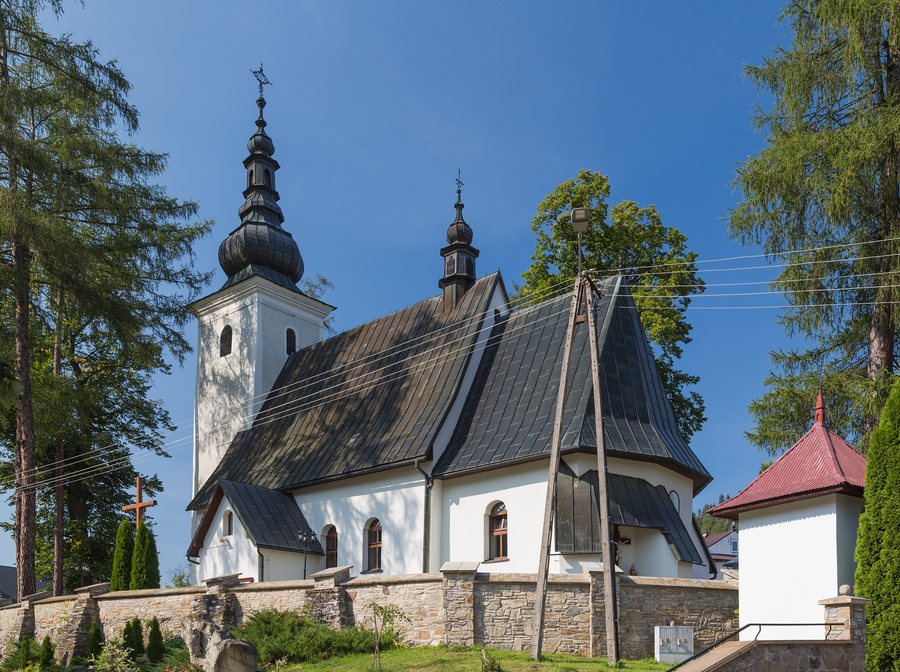
The Church of Saint Quirinus stands in the center of Łapsze Niżne. It is on a side street parallel to the Niedzica–Łapsze Wyżne road, on a slope above the Łapszański Stream. Its architectural history is also distinctive: the church was originally Gothic and was rebuilt in the Baroque style in the 18th century. This makes it possible to identify two stylistic periods in a single building. The church is also part of the Małopolski-Szlak-Bożogrobców. Its location marks a specific point in the village center, while its route connection places it in a broader cultural context. You can consider both when planning your visit: the building’s history and its precise location in the village.
Routes to Consider When Planning Your Trip
The named routes have different connections to Łapsze Niżne: the Pętla Spiska passes through the village, among other places; the Dom Ludowy is on the Szlak wokół Tatr; and the Church of Saint Quirinus is part of the Małopolski-Szlak-Bożogrobców. These distinctions help answer a practical question: Which route name is linked to the place or subject that interests you? For hiking and cycling, the Pętla Spiska is a useful reference point; the Dom Ludowy’s connection to a cycling route and the church’s route connection place the two cultural sites in different contexts. On a family trip, you can discuss these different interests before planning your days and choosing a holiday apartment.
Discover More Destinations
Discover more destinations: Bad Rabka, Lasek, Kacwin, Ochotnica Dolna, Podwilk, Zaskale, Obidowa, Szczawnica.
For the broader travel overview: Nowotarski.

