
Tymbark: Discover Culture and History
Accommodation in Tymbark
Tymbark can be explored through tangible traces of its history: a baptismal font dating from 1541, a sandstone chapel with its own history of origins and location, and routes with different historical connections. One branch of the Szlak Papieski leads over Łopień to Chyszówki. Another route focuses on the history of the German occupation in Tymbark and the surrounding area. Religious heritage, walking routes and local remembrance stand side by side, offering different ways to explore the town.
Religious heritage: baptismal font and chapel
The church in Tymbark has a Gothic-Renaissance baptismal font dating from 1541, which comes from the old church. For travelers interested in cultural history, its date, stylistic designation and origin give the object a specific local history. A sandstone chapel donated by the residents of Tymbark was built in 1870 and moved to its present location beside the parish church in 1975. This brings two different histories together: the baptismal font’s historical significance lies in its style and origin, while the chapel’s lies in its donation, construction and subsequent relocation.
A named route branch and information boards
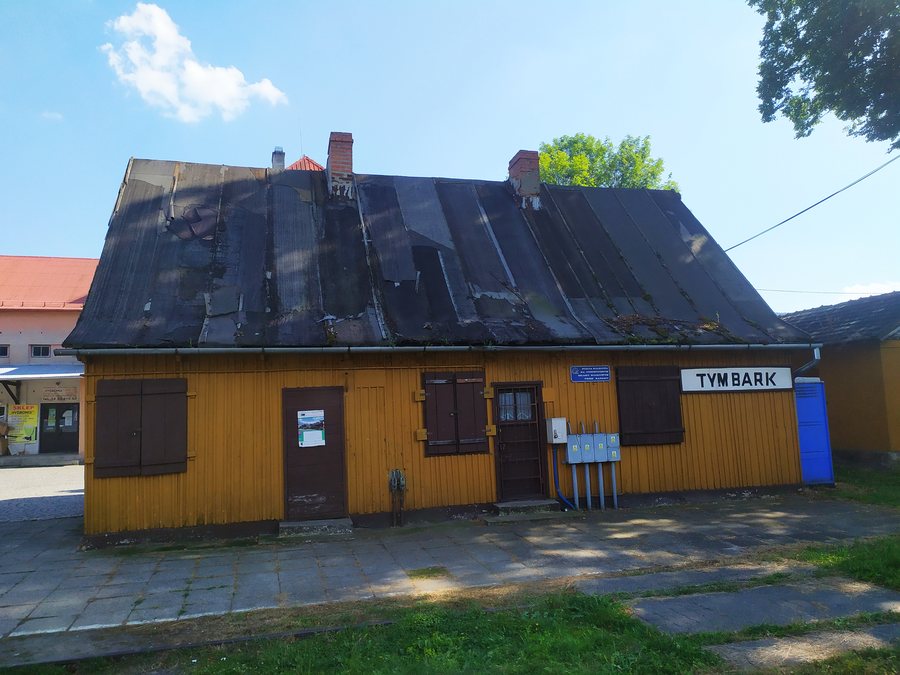
A branch of the Szlak Papieski leads from Tymbark over Łopień to Chyszówki. Information boards with maps of the routes traveled by Karol Wojtyła have been installed beside the railway station, in the market square and beside the SKR in Tymbark. The route description thus identifies a trail passing through several places; the boards focus on the routes traveled by Karol Wojtyła and are located at three spots in the town. Anyone interested in these route connections will find both a specific route description and information about the trails here.
The market square and the route about the history of the occupation
The educational tourist route about the history of the German occupation starts and ends in the market square in Tymbark. The market square is the route’s central point; from there, the trail leads to several historic sites from that period. Six stops focus on the underground activities of the residents of Tymbark and the surrounding area between 1939 and 1945. Each stop has information boards and photographs from the occupation period, describing important events at that location. The number of stops and the clearly defined period give the subject an easy-to-follow structure; the market square marks both the start and the end of the route.
Other cultural points of interest
Military Cemetery No. 365 in Tymbark was established as a separate section beside the existing parish cemetery. The Tymbark Public Municipal Library, named after Captain Tadeusz Paolone, offers a different focus. It includes a lending library, a reading room, an internet reading room, a national memorial site, and a conference room and exhibition space. The library’s various offerings complement the historic routes with a cultural point of interest. If you plan to visit the library, check its current visitor arrangements in advance.
Choose the focus for your stay
These are different ways to explore Tymbark—through individual cultural attractions, a named route branch or a themed sequence of historic stops.
Discover more destinations: Raba Nizna, Kostrza, Limanowa, Lubomierz, Kobyłczyna, Mszana Dolna, Nowe Rybie, Poręba Wielka
Go to the main travel overview: Limanowa.

