
Korzkiew: Castle, Church and Landscape
Accommodation in Korzkiew
Korzkiew can be explored through a variety of features: the Korzkiewka valley, the restored castle ruins on a prominent rocky promontory, and a church with pronounced defensive features. There is also a blue trail leading from Korzkiew into the Prądnik Valley and on to Ojców. You can tailor your stay to focus on historic buildings, the landscape or a walking tour.
A fortified church and precious objects
The Church of the Nativity of St John the Baptist in Korzkiew was completed in 1630. Its hilltop location, compact form and massive reinforced walls give it a defensive character. Numerous loopholes, now bricked up, are also part of its appearance. If you are interested in historic architectural forms, you can admire both the church’s exterior and its surviving objects.
Two 17th-century reliquaries are kept at the main altar. Made of wood, they are polychrome-painted and gilded, and shaped to represent a female and a male head. The church also contains a Gothic reliquary shrine from the 14th century. The church thus brings together objects from different centuries: the shrine dates from the 14th century, the two reliquaries from the 17th century, and the church building was completed in 1630. For visitors interested in religious art, these specific details offer several different points of interest.
Castle ruins on the promontory
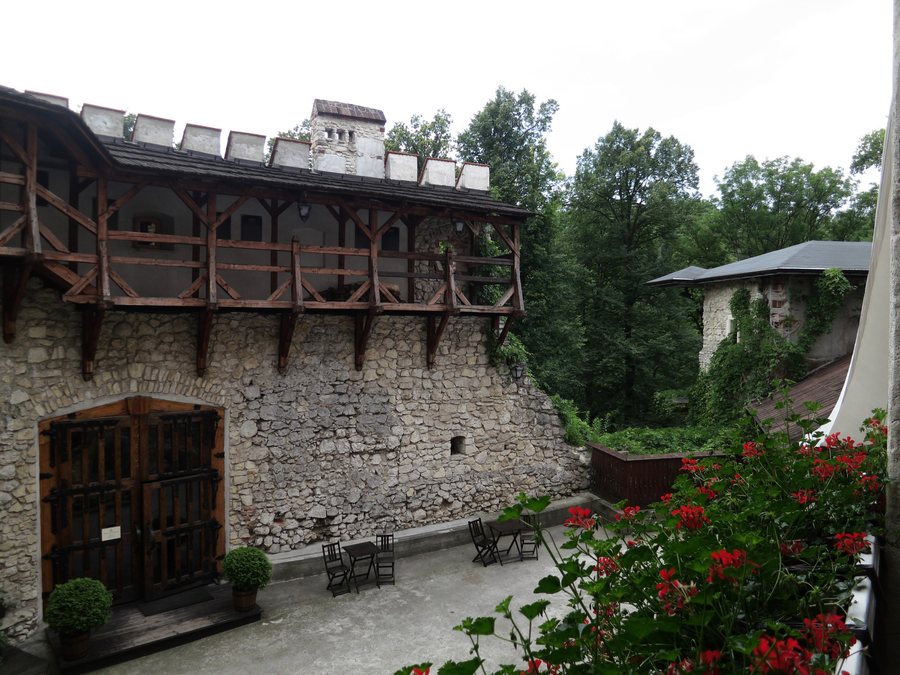
The restored ruins of Korzkiew Castle crown a prominent rocky promontory surrounded by a bend in the Korzkiewka. This setting gives the castle a striking silhouette in the landscape. Its oldest structure dates from the second half of the 14th century. During the reign of Casimir the Great, the castle was part of a borderland defensive system. Those interested in the area’s history will find both a specific historical function and restored ruins that are visible today.
The church and the castle offer different ways to explore Korzkiew’s past: the church focuses on defensive features and religious objects, while the castle highlights its historical role and its position on the promontory. This distinction can help you choose what to focus on during your stay, rather than viewing both buildings as interchangeable stops.
Landscape at the foot of the castle hill
At the foot of the castle hill lies a landscape park, established in 1820 and covering approximately 6 ha. With its own historical date and clearly stated size, it complements the castle ruins with a landscape perspective. Korzkiew has varied terrain shaped by erosion and karst processes. Its geographical location can also be described precisely: Korzkiew lies in the valley of the Korzkiewka, a left-bank tributary of the Prądnik.
Those who want to experience the area’s landscape as well as its buildings will find several distinct features here: the stream valley, the varied terrain and the park at the foot of the castle hill. The park is not part of the castle complex, but should be regarded as a distinct element of the local landscape. When planning your trip, these features may help you decide whether to choose Korzkiew mainly for its history or also for its distinctive surroundings.
Blue trail towards Ojców
A blue trail leads from Korzkiew into the Prądnik Valley near Prądnik Korzkiewski and continues to Ojców (6 km). So, alongside its buildings, the area also offers a specific route to explore.
When looking for a holiday apartment, consider Korzkiew if you would like to combine the castle, church, park and trail to Ojców. The right choice depends on what matters most to you: historic buildings and religious art, the landscape around the castle hill or a walk along the blue trail. The features described here give you a concrete basis for matching Korzkiew to your own travel interests.
For the broader travel overview: Dziekanowice.

