
Dolna Grupa and the Olęder Cultural Landscape
Accommodation in Dolna Grupa
Dolna Grupa stretches as a narrow strip of land in the Grudziądz Basin, between the edge of the Kępa Górnej Grupy upland and the Mątawa River. The character of the place is revealed through the interplay of its settlement pattern, drainage channels and traces of Olęder culture. Here, the landscape and local history can be considered together.
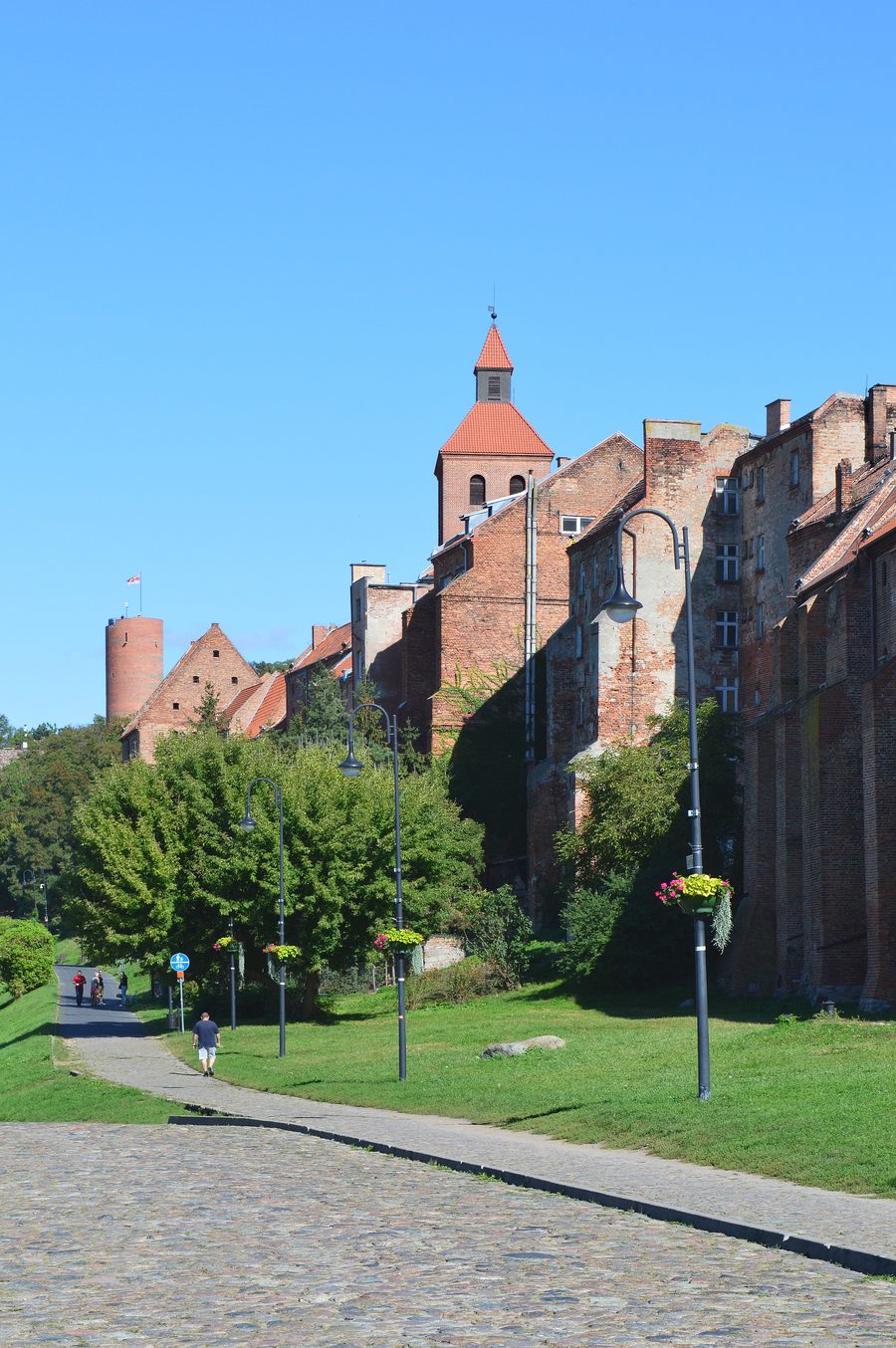 Historic granaries and pathway in Grudziądz, one of the wider-area heritage sights associated with the region.
Photo: Scotch Mist via Wikimedia Commons, CC BY-SA 4.0
Historic granaries and pathway in Grudziądz, one of the wider-area heritage sights associated with the region.
Photo: Scotch Mist via Wikimedia Commons, CC BY-SA 4.0
Settlement Pattern and Cultural Landscape
The settlement pattern of Dolna Grupa, still recognisable today, is characteristic of so-called marsh strip villages, typical of Olęder settlement. A preserved network of drainage channels in the lowest-lying areas is also part of the cultural landscape shaped by Olęder settlers. Thus, two scales sit side by side: the form of the settlement layout and the channels in the lower parts of the village. If you are interested in historic settlement patterns, Dolna Grupa combines this perspective with specific features of the landscape.
Wooden Houses and Architectural Details
Only a few post-Olęder wooden houses have been preserved in Dolna Grupa. They combine residential and agricultural sections under one roof. Houses No. 12 and No. 81 retain characteristic elements of their door and window fittings. They offer a way to appreciate the variety of the architectural heritage at a different scale from the settlement pattern: here, individual houses and their handcrafted details take centre stage. Together, the village layout and surviving architectural features provide a nuanced insight into the local cultural landscape.
Cemeteries and Traces of Remembrance
In the southern cemetery in Dolna Grupa stands an 1861 stele to Maria Tiahrt, decorated with an Eye of Providence. The cemetery also contains around thirty brick tombs dating from the late 19th century and the first half of the 20th century. Some tombs are adorned with the symbols of the cross, anchor and heart, representing faith, hope and love. Putti with wings folded in a sign of mourning are also among the decorations. Preserved features include the remains of the brick pillars of the former gate to the former Mennonite church, as well as a fragment of a Neo-Gothic tomb dating from 1905.
The Mennonite-Evangelical cemetery lies in the northern part of Dolna Grupa, on a high, tree-covered rise. Its multi-tiered tombs date from around the turn of the 20th century. Traces remain of the stone or cast-iron crosses that originally crowned them. Large oaks mark the cemetery boundaries; they were probably planted around the middle of the 19th century.
The cemetery in Dolna Grupa, by the road from Górna Grupa, was established no later than the end of the 18th century. Until the end of the Second World War, it served as a burial place for German- and Dutch-descended Lutherans and Mennonites who once lived in Górna Grupa. The southern cemetery also served as a burial place for residents of neighbouring Górna Grupa.
The Former Mennonite Church
The former Mennonite church beside the southern cemetery was built of brick in 1866 on a rectangular plan. Its design combined Neo-Gothic forms with arcade elements. The towerless building had a simple interior, which included benches, an altar table and an organ donated in 1897. The church was later demolished. Its history adds another perspective on the religious and architectural past of the place to the features of the cemeteries.
Choose Dolna Grupa as Your Destination
When looking for a holiday apartment, you can consider which focus you want your trip to have: the settlement pattern shaped by Olęder culture and the drainage channels, or the cemeteries and their historic tombs. These different perspectives make Dolna Grupa particularly interesting if you are interested in local history and the cultural landscape.
Discover more destinations: Świecie, Zbrachlin, Czersk Świecki, Stara Rzeka, Warlubie, Tleń, Taszewskie Pole, Jeżewo.
View the overview of the wider area: Świecie.

