
Strzelno: Romanesque Art and the History of the Order
Accommodation in Strzelno
Strzelno offers a cultural history reflected in Romanesque sculpture, monastic history and distinctive church interiors. The Parish Church of the Holy Trinity and the Rotunda of St. Procopius each make their own architectural statement; the collections of the Muzeum Romańskie Ottona i Bolesława add another dimension. Sacred architecture, ornately decorated columns and museum exhibits on the history of the Premonstratensian Order thus offer different ways to explore the area. If you are choosing a holiday apartment in Strzelno, this focus may appeal if you want to connect your stay mainly with history and architecture.
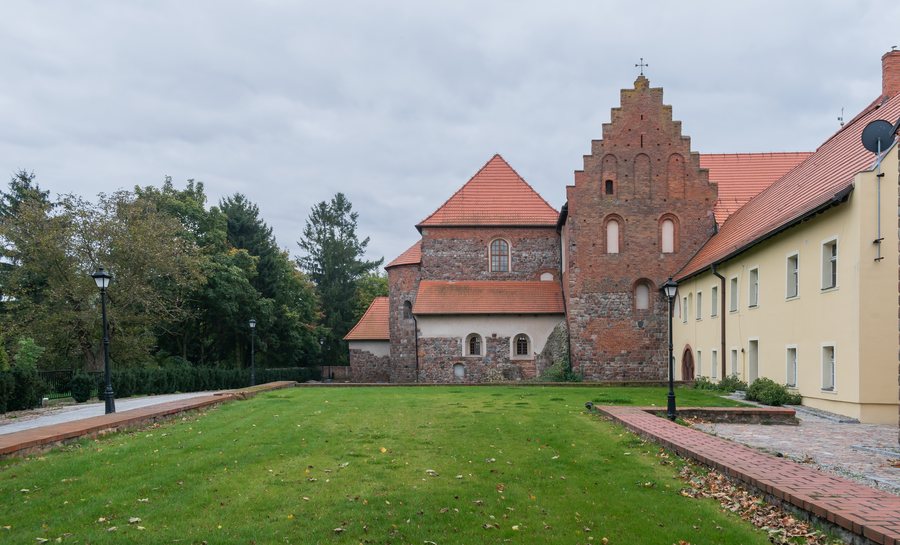 File:Holy Trinity church in Strzelno (2).jpg
Photo: Krzysztof Golik via Wikimedia Commons, CC BY-SA 4.0
File:Holy Trinity church in Strzelno (2).jpg
Photo: Krzysztof Golik via Wikimedia Commons, CC BY-SA 4.0
Romanesque Art and Monastic History
The museum’s collections are divided into a Romanesque and archaeological section and a liturgical section. Both deal with the history of the Premonstratensian Order. This division offers two distinct perspectives on the subject: the first section brings together Romanesque and archaeological themes, while the liturgical section focuses on ecclesiastical subjects. The cultural perspective thus extends beyond architectural forms: the Order is also a subject of the collections.
The former Premonstratensian convent complex includes three carved Romanesque tympana. Together, they are considered the largest collection of their kind in the country. A fourth tympanum from the Rotunda of St. Procopius is a reconstruction. A tympanum is a decorated field in Romanesque architecture; when considering Strzelno, it is important to distinguish the three carved works from the reconstruction. The complex is protected as a Polish Historic Monument for its historical, artistic and scientific value, as well as its authentic building fabric. In addition to the tympana, Romanesque sculptures include columns depicting virtues and vices, unique in Europe.
The Church of the Holy Trinity
The Parish Church of the Holy Trinity was built between 1174 and 1216 for the Premonstratensian convent. Its side chapels are dedicated to St. Barbara, the Sacred Heart of Jesus, St. Norbert and St. Restitutus. The contrast between Romanesque stonework and later structural changes is particularly striking: in 1946, four Romanesque columns between the naves were uncovered from within masonry in Baroque brick piers. Their surfaces are richly decorated with personifications of virtues, sins and vices, as well as plant ornaments. Personifications make abstract ideas recognizable in visual form; the columns combine this imagery with floral motifs. The year 1946 marks not their creation but their uncovering.
The Spatial Forms of the Rotunda of St. Procopius
The spatial form takes center stage in the Romanesque Rotunda of St. Procopius: it has a circular nave, two apses and a rectangular presbytery. The interplay of spatial forms makes its layout more specific than the general label “Romanesque.” Opposite the presbytery is a double Romanesque window, or biforium. The interior is simply furnished and predominantly Baroque; its furnishings date from the 18th century. Romanesque architectural features and a predominantly Baroque interior thus coexist in the same building, although they do not belong to the same period.
A Cultural Focus to Help You Choose Where to Stay
If you are looking for a holiday apartment in Strzelno, considering your preferred cultural theme can help you choose where to stay. The construction dates of 1174 to 1216, the chapel dedications and the columns uncovered from the masonry give the parish church a historical architectural focus. In the rotunda, by contrast, the main points of interest are the layout of the space and the relationship between Romanesque architecture and Baroque furnishings. The museum collections complement these perspectives with the history of the Premonstratensian Order. You can choose what to focus on based on whether you are particularly interested in architectural history, sculpture or the history of the Order.
Discover more destinations: Wójcin, Mielenko, Izdby, Chabsko, Mogilno, Kwieciszewo
Back to the main travel overview: Mogilno.

.jpg)