
Poznań: History, Culture and Special City Experiences
Accommodation in Poznań
Poznań brings together impressive evidence of the city’s and country’s history with unusual discoveries: in the crypt, you’ll encounter tombs believed to belong to Mieszko I and King Bolesław Chrobry, while the Enigma Cipher Centre tells the story of codebreaking, which began in Poznań. Other highlights include a Renaissance town hall, a large palm house and the grounds around Lake Malta. The topics that interest you most can help you choose a holiday apartment in Poznań to suit the kind of city experience you’re looking for.
History and Culture in Poznań
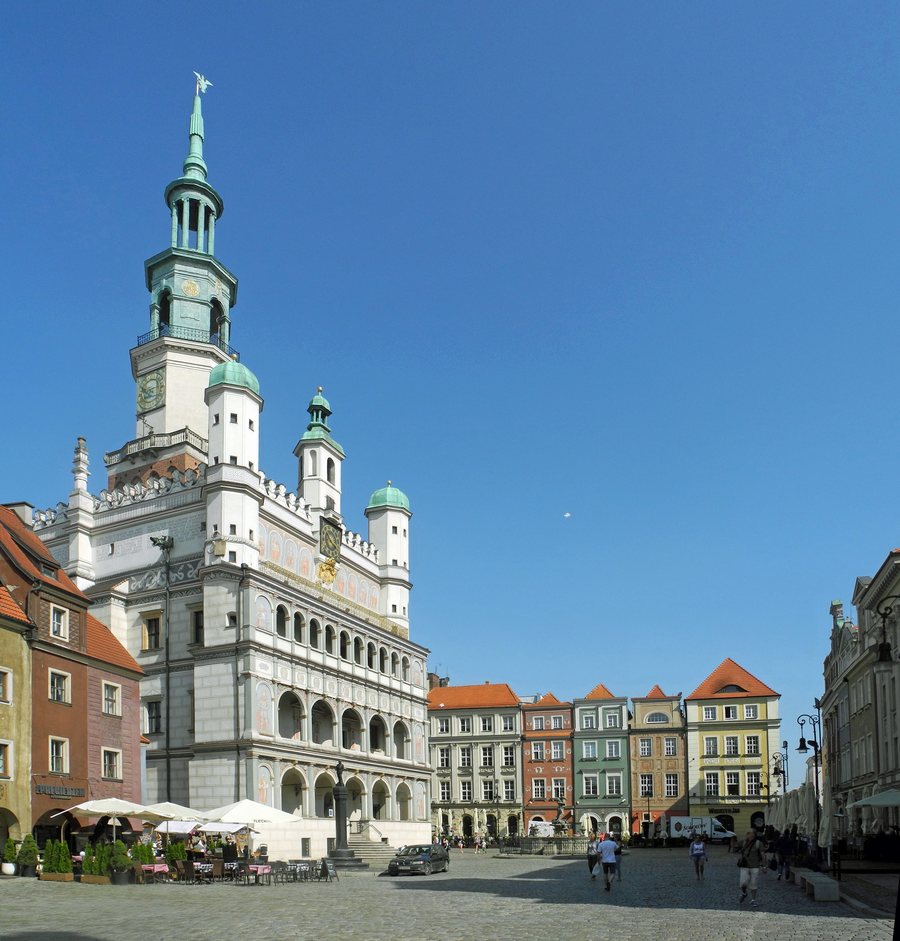
Old Market Square has been the vibrant heart of Poznań since 1253. The Poznań Town Hall, a Renaissance building dating from the 16th century, stands here. The famous goats on the town hall tower are also one of the city’s distinctive sights: they appear every day at 12 noon and 3 p.m. and butt heads twelve times. The square thus combines a tangible connection to history with a recurring city experience.
Another glimpse into the past awaits at the Genius loci Archaeological Reserve. Here, you can see well-preserved sections of the 10th-century ramparts of Poznań Castle. Tombs believed to belong to Mieszko I and King Bolesław Chrobry can be seen in the crypts of Poznań Cathedral. If you’re interested in the early chapters of Polish history, you’ll find different ways to explore them here: archaeological remains and tombs attributed to these figures with some reservation.
Museums also have their own distinctive focus. The “Archdiocesean Museum” was founded in 1898 by Archbishop Florian Stablewski and is the oldest museum institution in Poznań. It is located on Ostrów Tumski in the former Lubrański Academy. Porta Posnania uses modern technology to present the history of Cathedral Island, the development of Poznań and the beginnings of the Polish state. As Poland’s first Heritage Interpretation Centre, it offers a distinctive way to explore these subjects.
The Enigma Cipher Centre is dedicated to the story of cracking the Enigma code, which began in Poznań; its exhibition consists of three main sections. It’s a way to add a scientific and technological perspective to the city’s history. The combination of city history, archaeology and the Enigma story makes Poznań especially appealing to travellers who don’t want to limit their cultural experiences to a single museum subject.
Plants and Water Experiences
The Poznań Palm House in Wilson Park reveals a completely different side of the city. It is home to 17,000 plants from 700 species and subspecies, making it one of the largest facilities of its kind in Europe. It’s a well-defined destination for anyone interested in plant diversity. Alongside the city’s historic collections, it offers a distinctly different experience, without requiring you to focus your trip on just one theme.
Water sports take centre stage at Lake Malta, which has a 2,190-metre regatta course. The Malta Thermal Baths add four areas to the mix: Waterpark, Sports Pools, Sauna World and SPA 1306. Some pools are supplied with geothermal water extracted from a depth of 1,306 metres. If you’d rather build your trip around water and swimming than museums, these features offer a different basis for choosing your accommodation and excursions.
St Martin’s Croissant is a local culinary speciality that can only be sampled in Poznań. It adds a distinctive food experience to the historical and technological discoveries. The city therefore offers various ways to plan your days: you can focus on architecture and history, choose exhibitions, or include plants and water experiences. The best way to choose a holiday apartment in Poznań is to consider which of these interests matter most to your trip.
Getting Around During Your Stay
Poznań city centre is connected to Poznań-Ławica Airport by daytime bus routes 159 and 148 and night bus route 222. These routes provide clear guidance for travelling between the airport and the city centre. To explore the city further, the “The Oldest Poznań” audio guide offers two walking routes starting from Cathedral Island: one to Śródka and one to Chwaliszewo. Choosing between the two destinations lets you tailor your walk to your interests.
The Poznań Tourist Information Centre provides free information materials about Poznań and the surrounding area. These can be useful if you’d like to include places beyond the city’s central attractions in your travel plans. Whether you’re looking for a holiday apartment as a base for culture, city history or water experiences, the attractions mentioned offer different points of focus to help guide your plans.
More Places
More destination pages: Kamińsko, Kicin, Wojnowko, Wysogotowo, Lusowo, Zakrzewo, Murowana Goslina, Stęszew, Poznań, Kobylnica, Swarzędz, Plewiska, Wiry K/Poznania, Chludowo, Golęczewo, Suchy Las, Przeźmierowo, Dymaczewo Nowe, Czerlejno, Kiekrz, Luboń, Mościenica, Kórnik, Owińska, Bogucin, Skórzewo, Trzebaw, Promienko, Pobiedziska, Sobota, Sierosław, Walerianowo, Warthelager Training Area, Buk, Runowo, Komorniki, Puszczykowo, Mosina, Swiatniki N Warta, Czerwonak, Tarnowo Podgórne, Jarosławiec, Rokietnica, Radzewice, Tomice, Będlewo, Czmoń, Ceradz Kościelny, Sady, Mrowino, Glinka Duchowna, Kostrzyn, Koziegłowy, Szczytniki, Poznań, Głęboczek, Wiktorowo, Boduszewo, Tulce, Złotoryjsko, Dąbrówka, Strykowo, Sapowice, Stęszewko, Palędzie and Chomęcice.
Back to the main travel guide: Greater Poland.

