
Kamionna: Valley, Market Square and Historical Traces
Accommodation in Kamionna
Kamionna combines a distinctive valley landscape with a market square whose layout recalls the time when the settlement was a town. To the southwest, the Church of the Nativity of the Blessed Virgin Mary stands on a high ridge above the Kamionna River. The former town hall, 19th-century half-timbered houses and a statue of Saint Lawrence come together in the square. Nature and local history offer different starting points for planning your trip.
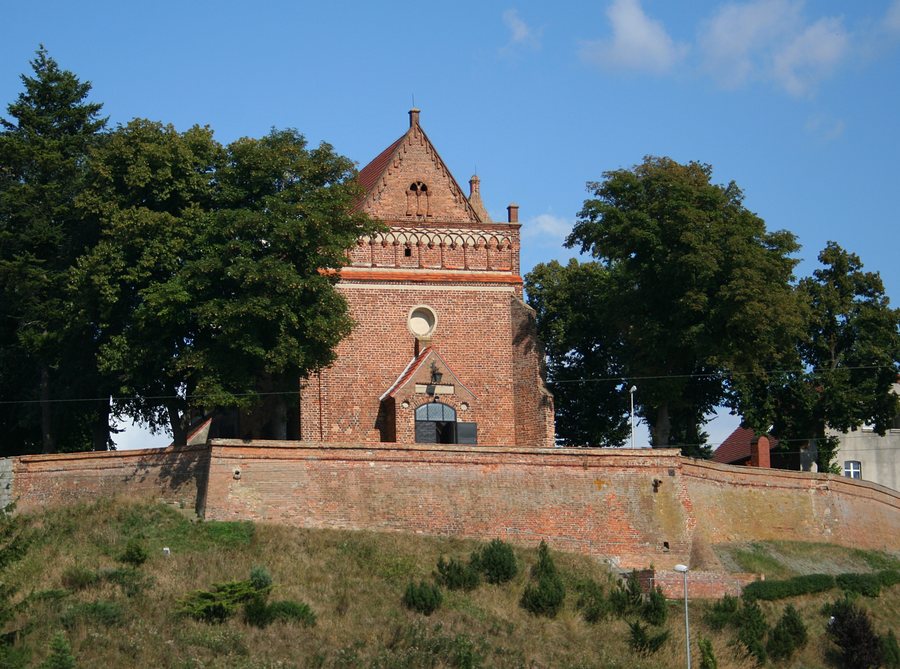 File:Kamionna kościół Narodzenia NMP 23. 08. 2013 p.jpg
Photo: Przykuta via Wikimedia Commons, CC BY-SA 3.0 pl
File:Kamionna kościół Narodzenia NMP 23. 08. 2013 p.jpg
Photo: Przykuta via Wikimedia Commons, CC BY-SA 3.0 pl
The Kamionka Valley and its landscape
South of Kamionna lies the deeply cut valley of the Kamionka River. Its 1,970 hectares include wooded ravines with beech forest, oak-hornbeam forests and alder carrs, as well as meadows and spring areas. The valley is part of the Dolina Kamionki Landscape Protection Park. The park covers 2,046.86 hectares and protects the landscape of the Kamionka Valley, natural valley ecosystems, and the habitats of rare and protected plants, animals and fungi. The area figures refer to different units: the valley and the Landscape Protection Park.
The park’s protection dates back to 1986, when the area was protected as one of two parts of the Pszczew Landscape Protection Park. Since 2019, the Dolina Kamionki Landscape Protection Park has existed under its current name and within its current boundaries. Those interested in protected habitats and different types of woodland and open land will find a tangible connection with nature here during a trip to Kamionna. The landscape features mentioned set the valley apart from the historic setting of the market square.
The market square and its historical details
The market square retains the layout from the time when Kamionna was a town. The former town hall stands in its centre, surrounded by several 19th-century half-timbered houses. The statue of Saint Lawrence adds another visible detail to the ensemble. The history of the settlement can thus be read in the various buildings and features in the square, without any one building needing to convey the character of the square on its own.
Another special kind of historical landmark can be found beside the church: a bell-shaped milepost. It was erected between 1826 and 1835 on the main road from Poznań to Berlin. The stone initially stood by the fire station and was later moved to the church. Its present location and former use are different stages in its history. Together with the church’s position on the ridge, the milepost offers another reason to look for Kamionna’s historical traces.
Hiking with views of the surroundings
A hike offers, among other things, views of the Kozie Góry, the highest elevations in the area around Kamionna, and Lake Kuchenne. Prusim is 3.6 kilometres away. These details give you a concrete reference point for planning your day: as well as enjoying the scenery of the Kamionka Valley, you can also consider the elevations, the lake and the route to Prusim.
Which holiday apartment in Kamionna suits your trip?
When planning your day, you can decide whether to make more time for exploring the settlement or for a hike. Tailor your search for a holiday apartment in Kamionna to the experiences that appeal to you most for your trip. The nature and cultural themes described here offer different starting points.
If you would like to visit more pages about local destinations, find Miedzychod, Bucharzewo, Kwilcz, Śródka, Sieraków, Łężeczki, Zatom Nowy and Tuchola here.
For the broader travel overview: Birnbaum.

