
Ottoland: Village History and Sheepfold
Accommodation in Ottoland
Ottoland is an elongated planned settlement that developed on both sides of the Ottolandse Graafstroom, a peat stream that had been canalized at the time, in the first half of the 13th century. In the west, it flows into the Graafstroom of Molenaarsgraaf.
Other destinations: Nieuw-Lekkerland, Oud-Alblas.
Culture
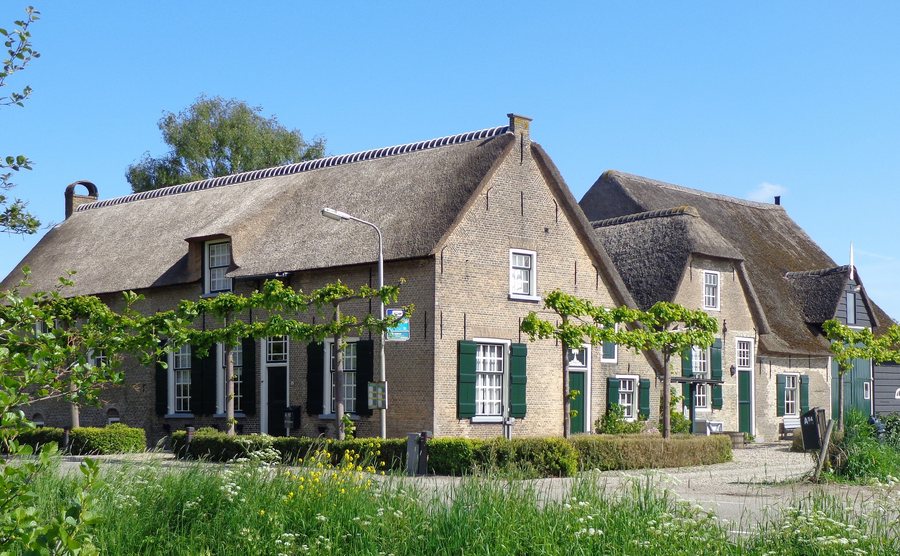
The monumental Het Hoge Huis farmstead probably dates back to the early 18th century. The residential building has a broad front façade and a structure that is largely designed as an upper room. Particularly striking is the very high front door set in an 18th-century frame. The façade, upper room and front door are among the defining architectural elements of the Het Hoge Huis farmstead in Ottoland.
Het Regthuis is an approximately 400-year-old farmhouse at address A92 in Ottoland. For many years, the schout and schepenen of Ottoland held their meetings in the converted upper room; until 1954, the municipal administration also met there. The village’s political and administrative history is therefore directly connected with a farm building.
The Huisterp also forms part of the historical character of low-lying areas. A Huisterp is an artificially raised mound on which a house stood, often together with sheds, barns and other outbuildings. Such house mounds were created to keep one’s feet dry. The archaeological Rijksmonument on Hoefweg in Ottoland is associated with a Huisterp, on whose artificially raised mound a house with possible outbuildings, barns or other structures stood. The Schaapskooi Ottoland was designed as a sustainable building in the style of the existing farmhouses.
Nature
In the surrounding area, the flock of the Schaapskooi Ottoland is used to graze dikes, Tiendwegen and natural areas. Targeted grazing by the Schaapskooi Ottoland promotes biodiversity: the sheep’s wool and droppings enable plants and herbs to spread and develop. Dikes, paths and natural areas are thus also connected with sheep farming.
On the Way
The visitor center of the Schaapskooi Ottoland is a starting point for hiking and cycling tours. Cycling and hiking maps, as well as information about the region, are available there. The visitor center also includes a shop selling regional products. Ample parking facilities, a charging station for electric bicycles and a bicycle repair station are also available at the visitor center.
Sheep, goats and donkeys are kept at the Schaapskooi Ottoland. From a special “Skybox,” visitors can look down into the sheep shelter from above.
Village Life
From November to May, all the sheep of the Schaapskooi Ottoland are in the sheep shelter. During the rest of the year, the Schaapskooi Ottoland premises are used for workshops, among other things.
The Gereformeerde Kerk in Ottoland is a place of gathering, celebration and fellowship, and is building an inspiring faith community in Ottoland.
To the overarching travel overview: Molenwaard.

