
Holiday apartment in Oosthuizen: stories, churches and the Markermeer
Accommodation in Oosthuizen
Oosthuizen: stories, churches and paths along the Markermeer
Oosthuizen combines literary heritage with churches and a landscape of reed beds, meadows and small country lanes. For families interested in culture, the discovery begins at Het Schooltje van Dik Trom, a children's book museum housed in a unique former one-room schoolhouse. The museum displays various editions of the Dik Trom books, other books by C. Joh. Kieviet, and children's books from before 1940. Kieviet taught here from 1883 to 1902; in the adjacent teacher's house, he wrote his first book about Dik Trom. Together, the former schoolhouse and the adjoining teacher's house preserve Dik Trom's literary connection to the village.
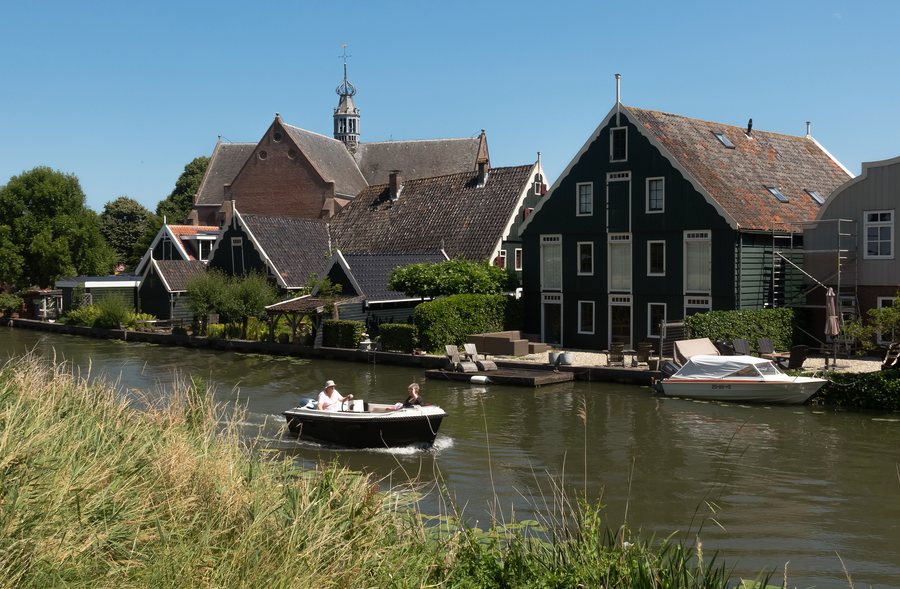 File:Edam-Volendam Oosthuizen, de Grote of Sint-Nicolaaskerk RM40332 IMG 6999 2023-06-25 14.21.jpg
Photo: Michielverbeek via Source, CC BY-SA 4.0
File:Edam-Volendam Oosthuizen, de Grote of Sint-Nicolaaskerk RM40332 IMG 6999 2023-06-25 14.21.jpg
Photo: Michielverbeek via Source, CC BY-SA 4.0
Church route and cultural impressions
The Grote Kerk Oosthuizen contains the pipework and case of a 15th-century organ. The church regularly hosts cultural events, including classical concerts and exhibitions. The Grote Kerk Oosthuizen can be visited during exhibition opening hours and by prior arrangement. The Kerkenroute passes through seven distinctive village churches in Kwadijk, Middelie, Oosthuizen, Beets, Schardam, Etersheim and Warder. At its stops, QR codes provide brief historical information as well as photos and videos. For a cultural day, the Kerkenroute can be planned as a separate focus alongside the museum and landscape. The stops combine local church history with digital image and video elements.
Museums between history and landscape
The De Waterwolf Archaeological Mini-Museum presents archaeological finds and tells the story of the lost settlement of Etersheim, the struggle against the sea and the creation of the landscape. The Etersheim Braakmolen, also known as Museummolen De Breek, was put back into operation in 2005 after a six-year restoration. The mill can be visited inside and experienced while in operation. De Waterwolf and De Breek focus on different aspects of Etersheim's history: settlement and landscape on the one hand, and restoration and mill operations on the other.
Reeds, meadow birds and the Markermeer
The former Zeevang region is characterised by reed beds, small country lanes, distinctive meadow birds, and elongated villages with stolp farmhouses and wooden houses; cycling tours, walks and canoe trips with views of the Markermeer are possible there. The Bezoekerscentrum en Poldercafé De Breek is a visitor centre with a terrace on the Markermeer dike; birds sing and sheep graze in the surrounding area. Cycling tours, walks and canoe trips make use of this landscape in different ways. Nature days here combine exercise, views over the water and birdwatching.
Routes for different day plans
The 10.6-kilometre Kogen- en brakenroute starts in Oosthuizen. Further afield, it passes the Oosterkoog wetland on the edge of the Markermeer, which is known for wintering whimbrels and black-tailed godwits present in spring. The Pontjesroute runs through meadows and uses two hand-operated cable ferries. The stated distance provides a fixed framework for planning the day, while the seasonal bird populations at Oosterkoog offer a separate focus for observation. The choice of route therefore depends on the preferred combination of a set distance, wetland and hand-operated ferries.
For further orientation in the region, Kwadijk, Middelie, Warder, Beets and Schardam are available to you.
For the broader travel overview: Zeevang.

