
Holiday apartment in Oterleek – Dikes, windmills and history
Accommodation in Oterleek
Oterleek between dikes and windmills
Oterleek is located on the dike of a former peat island, near Heerhugowaard and along the Westfriese Omringdijk. Dikes, polders and traces of water management give the village a distinct landscape character. Dikes, polders and water management represent three different aspects of the landscape, which can be considered separately during a stay in Oterleek. The former peat island adds a historical landscape dimension to the location on the dike.
Historic architectural heritage in Oterleek
The architectural heritage includes Oterleek’s former Reformed church, a municipal monument. The building was erected in 1925 to a design by Amsterdam architect Jaap Molenaar, in a restrained expression of the Amsterdam School style. Willem Moeijes and Hannes van Harskamp also built the church in 1925. For those interested in culture, Oterleek offers several specific points of interest: the former Reformed church, the windmills and the Boerderij “Dijkzicht”.
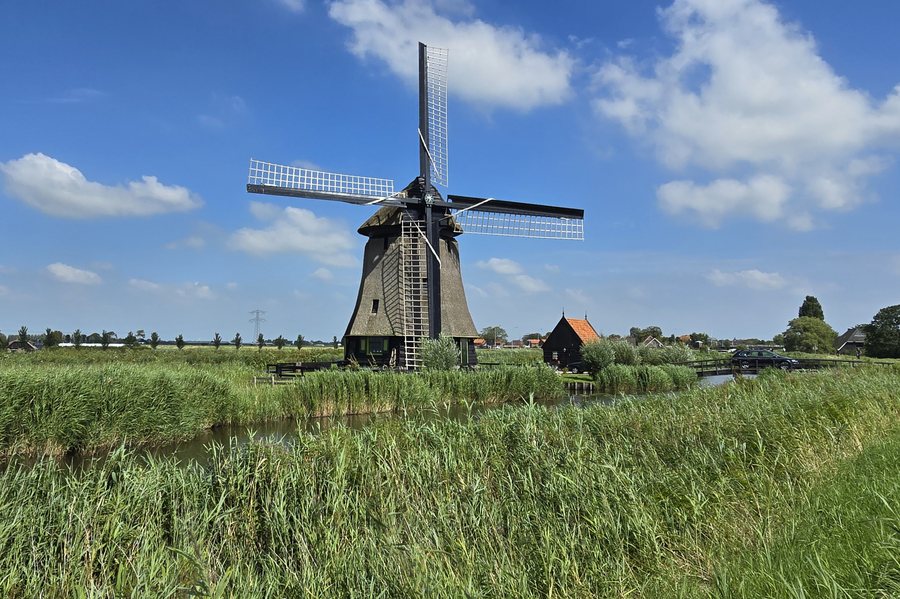
The range of windmills is particularly diverse. De Otter is a thatched, octagonal wooden grain mill; as Korenmolen De Otter, it is also the only post mill and grain mill in the Schermer. Strijkmolen K was built around 1627 to mill excess water from the Raaksmaatboezem into the Schermerboezem. Strijkmolen I is the rightmost of three strijkmolens standing in a row along the Noordschermerdijk in Oterleek (Rustenburg).
Dike landscape, history and rural character
The village’s rural side is also clearly evident. The Boerderij “Dijkzicht” is a Stolphoeve from the first half of the 19th century, with a tiled roof and a clock gable. From the 10th century onward, a small settlement developed in Oterleek during the “Great Reclamation”, starting from Oudorp. Its inhabitants lived from livestock farming and fishing. The Stolphoeve dates from the first half of the 19th century; the settlement’s origins go back to the 10th century.
Walking and cycling around the village
Two different routes provide clear options for active days. Stage 02 of the Streekpad Westfriese Omringdijk passes through Oterleek. The “Stad, Dijk en Waard” cycle route runs through dike villages and polders. The two routes offer different planning frameworks. The Streekpad connects Oterleek to the Westfriese Omringdijk as a walking stage; the cycle route runs through dike villages and polders. This places the section through the village at the centre of a day’s walk, while a cycling tour follows the sequence of rural landscapes. A day’s walk and a cycling excursion thus each have their own spatial focus.
Another reason to visit lies next to the windmill: at the bakery beside the windmill, people with disabilities mill grain, bake bread and biscuits, and sell their own products in the shop. The artisanal offering ranges from milling and baking to selling products in the shop. Bread and biscuits are among the products made in-house.
More destinations
More destinations: Zuidschermer, Grootschermer.
To the higher-level travel overview: Schermer.

