
Discover Scheulder: Plateau, marl and culture
Accommodation in Scheulder
Scheulder lies on the edge of the Margraten plateau and opens onto an open plateau landscape. The surrounding area offers wide views. In the village itself, marl, church architecture and farmhouses stand out as tangible architectural features. The open views in the surrounding area thus contrast with the built character of the village: outside, the expansive landscape; in the village, the visible traces of materials, architectural history and rural architecture.
Plateau, paths and different day plans
The 30.5-kilometre Margraten MTB route passes through Scheulder. When hiking across the Scheulder plateau, there are no significant elevation gains to tackle. The “1933. Scheulder” walk follows a footpath into the Gerendal and returns to Scheulder via a forest track and a narrow road. On the plateau, the low elevation gain is the key feature when hiking; on the Gerendal loop, the footpath, forest track and narrow road determine the sequence. For an active day, the 30.5 kilometres of the MTB route provide a fixed framework, while the return to Scheulder completes the walking route.
Marl, church and distinctive village details
The Sint-Barbara Church is built entirely of marl. Scheulder’s church is a neo-Gothic building with a west tower dating from 1850. Inside the church is a late-medieval wooden sculpture of Saint Barbara from the former chapel; it still occupies a place of honour on the side altar dedicated to the saint. For those interested in culture, the church thus combines the neo-Gothic west tower with an older work of art from the former chapel. The use of marl connects the church and the Wingerd, although both buildings have different features: the neo-Gothic west tower in one case, and the two gateways of the Carréhoeve in the other. The wooden sculpture comes from the former chapel, while the village church, with its west tower, dates from 1850. The west tower and the sculpture do not therefore date from the same period of construction.
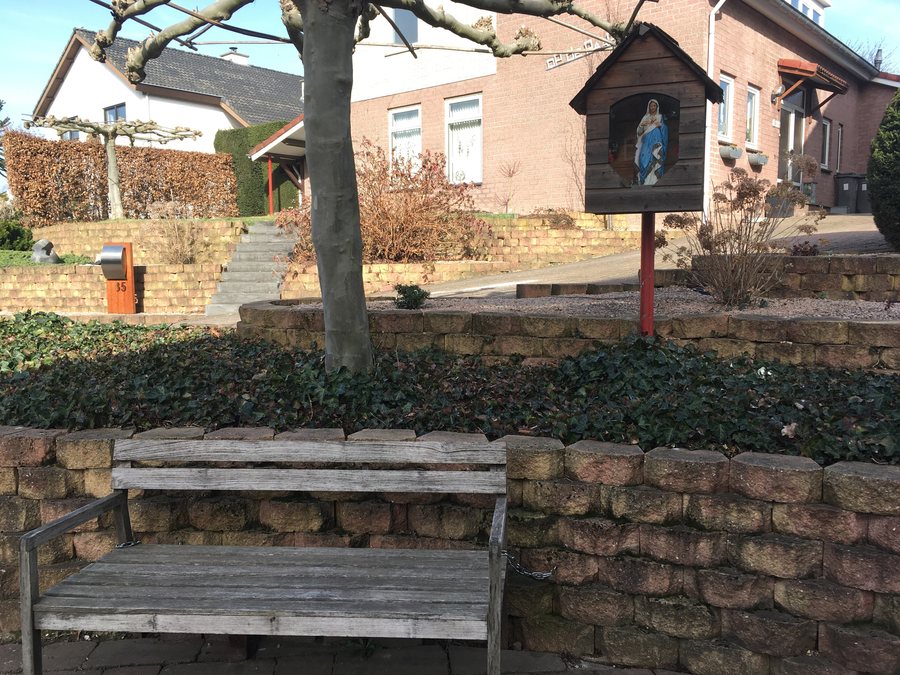
The “Lichtgraffiti” installation makes visible hidden notches carved over time into the soft marl of the church tower and is part of the cultural cycling route “Langs Kunst en Cultuur in Eijsden-Margraten”. At the intersection of Scheulderdorpsstraat and Scheuldersteeg stands the H. Hartbeeld. The Wingerd is a Carréhoeve built of marl, dating from the 19th century and protected as a Rijksmonument, with two gateways. In addition to the church tower, a Carréhoeve is therefore also part of the village character, with its own construction period, marl masonry and two gateways.
A village with a rural history
Old farmhouses stand along the road in Scheulder. Scheulder developed along an old trade route between Maastricht and Aachen. The old farmhouses and the historic trade route are thus part of the village’s rural appearance. In 2025, Arriva route 791 ran between Meerssen and Eijsden via Scheulder.
The surrounding area also includes Cadier En Keer, Sint Geertruid and Banholt.
More about the surrounding area: Margraten.

