
Holiday apartment in Vierhuizen: terp, churches and trails
Accommodation in Vierhuizen
Those looking for a holiday apartment in Vierhuizen will find concrete points of interest for planning their trip: Vierhuizen Church stands on a terp, a section of the Ziltepad runs through Vierhuizen, and historical traces extend back to the former Lauwerszee. This makes the village interesting for families who want to include cultural discoveries, trails and a clearly recognizable landscape history in their holiday.
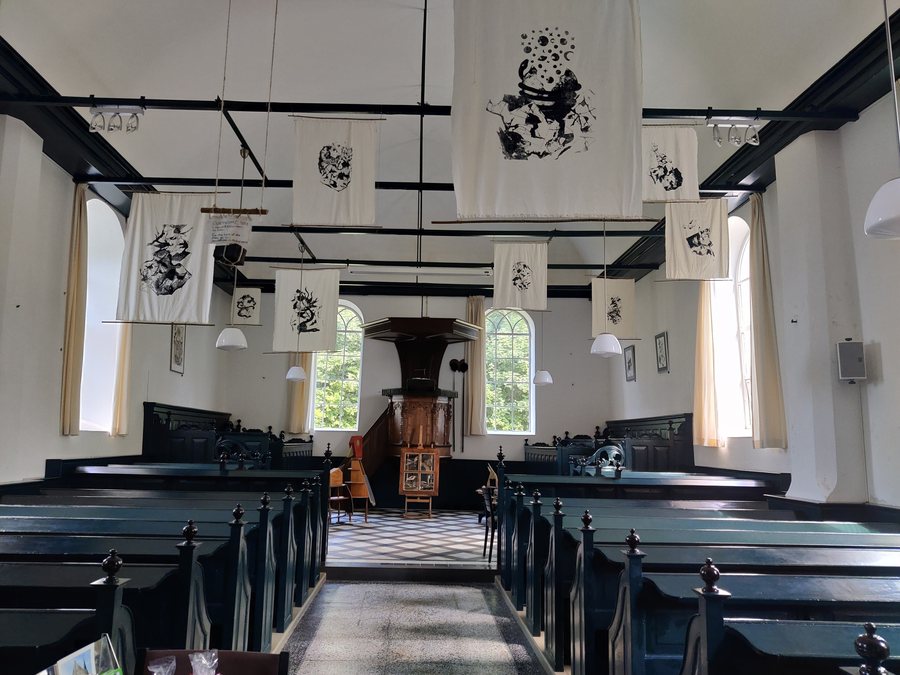 File:Vierhuizen, interieurfoto met kunstwerken op doek van Janneke Hoek.jpg
Photo: Sjettie Bruins via Wikimedia Commons, CC BY-SA 4.0
File:Vierhuizen, interieurfoto met kunstwerken op doek van Janneke Hoek.jpg
Photo: Sjettie Bruins via Wikimedia Commons, CC BY-SA 4.0
Terp and coastal past
Vierhuizen used to lie on the Lauwerszee. Around 1300, the sea dike now called Oude Provinciale Dijk was built around Vierhuizen. Those looking for historical connections while exploring the area can link these two periods: the former location on the Lauwerszee and the construction of the dike around 1300. The coastal past therefore remains an important reference point for understanding the village.
Vierhuizen Church and its historical connections
Vierhuizen Church was originally built in the 12th or 13th century. A free-standing tower once stood beside the church and served as a reference point when determining the boundary between Groningen and Friesland. Together with its location on a terp, this creates a historical focal point that also remains understandable for younger visitors: architectural history, landscape and regional border history meet in one specific place.
Organ, gallery windmill and artwork
Vierhuizen Church contains an organ with a long and unchanged history: it was installed by the Van Oeckelen company in 1892 and has remained unchanged ever since. Another distinctive feature is the De Onderneming windmill. It is an octagonal gallery windmill and was built in 1858 on behalf of J.J. Loots. The artwork „Inkstone or Protective Stone“ by Huang Yong Ping is also located in the Vierhuizen cemetery. These three themes provide different cultural accents, ranging from traditional sacred music and windmill construction to contemporary art.
Ziltepad and accessible churches
An initial section of the Ziltepad runs from Eastrum via Lauwersoog and Vierhuizen to Hornhuizen, or in the opposite direction. The churches along the Ziltepad are accessible. In winter, you can visit these churches by collecting the key from the key address indicated next to the church door. This allows you to combine part of the route with an interest in churches and spiritual places, without having to commit to just one type of experience.
A cycling route starting and ending in Winsum
For cycling enthusiasts, the 46-kilometre Op Hoogte Gedacht cycling route offers a clearly defined tour: it starts and ends at the artwork beside the church of Obergum in Winsum. The Ziltepad, by contrast, represents a route connection linking Vierhuizen with Eastrum, Lauwersoog and Hornhuizen. When planning your trip, you can therefore distinguish between a designated cycling route and a section of the Ziltepad.
When choosing a holiday apartment in Vierhuizen, you can focus on this combination of culture, walking experiences and cycling. Vierhuizen Church, De Onderneming, the Oude Provinciale Dijk, the Ziltepad and the cycling route offer different ways to plan your day. For families with different interests, this provides a clear basis: while some can explore the history of the churches and village in greater depth, others can plan part of the route or a longer cycling tour.
More destinations for planning your trip
Westernieland, Hornhuizen, Mensingeweer, Wehe-Den Hoorn, Houwerzijl, Warfhuizen, Kloosterburen, Pieterburen
To the higher-level travel overview: De Marne.

