
Radviliškis District Municipality: Museums, Hills and Nature
Accommodation in Radviliškis District Municipality
In Radviliškis District Municipality, archaeological sites, museums and nature come together. Each offers a different focus: you might be interested in the history of the Jewish community of Šeduva, exploring historic village buildings, or visiting prominent hillforts and scenic locations. When choosing a holiday rental, it helps to first consider which of these themes you want to shape your trip. The places described are at various named locations, so you can choose accommodation based on your own sightseeing interests without assuming that it is close to any particular site.
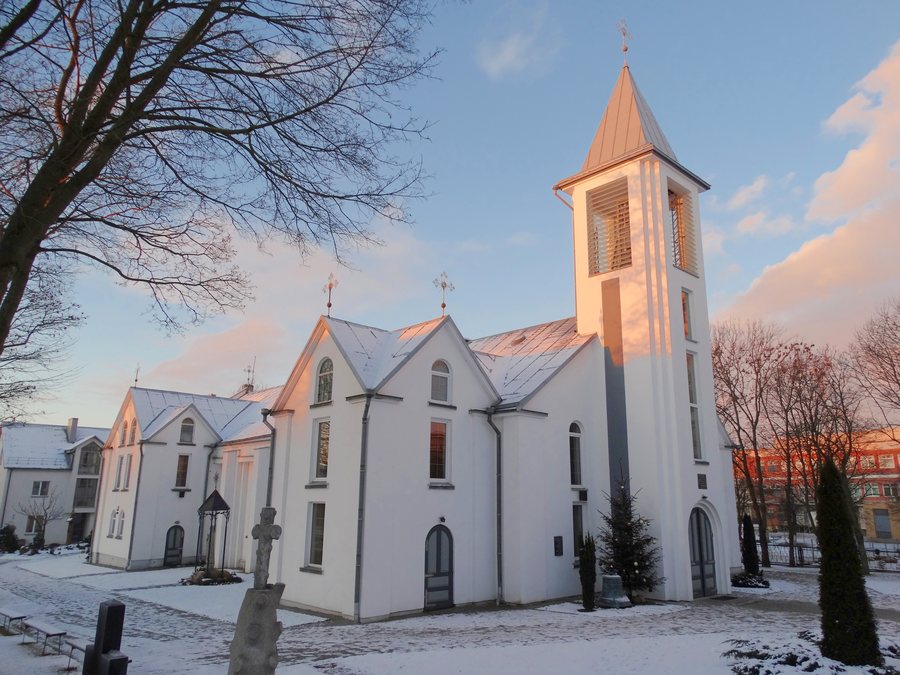 Church of the Birth of the Most Holy Virgin Mary, Radviliškis
Photo: Vilensija via Wikimedia Commons, CC BY-SA 3.0
Church of the Birth of the Most Holy Virgin Mary, Radviliškis
Photo: Vilensija via Wikimedia Commons, CC BY-SA 3.0
Hillforts, Routes and Landscapes
Kudinų Hillfort, also known as Šiaulės Hill, is in the village of Kudinų and dates to the 2nd to 1st millennium BC. To get there, take the Šiaulėnai–Lenartuva road to Viliošiai. Turn off 100 metres past the forest entrance, first cross the dam of a pond, then continue for 1.3 kilometres along a forest track. These precise directions give you a specific reference point for planning a visit to this archaeological site.
Diauderių Hillfort, also known as Baisogala Hillfort or Šatrija, also dates to the 2nd to 1st millennium BC. It is near Diauderių, on the left bank of the Serbentynė (Kiršinas) Stream, or the present-day pond. From the Baisogala–Grinkiškis road, turn towards Augmėnai at Biliūnai and continue for 750 metres. After the Serbentynė Stream, take another turn; the route continues across fields for 450 metres to the slope. For both Kudinų and Diauderių Hillforts, the focus is on their different location details and specific directions.
Raginėnų Hillfort, also known as Witches’ Hill, is in the Daugyvenė Culture-History Museum-Reserve near Raginėnų. It dates from the 1st millennium to the beginning of the 2nd millennium. Another scenic landmark is the Šiaulės observation tower, which is 21 metres high. Arimaičiai Lake has been an ornithological reserve since 1967. Valatkonių Stone, also known as Devil’s Stone, is in Valatkonių Forest; it was added to the Lithuanian Cultural Heritage Register on 14 July 1998.
Museums and Local History
Kleboniškiai Village Household Museum is in the Daugyvenė Valley near Kleboniškių and covers 18 hectares. It features village buildings relocated there that are typical of the 19th and early 20th centuries. Its offerings include exhibitions, educational programmes and evening events, as well as barn theatre, folk music and craft events, and Užgavėnės celebrations. The combination of buildings, everyday history and a variety of events makes the museum a versatile cultural destination to consider when planning your trip.
The Šeduva Jewish History Museum “Lost Shtetl” is dedicated to the Jewish community of Šeduva in interwar Lithuania, as well as its culture, traditions and history. The museum complex was designed by Finnish architect Rainer Mahlamäki. In Šiaulėnai, the regional museum preserves an authentic kitchen with a bread oven and a chimney once used for smoking meat. Those interested in historical ways of life and cultural memory will find different perspectives here, from the history and culture of a community to a tangible glimpse into the former use of a kitchen.
The V. Karmono Space Modelling Museum in the Vaižganto Progymnasium in Radviliškis offers a different focus. It displays rocket models made by students from the Radviliškis Space Modelling Club and by Victor Karmonas. The exhibits therefore represent a subject distinct from the historical collections and archaeological sites.
Manors, Crafts and Special Interests
At Baisogala Manor, the main manor house, stables, coach house, kitchen, warehouse and mill have been preserved. The estate also includes a park with numerous exotic tree species. Baisogala Windmill adds to this view of the area’s architecture: it is a three-storey, octagonal masonry structure with a conical, pyramid-shaped form and surrounding galleries.
Educational activities at the Pakiršinis Crafts Centre in Pakiršinis Manor range from marbling and baking to folk music and linen carving, as well as making wooden tulips, pottery and candle-making. Šeduva Stud in Raudondvaris welcomes experienced riders and people getting into the saddle for the first time; it also caters to horse lovers and visitors who simply want to see the animals. When choosing a holiday rental, you can take different travel interests into account without assuming any particular accommodation amenities.
Every spring, the “Tulip Bloom Festival” is held at Burbiškio Manor near Burbiškis. Sodyba “Molinė saulėgrąža” in Valdeikiai invites visitors to take photos in the sunflower field and visit the ceramic jug museum. These special events and attractions may be a deciding factor in your travel plans. Another place within the destination is Pociūnai.
Other destinations at the same higher level are Pakruojis District Municipality, Šiauliai District Municipality, Kelmė District Municipality, Akmenė District Municipality and Joniškis District Municipality.
For the broader travel overview: Šiauliai County.

