
Holiday apartment in Castello: church, panorama and local festivals
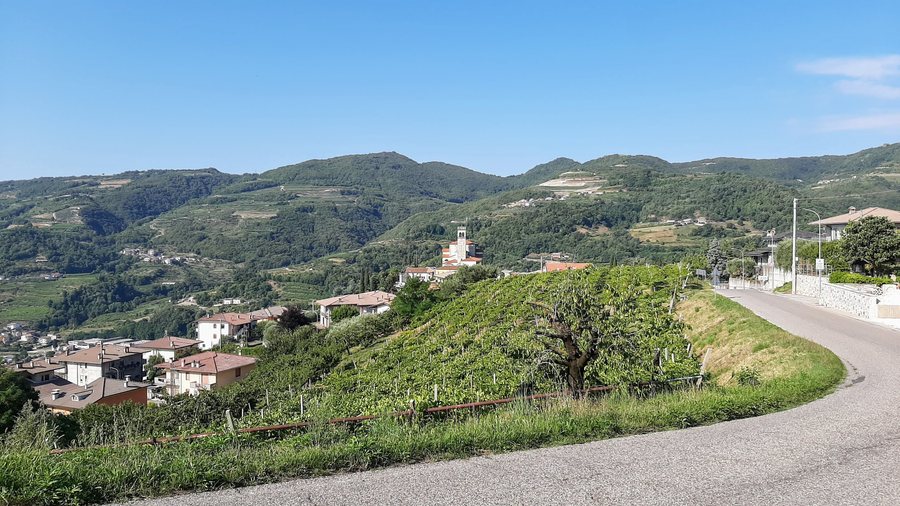
Castello between basalt, church and panorama
Castello reveals its distinctive character on a rocky hill: this is where the now-disused Basalti Colonnari quarry is located, on which the Castello district stands. The Basalti Colonnari are hexagonal prismatic formations created by the cooling and contraction of lava flows. In Castello, geological formations and historic buildings therefore meet directly as different themes within the local landscape. When choosing a holiday apartment in Castello, you can plan your stay according to whether you mainly want to experience culture, views, geological features or local festivals.
Church, parish museum and traces of the past
The present-day Chiesa di San Giovanni Battista detta il Castello stands in the Castello district on the site of a medieval castle. Together with its bell tower, it was built between 1808 and 1812. The central vault features the fresco “Gloria di San Giovanni Battista”, created in 1943 by the Verona-born painter Dino Menato. The parish museum is located on the north side of the church. It contains valuable paintings as well as various liturgical and religious objects that convey the history of the area. The parish museum tour ends at visible foundations of the keep, which was later converted into the bell tower. This provides several specific historical points of interest in Castello for days focused on culture.
Circular trails with panoramic views and Bunker 44
The landscape can also be explored via distinctive circular trails. The circular trail offers a 360-degree view over the Val d'Alpone and the Monti Lessini. The “Salita al Castello con affaccio sui Lessini e la Val d'Alpone” circular trail begins at the Chiesa di Santa Caterina and leads to the discovery of the Castello di San Giovanni Ilarione. These two described routes give your daily planning different focuses: one centres on the expansive view over the valley and mountain landscape, while the other focuses on the connection between the starting point, Castello and its surroundings. Bunker 44 lies below the floor level of the church above. It consists of underground rooms at a depth of 14 metres, connected by four side exits. Bunker 44 was built between April and November 1944 by workers from the Todt Organization.
San Zeno and local festivals
The Chiesa di San Zeno is also part of the church’s history. It contains a stone statue of Saint Zeno dating from 1442. The Chiesa di San Zeno features Romanesque architectural elements, including a bell tower with bifores, a pitched roof and round arches. The Sagra di San Zeno is associated with the second Sunday after Easter, the Località Castello, the 13th-century Romanesque church and local cuisine. The Sagra di San Giovanni Battista is associated with the last Sunday in June in the Località Castello, as well as with music, local cuisine and a cherry market. In addition to churches, circular trails and historic sites, your travel plans can therefore include two different festival occasions with culinary and local connections.
Check prices, availability and amenities for your travel dates directly on Booking.com.
View accommodation and offersAdvertisement · Affiliate link to Booking.comMore destinations for your travel plans
Garda, Bevilacqua, Angiari, Tacconi, Bonavigo, Salionze, Moschina and San Zeno Di Montagna
For the overarching travel overview: Verona.

