
Discover Isola D'Arbia: Via Francigena, Mills and Val d'Arbia
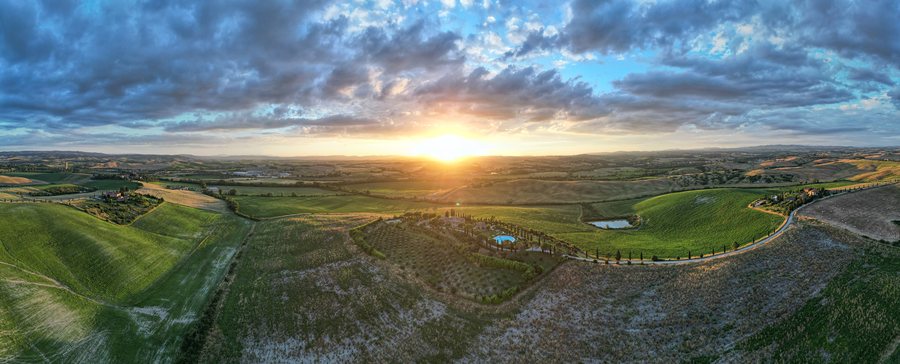 File:Isola d'Arbia, sunset from above. June 2024.jpg
Photo: BobTanGo via Wikimedia Commons, CC BY 4.0
File:Isola d'Arbia, sunset from above. June 2024.jpg
Photo: BobTanGo via Wikimedia Commons, CC BY 4.0
Isola D'Arbia combines pilgrim history and rural landscapes; cultural attractions can be found in the surrounding area. The Val d'Arbia is considered the historic breadbasket of the Republic of Siena and continues to be shaped by wheat cultivation. Those looking for a holiday apartment in Isola D'Arbia will find a travel setting that combines active days, historical themes and impressions of Tuscany's cultural landscape.
A holiday apartment in Isola D'Arbia for active and historical days
An important route for planning is stage 34 of the Via Francigena, from Siena to Ponte d'Arbia. It is 25.79 kilometres long and can be travelled on foot or by mountain bike. The route therefore appeals to different interests: You can make a hike or a mountain-bike tour the focus and use the distance as a guide for planning your day. The route is an independent destination and does not constitute proof of any particular features of an accommodation.
History can also be encountered within Isola D'Arbia itself. The small Romanesque church of Sant'Ilario is located here. It was a place of worship for French pilgrims and is therefore historically connected with the pilgrimage route. In the Middle Ages, parts of this area were covered by water; Isola d'Arbia was situated on a spot rising above the water. This history of the landscape gives the place a distinctive temporal and spatial context, without allowing any current conditions of use or access to be inferred from it.
Cultural attractions and historic traces in the surrounding area
The area's history is also reflected in its mills. The Hospital of Siena owned the mills of Monteroni and Isola d'Arbia until 1786. The mill of Isola d'Arbia is one of the area's historic mills. Directly behind Isola d'Arbia, next to a short cycle and walking path, stands the former Idit di Isola d'Arbia industrial factory. The contrast between medieval pilgrimage history, milling tradition and former industry makes the local themes particularly varied.
Several cultural attractions can be found in the surrounding area: Bologna Buonsignori, a museum; the Musei dell'Accademia dei Fisiocritici, a museum; and the Fondazione Musei Senesi, a museum. The Vestri Palace, a palace, is also located in the surrounding area.
Landscape between mountains, gardens and wheat fields
The broader landscape also includes several destinations described in different ways. Poggio Cerrete, a mountain, is located in the surrounding area. Poggio la Biffa, also a mountain, is located in the wider regional area. The Orto Botanico dell'Università di Siena, a garden, and the Giardino Emilio Montagnani, also a garden, are likewise located in the surrounding area. Together with the Val d'Arbia, which continues to be shaped by wheat cultivation, this creates a broad range of options for planning your trip: exercise, culture, an interest in gardens and views of the valley's agricultural character can provide different focal points.
When choosing a holiday apartment in Isola D'Arbia, you can use these themes as criteria for planning your personal daily activities. The decisive factor is whether you would like to focus your stay more on the 25.79-kilometre Via Francigena stage, historic sites or the landscape character of the Val d'Arbia. Isola D'Arbia offers a destination-oriented perspective that is not limited to a single experience.
Discover other places in the surrounding area
For further orientation, you can also look at Colombaio, Siena, Taverne D'Arbia, Campriano, Torrita Di Siena, Valiano, La Fratta and Sarteano.
Check prices, availability and amenities for your travel dates directly on Booking.com.
View accommodations and offersAdvertisement · Affiliate link to Booking.comReturn to the higher-level travel overview: Siena.

