
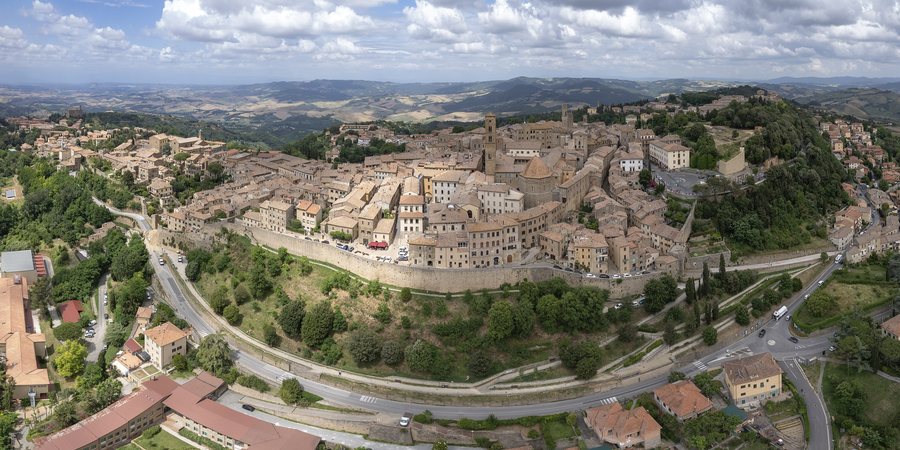
Volterra invites you on a journey through Etruscan, Roman and medieval history. At the same time, museums, alabaster and the Berignone Forest offer different holiday experiences. When choosing a holiday apartment in Volterra, you can combine culture, nature and shared discoveries at your own pace.
Cultural history between the Palazzo and the Acropolis
A striking starting point is the Palazzo dei Priori. Construction began in the early years of the 13th century based on a design by the master builder Riccardo da Como and was completed in 1257. The council chamber contains a fresco of the Annunciation of Saints Giusto, Ottaviano, Cosma and Damiano from 1383 by Iacopo di Cione Orcagna.
On the Etruscan Acropolis in Piano di Castello, the visible foundations of two buildings identified as Temples A and B have been preserved. An intertemple road separates them. The Acropolis also includes the remains of Hellenistic residential buildings, a cistern system including the so-called Piscina, medieval tower structures and roads built on older foundations. Superimposed archaeological layers make it possible to trace Volterra’s emergence and development there from prehistoric times to the 15th century.
The Museo Etrusco Guarnacci is one of Europe’s oldest public museums and preserves one of the world’s most important collections of Etruscan antiquities. The Museo Diocesano d’Arte Sacra mainly displays works from Volterra Cathedral and other city churches, including paintings and liturgical objects such as reliquaries and furnishings. It is located in the Church of Sant’Agostino and also presents architectural fragments, works of art and liturgical objects connected with the development of the appearance of Volterra Cathedral over the centuries. Since 1982, the Pinacoteca di Volterra has been housed in the Renaissance palace Palazzo Minucci Solaini.
The Ecomuseo dell’Alabastro traces the journey of alabaster from extraction in the quarry through processing to trade.
Nature experience in the Berignone Forest
For a contrast to the historical sites, the Foresta di Berignone nature reserve offers a landscape-focused experience. It is part of the somewhat larger Berignone Forest in the Alta Val di Cecina. The forest extends between the municipalities of Volterra and Pomarance across more than 2,000 hectares of woodland and maquis. The Berignone Forest has well-maintained paths that enable safe exploration of the forest, as well as educational boards about life in the forest.
Choose a holiday apartment in Volterra based on your holiday focus
When choosing your accommodation, you can therefore consider whether you would primarily like to combine your stay with Etruscan archaeology, art and alabaster, or whether nature days in the Berignone Forest should take up more space. For families with different interests, the holiday can thus be mentally divided between focused cultural experiences and a more peaceful stay in the forest, without having to commit to a single focus. The Volterra Card may also be relevant for planning your time: It is valid for 72 hours.
Other destinations for choosing your location include Pignano, Prato D'era, Saline, Mazzolla and Villamagna.

