
Holiday Apartment in Sesto Fiorentino: Culture, Nature and History
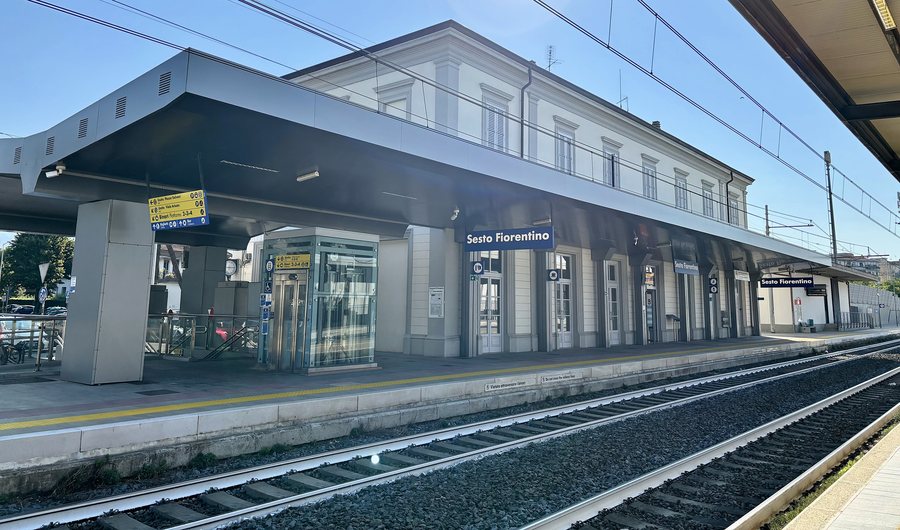 File:Edificio Stazione Sesto Fiorentino 2025.jpg
Photo: Emabarto01 via Wikimedia Commons, CC BY-SA 4.0
File:Edificio Stazione Sesto Fiorentino 2025.jpg
Photo: Emabarto01 via Wikimedia Commons, CC BY-SA 4.0
Sesto Fiorentino offers you a journey through art, villa gardens, Etruscan history and restored wetlands. If you choose a holiday apartment in Sesto Fiorentino, you can shape your stay around very different interests: historic architecture, distinctive ceramic art, nature observation or travel arrangements where the railway station and bus route play a role.
Art, Villas and Etruscan History
At the Chiesa di San Romolo in Colonnata, numerous porcelain furnishings preserve a distinctive touch of craftsmanship. The Chiesa di Santa Maria e San Jacopo in Querceto contains a marble-effect terracotta altar created by Manifattura Ginori between the late 18th and early 19th centuries. The collection of the Museo Ginori comprises almost 10,000 porcelain and maiolica objects dating from 1737 to 1990. The Archivio della Ceramica Sestese also contains thousands of ceramic objects, models, plaster moulds, sketches and historic photographs.
The history of Sesto Fiorentino is also reflected in its villas and representative buildings. During the Florentine Republic, the Palazzo Pretorio was the seat of the Podestà of Sesto. Villa Gerini has been documented as a suburban residence since the 14th century. The garden of Villa Guicciardini Corsi Salviati reveals stylistic layers and changes spanning more than three centuries since 1500. Around the middle of the 17th century, Giovanni and Lorenzo Corsi commissioned Gherardo Silvani and Baccio del Bianco to carry out work on the villa and its garden. Both acquired the forms that have survived and been restored to the present day through a comprehensive redesign carried out approximately between 1708 and 1750.
The parks also tell stories of their own. The 19th-century park of Villa Gerini includes a holm oak grove crossed by paths. Its artificial lake has two islands with a pavilion intended as a tea salon. The Teatro Limonaia is located in the former orangery of Villa Corsi Salviati Guicciardini. Since 2013, it has been the home of the Residenza Multipla theatre project recognised by the Region of Tuscany. The Pieve di San Martino preserves a shaped wooden cross painted by Agnolo Gaddi around 1390.
Two remarkable tomb monuments offer a glimpse into the Etruscan past. The Tomba della Montagnola is considered one of the most important Etruscan tomb monuments in central Italy; a virtual tour and visits to the exterior and interior are available. The Tomba della Mula is a remarkable example of Etruscan architecture from the Orientalising period. It is distinguished by the absence of a central pillar and was built in the middle years of the second half of the 7th century BC as a tomb monument for an exceptionally wealthy princely family.
Landscape and Wetlands
Monte Morello covers approximately 1,700 hectares within the territory of Sesto Fiorentino and has considerable landscape and ecological importance. Another natural area is the Parco della Piana, a protected area of around 50 hectares established to restore a former wetland ecosystem. The park lies along an important migration route used by cranes, flamingos and wild geese.
The Oasi WWF Val di Rose includes a lake basin, numerous marshlands, wet meadows and habitats characterised by trees and shrubs. These areas were restored to preserve flora and fauna. A visitor trail runs through the historic core and the newer restored area. If, when choosing your accommodation, you place greater emphasis on nature experiences than on art and architecture, Monte Morello, the Parco della Piana and the Oasi WWF Val di Rose offer different thematic points of interest.
Accommodation and Orientation
When searching for a holiday apartment in Sesto Fiorentino, you can therefore decide first on your preferred focus: villas, churches, ceramics and Etruscan tomb monuments favour a cultural and historical stay, while Monte Morello and the region’s wetlands offer a landscape-oriented perspective. For planning your mobility, Sesto Fiorentino railway station is also a verifiable point of reference. It is served by the Pistoia–Viareggio railway line. Bus route 64 runs from Sesto Fiorentino railway station to the terminus. This allows cultural interests, nature themes and the location of your accommodation to be considered as different selection criteria.
Further Places for Orientation
For further location choices, here are some concise points of reference: Segalari, Firenzuola, Castelfiorentino, Bassa, Scarperia, Gaville, Pelago and Dicomano.
For the broader travel overview: Florence.
Check prices, availability and amenities for your travel dates directly on Booking.com.
View Accommodation and OffersAdvertisement · Partner link to Booking.com
