
Holiday apartment in Acquedolci: cave, history and surrounding beaches
Accommodation in Acquedolci
Acquedolci combines a palaeontological past, historic architecture and regional landscapes. The Grotta di San Teodoro is a particularly prominent focal point: it opens in a rock face 140 metres above sea level and is considered the first and most important site providing evidence of burials from the Upper Palaeolithic.
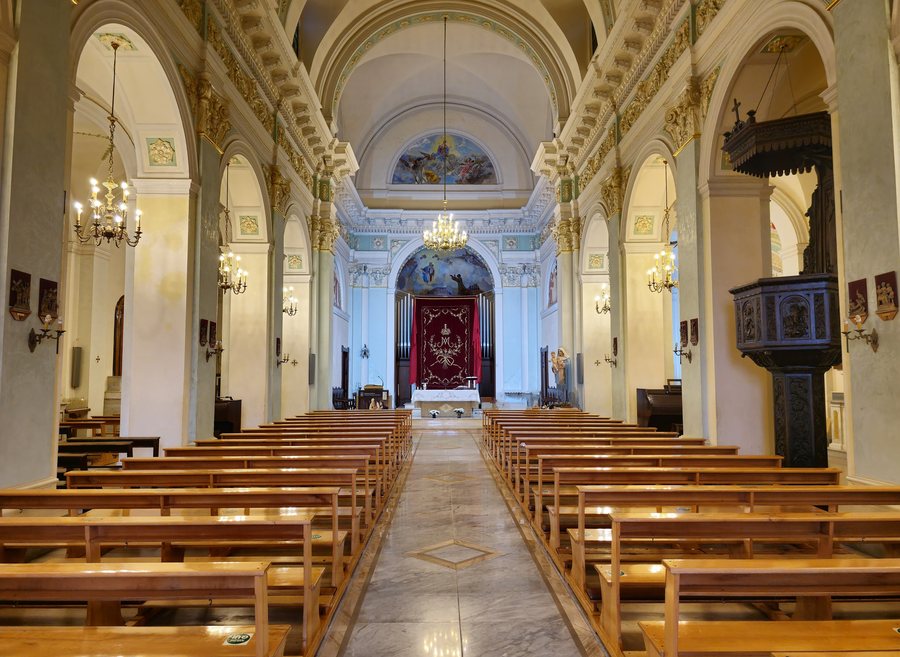 File:Acquedolci, Chiesa San Benedetto il Moro (05).jpg
Photo: Subbass1 via Wikimedia Commons, CC BY-SA 4.0
File:Acquedolci, Chiesa San Benedetto il Moro (05).jpg
Photo: Subbass1 via Wikimedia Commons, CC BY-SA 4.0
Grotta di San Teodoro: Traces of a very early past
The more recent deposit in the Grotta di San Teodoro provides evidence of human settlement dating from approximately 15,000 to 11,000 BC and is attributed to the Late Epigravettian. In front of the cave there is also a Pleistocene lake deposit dating from approximately 200,000 years ago. It contains thousands of remains of the hippopotamus Hippopotamus pentlandi Meyer. Those interested in geological history, archaeology and the development of human habitats will therefore find several chronological layers in Acquedolci that can be connected mentally.
Culture and architectural history in Acquedolci
The Antiquarium Comunale in Acquedolci displays palaeontological and prehistoric finds from the nearby Grotta di San Teodoro. The Baglio del Castello, also known as Castello Larcan-Gravina, provides a different historical accent; it is a fortified complex dating from the 17th to the 18th century. The Baglio del Castello contains the Chiesetta di San Giuseppe, dating from the 16th century. The church was restored in 2004 and has a late-Baroque Sicilian altar as well as antique maiolica tiles.
The Chiesa Madre is also part of the local architectural history. Its foundation stone was laid in 1926, and the building was completed in 1928. Thus, religious architecture, a fortified complex and engagement with a very distant past stand side by side in Acquedolci.
Traditions and fixed dates
The Carnevale Acquedolcese has a very long tradition and is accompanied by various folkloric events. The celebrations of San Giuseppe also have a fixed place in the annual calendar. They take place on the third Sunday in May or on the Sunday after the historic Fiera di Acquedolci; this historic fair takes place every year on 14 May.
Palaces, mountains and beaches in the wider region
Several historic buildings are located in the immediate surroundings of Acquedolci: Palazzo Corrado is a palace, as is Palazzo Calì. Castello Gallego is also located nearby and is a museum. In the wider regional area lies Palazzo Cupane, which is likewise a palace. Monte San Fratello, a mountain, serves as a landscape landmark in the immediate surroundings of Acquedolci.
The wider regional area around Acquedolci includes the beaches Spiaggia di Capo d'Orlando, Spiaggia di San Gregorio and Spiaggia di Testa di Monaco.
Further destinations for your research include San Pier Niceto, Furnari, Malfa, Rinella, Stromboli, Mistretta, Monforte Marina and Gioiosa Marea.
For the higher-level travel overview: Messina.

.jpg)