
Holiday apartment in Calascibetta: history and rocky landscapes
Accommodation in Calascibetta
Holiday apartment in Calascibetta amid history and rocky landscapes
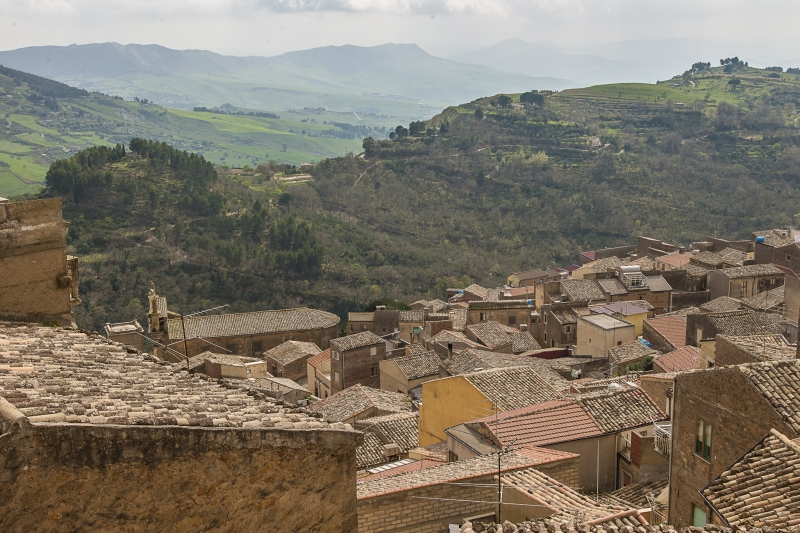
Calascibetta combines a historic town center with extraordinary traces of past cultures. The town center preserves its medieval urban structure, while the Rocca di Cerere UNESCO Global Geopark extends across the Monti Erei in central Sicily and includes, among other areas, the municipality of Calascibetta. This gives you points of connection if you would like to combine cultural history and landscapes closely on your journey.
The Chiesa Madre and the history of the town center
The Chiesa Madre is a particularly multifaceted place to visit. It was built over the ruins of the former Castello Marco, completed in 1340 and designated the Regia Cappella Palatina by King Peter II of Aragon in 1342. Through a window in the floor, a partially visible Paleo-Christian rock church inside the former castle can be seen. The Chiesa Madre is also regarded as one of the most significant expressions of Catalan art in the province of Enna.
The Jewish heritage is also present in the townscape. In the Jewish quarter of Calascibetta, 25 Jewish families lived in the 14th century. The Bevaio on Via Giudea alta consists of a monolithic round basin made of Cutu stone and is considered the historic fountain complex of the Jewish quarter that is still recognizable today. The Chiesa Maria SS. della Catena emerged from the local Jewish synagogue, which was converted into a Catholic church after the expulsion of the Jews from Sicily in 1943. The synagogue of Calascibetta is said to have been identified in a house on Via Giudea.
Rock settlements and the Realmese necropolis
The Realmese necropolis and the Canalotto rock settlement represent a much older past shaped by the rock. Realmese is considered Sicily’s second-largest Pantalican necropolis. It comprises 288 Pantalican-type tombs dating from the 9th to the 6th century BC and was initially used during the Protogeometric or Protohistoric period, and later during the Archaic period.
Canalotto is a rock settlement from the Late Antique Roman-Byzantine period. It includes two two-storey rock churches and around 30 caves, some of which extend across several levels. Along Via Carcere, caves were carved into gray calcareous sandstone; Via Carcere is also a typical example of Calascibetta’s rock-hewn settlement form.
Routes and practical information
The Regia trazzera Calascibetta–Gangi passes through the area of the Realmese necropolis. Sections of the historic paving made of Cutu stone, as well as a section of path carved into the rock, can still be seen there. Calascibetta is also one of the places connected by the Cammino dell’Antica Trasversale sicula.
For your planning, access to the individual sites varies: the Chiesa Madre, the Realmese necropolis and Canalotto are accessible on foot, not accessible to people with reduced mobility and have no entrance fee. Via Carcere is accessible on foot, accessible to people with reduced mobility and also has no entrance fee.
Further places to include in your travel plans
You can also consider Villarosa, Enna, Agira, Nissoria, Centuripe, Gagliano Castelferrato, Troina and Catenanuova when planning the rest of your journey: Villarosa, Enna, Agira, Nissoria, Centuripe, Gagliano Castelferrato, Troina, Catenanuova.
To the higher-level travel overview: Enna.
