
Holiday apartment in Caltanissetta – Culture, History and Traditions
Accommodation in Caltanissetta
Caltanissetta is closely associated with sulfur mining: until the first decades of the 20th century, it made the city Sicily’s mining center. This past stands alongside churches, museums, historic squares and landscape sites that reveal different chapters of the city and its surroundings.
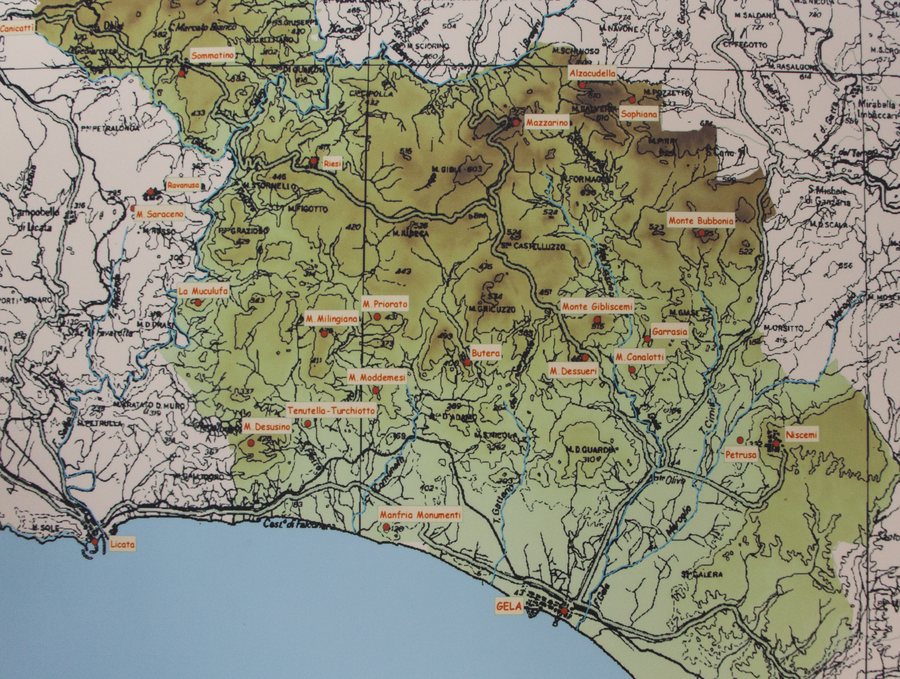 File:Mappa dei siti archeologici della provincia di Caltanissetta 01.jpg
Photo: Davide Mauro via Wikimedia Commons, CC BY-SA 4.0
File:Mappa dei siti archeologici della provincia di Caltanissetta 01.jpg
Photo: Davide Mauro via Wikimedia Commons, CC BY-SA 4.0
Culture and History
Among the notable religious buildings is the Cattedrale di Santa Maria La Nova, which was built from 1536 to 1622 in the Neoclassical style. Its interior contains frescoes by the Flemish painter Guglielmo Borremans and his school. The Chiesa di Sant'Agata al Collegio was built between 1600 and 1610 at the request of the Jesuits in the late Renaissance style. It contains 18th-century frescoes by Luigi Borremans, as well as a painting by Agostino Scilla from 1654 depicting the martyrdom of Saint Agatha.
The Museo Archeologico di Caltanissetta was reopened to the public in 2006 after its exhibitions, educational programs and content had been renewed. It presents the history of settlements in the urban and non-urban areas of Caltanissetta, as well as other places in the province, from prehistoric times to late antiquity. The Palazzo Moncada remained unfinished after construction work was interrupted and regained its original appearance through extensive restoration.
Cityscape
The Arab quarter of San Domenico contains one of the best-preserved courtyards of Arab origin in the district; the quarter also preserves numerous elements of Arab urban planning. Exploring the Arab quarter of San Domenico on foot is recommended. Another historic trace is the Strata 'a foglia, a historic street in the city where the traditional fruit and vegetable market has been held since 1500.
Traditions and Squares
The Settimana Santa di Caltanissetta has been celebrated in Caltanissetta with great participation for more than a century and includes processions connected with the Passion of Christ. The procession of the Vare di Caltanissetta features sixteen groups of figures depicting scenes from the Passion of Christ and the Stations of the Cross. It passes through the historic center of Caltanissetta and begins and ends in Piazza Garibaldi.
Piazza Garibaldi is home to the Fontana del Tritone, with a bronze group depicting Tritons, a seahorse and two sea monsters. Michele Tripisciano created the statue in 1890; in 1956, it was moved to its present location. The gallery of the Museo Diocesano di Caltanissetta displays numerous paintings, most of which date from the 17th and 18th centuries. It also includes four paintings with scenes from the Stations of the Cross, originating from the Capuchin monastery of Caltanissetta.
Landscape and Trails
The Monumento al Redentore stands on the highest peak of Monte San Giuliano above Caltanissetta. It was designed by the architect Ernesto Basile as Sicily’s contribution to the national series of Christ the Redeemer monuments commissioned by Pope Leo XIII. There is a nearby ACI car park at the Monumento al Redentore, on Via Medaglie d'oro. Travel by public bus is possible via the Via Borremans stop served by route 2 of the SCAT company, whose terminus is Piazza Roma.
The ancient site Archeological park of Gibil Gabib is located in the immediate surroundings of Caltanissetta. The Museo del Folclore e delle Tradizioni Popola, the Palazzo Vescovile and the art gallery Galleria D'Arte 'La Vetrinetta are also located in the same immediate surroundings. The mountain Monte Cane is located in the area around Caltanissetta.
In the wider regional surroundings of Caltanissetta lies the viewpoint Landscape from Piazza Crispi. Sicily, an island, is also located in the wider regional surroundings of Caltanissetta. The mountain Monte Altesina is likewise situated in this wider regional area.
The Castello di Pietrarossa is a fortress made of red bricks on a rock, overlooking the valley below. The ruins of the Castello di Pietrarossa are still visible near the city, even after the 1567 earthquake.
Other Places
Other place pages in the direct regional context: Butera, Santa Caterina Villarmosa, Resuttano, San Cataldo, Caltanissetta, Ciolino, Delia, Gela, Vallelunga Pratameno, Montedoro, Niscemi, Riesi, Villalba, Sommatino, Bompensiere, Sutera, Mussomeli, Mazzarino, Serradifalco, Campofranco and Acquaviva Platani.
To the higher-level travel overview: Sicily.

