
Bari Sardo: Coast, Culture and Holiday Apartments
Accommodation in Bari Sardo
Bari Sardo combines extensive sandy coasts with prehistoric evidence, a distinctive history of coastal towers and Sardinian festivals.
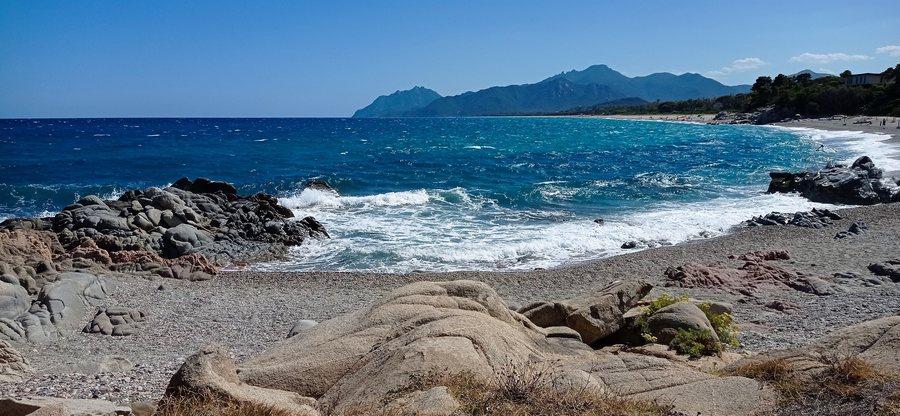 File:Rough sea at the beach in Bari Sardo, Sardinia, Italy.jpg
Photo: Fabio Pani via Wikimedia Commons, CC BY-SA 4.0
File:Rough sea at the beach in Bari Sardo, Sardinia, Italy.jpg
Photo: Fabio Pani via Wikimedia Commons, CC BY-SA 4.0
Holiday apartment in Bari Sardo between beach and nature
Spiaggia di Barì is approximately 8 kilometres long and 100 metres wide. A rocky promontory with the Torre di Barì divides the sandy beach into two sections and gives the coast a distinctive landscape feature. The tower is made of local granite and basalt, has a truncated-cone shape and is approximately 13 metres high.
The coastal section where the volcanic basalt plateau of Teccu meets the sea also shapes the character of Bari Sardo. The Sardinia Region has recognised it as an area of significant naturalistic interest, known as an Area di Rilevante Interesse Naturalistico (R.I.N.). For windy days, the approximately 3-kilometre-long sandy coast of Planargia offers a focus of its own: extending from the Foddini and Tramalitza beaches between Cardedu and Bari Sardo to the section known as Sa Marina, it becomes a destination for windsurfers and kitesurfers on windy days.
History and brief discoveries
The Torre di Barì is noteworthy not only for its construction. The building was recommended in 1572 by the captain of Iglesias, Marco Antonio Camos, because the site was frequently visited by corsairs. Thus, a specific historical event is linked to the granite and basalt tower on the coast.
Funtana ‘e su Rettore points to a much older past. The site is among the best-known Domus de janas in Bari Sardo and dates from the period between the fifth and third millennia BC. The route to Nuraghe Sellersu takes approximately 15 minutes and has a low level of difficulty.
Festivals, crafts and Sardinian cuisine
The events calendar brings together various facets of Bari Sardo in summer. In June, during the Corpus Christi procession, handmade blankets and carpets produced on looms are displayed on balconies and at windows. In July, the Sagra de Su Nenniri takes place as part of the San Giovanni festival. It recreates the preparation of vessels with wheat sprouts as an agro-pastoral tradition. At the end of a religious procession, the vessels are thrown into the sea as symbols of good luck; Luneddas, people in historical clothing, seasonal fruit and Pane pintau accompany the festival.
In August, a culinary festival in honour of Culurgiones puts typical products of the region, as well as the culinary tradition and culture of Bari Sardo and the Sardinian coast, at the centre of attention. Cosa Bona & Bariesa takes place every year and invites visitors to discover the culinary traditions of the town through experience-oriented show cooking, courses, workshops, exhibitions, excursions and guided tours of the area.
Discover more places
Ulassai, Gairo, Elini, Girasole, Tortoli, Perdasdefogu, Arzana and Tertenia
To the higher-level travel overview: Ogliastra.

