
Holiday apartment in Livorno Ferraris – discover culture and rice farming traditions
Accommodation in Livorno Ferraris
Livorno Ferraris offers an unusual combination of sacred art, the history of technology, medieval traces and rice farming traditions. When choosing a holiday apartment in Livorno Ferraris, you can place cultural discoveries and insights into the town’s agriculture-based everyday history at the centre of your stay.
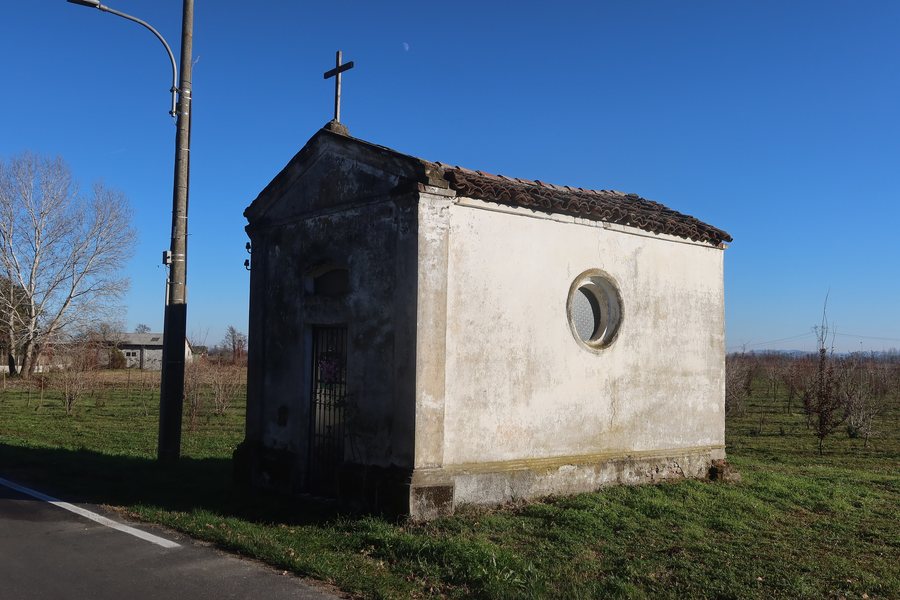 File:Livorno Ferraris Cappella della Madonna del Rosario 01.jpg
Photo: Francoerbi via Wikimedia Commons, CC0
File:Livorno Ferraris Cappella della Madonna del Rosario 01.jpg
Photo: Francoerbi via Wikimedia Commons, CC0
Holiday apartment in Livorno Ferraris: culture, history and rice farming traditions
At the Museo Sacrario “Galileo e Adamo Ferraris”, you encounter a place of family and historical significance: the museum is housed in the former residence of the Ferraris family. It was handed over in 1931 and contained documents and objects commemorating the Ferraris brothers. A visit therefore leads into a specific part of the history of Livorno Ferraris.
The Chiesa Parrocchiale di San Lorenzo Martire combines architectural history with important works of art. It was completed in 1778 under the direction of Filippo Castelli and consecrated on 9 August 1778 by Giuseppe Luigi Avogadro, Bishop of Casale Monferrato. Inside, it preserves paintings by Giorgio Alberini from 1823 and around 1620, as well as works by Bernardino Galliari dating from around 1776. These are joined by the reliquaries of Saint Clement and Saint Lawrence, along with a wooden crucifix from the 16th century.
The marks left by the drawbridge can still be seen at the Torrione Medievale. They point to a moat and the former existence of a castle. The Roman necropolis of Livorno Ferraris is dated to the 1st to 4th centuries AD.
The museums also offer accessible ways to explore the area. The M.A.V.O. exhibition uses explanatory panels and leads through the main corridor and four exhibition rooms. The M.A.V.O. is directly accessible from the street and has a step-free entrance. In 1997, the Museo Civico “Ferraris” became a cultural centre with an educational and general education laboratory through expansion and redesign. Activities and experiments on the origins of electrical engineering take place there.
A special place is the Chiesa Santa Maria d'Isana. It is located on a farm 3 km east of the centre of Livorno Ferraris, on a side road perpendicular to the SP 7 (Livorno Ferraris–Trino). Access is directly from the road, and the entrance is at street level. The church is considered the only Templar church in Piedmont that has survived to this day.
Every year on 15 August, a festival with a votive foot procession is held at the Chiesa Santa Maria d'Isana. According to some traditions, its origins date back to the plague of 1624. This fixed date combines religious tradition with a specific insight into the local culture of remembrance.
Rice farming traditions and everyday life in Livorno Ferraris
The Ecomuseo della Coltura del Riso displays household furnishings, workshops belonging to the blacksmith, farrier and margaio, a school, agricultural machinery and farm carts. It also preserves the historical memory as well as the living and working culture of the people of Livorno. At Riseria Riso Acquerello, the complete production chain for organic rice is presented – from cultivation and processing through to filling and packaging.
When choosing your accommodation, you can therefore consider which focus best suits your stay: exhibitions and electrical engineering, churches and historical traces, or rice processing and rural working life. A holiday apartment in Livorno Ferraris is a suitable search option for anyone who does not want to limit their holiday to a single theme, but instead wants to combine culture, history and regional everyday life.
You can find more local ideas for planning your trip at Rimella, Fobello, Campertogno, Crescentino, Cellio, Vercelli, Gattinara and Ferrera.
Return to the higher-level travel overview: Vercelli.

