
Discover Vicolungo: Castle, Churches and Rice Fields
Accommodation in Vicolungo
Vicolungo is considered a small village surrounded by rice fields. At the same time, fortifications, churches and individual works of art shape the appearance of the village. The rice fields define its rural setting.
Castle and Military Architecture in the Piazza
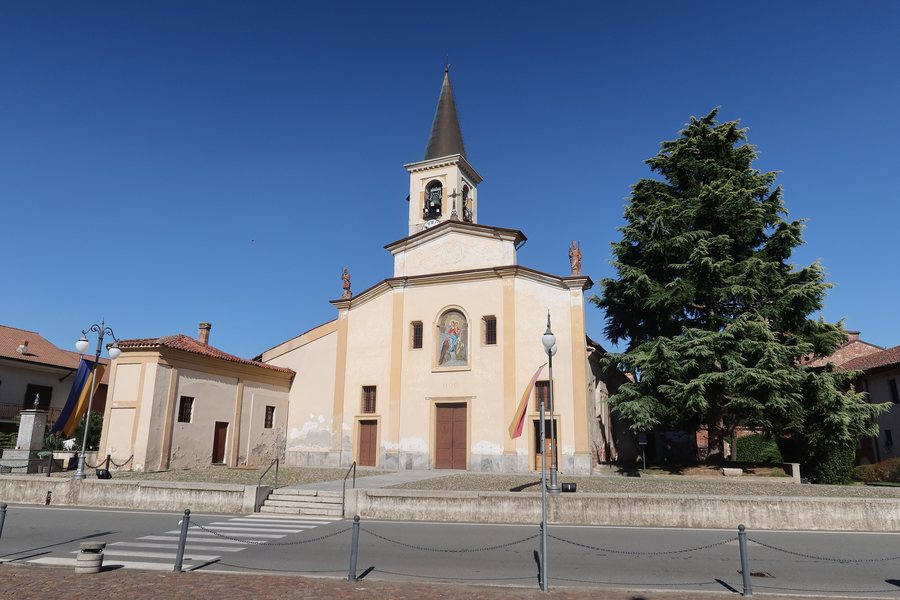
In the village centre, Castello di Vicolungo and the Parrocchiale di San Giorgio, the former parish church, stand next to each other on the village piazza. The Rocchetta is the oldest part of the fortifications of Castello di Vicolungo and dates back to the 15th century. The castle is also notable for its pointed-arch windows and imposing machicolations. The military architecture is reflected in several details: the complex includes the Rocchetta as its oldest part, while the castle is additionally distinguished by its windows and machicolations. The castle complex and former parish church therefore stand directly next to each other on the piazza; within the castle complex, the Rocchetta points to the oldest section, dating from the 15th century. The interplay of piazza, castle and defensive architecture gives the historic centre a clearly recognisable character.
Church Art and Distinctive Architectural Forms
The Parrocchiale di San Giorgio contains a panel depicting the Virgin and the saints, attributed to Bernardino Lanino and executed around 1580. The Chiesa di Santa Maria delle Grazie was founded in 1591 by Enrico Gritta, the feudal lord of Vicolungo. The structure of the Chiesa dates from the 15th century and has a single nave, a vaulted ceiling and a semicircular apse. The panel and the structure create different focal points: in San Giorgio, the focus is on a single work of art, while in Santa Maria delle Grazie, it is on the spatial design of the church. The dates mark different points in history: the structure of Santa Maria delle Grazie dates from the 15th century, the panel was executed around 1580, and the church was founded in 1591.
Historical Traces South of the Village
I Palazzi is a fortified complex from the Middle Ages and was built at the edge of the ancient Biandrina road. South of Vicolungo, the Oratorio di San Martino stands near the cemetery; the settlement of San Martino di Zuxiana was once located there. In the case of the Oratorio, the chronological status is clear: the settlement of San Martino di Zuxiana was once located there.
The Villagescape between the Piazza and the Rice Fields
The piazza with the Castello and Parrocchiale represents a concentration of cultural history, while the Chiesa di Santa Maria delle Grazie adds distinctive architectural forms to this focal point. I Palazzi and the Oratorio di San Martino to the south provide further historical references, while rice fields characterise the surroundings of the small village. The spatial references extend from the village centre at the piazza, across the edge of the ancient Biandrina road, to the Oratorio near the cemetery to the south.
Further Places for Planning Your Trip
For your further selection, you may also consider Vacciago, Gargallo, Orta San Giulio, Meina, Barengo, Lumellogno, Casalino, Nebbiuno.
For the overview of the wider area: Novara.

