
Emilia-Romagna: Holiday Apartments and Holiday Homes
Accommodation in Emilia-Romagna
Emilia-Romagna combines history, regional production and protected landscapes.
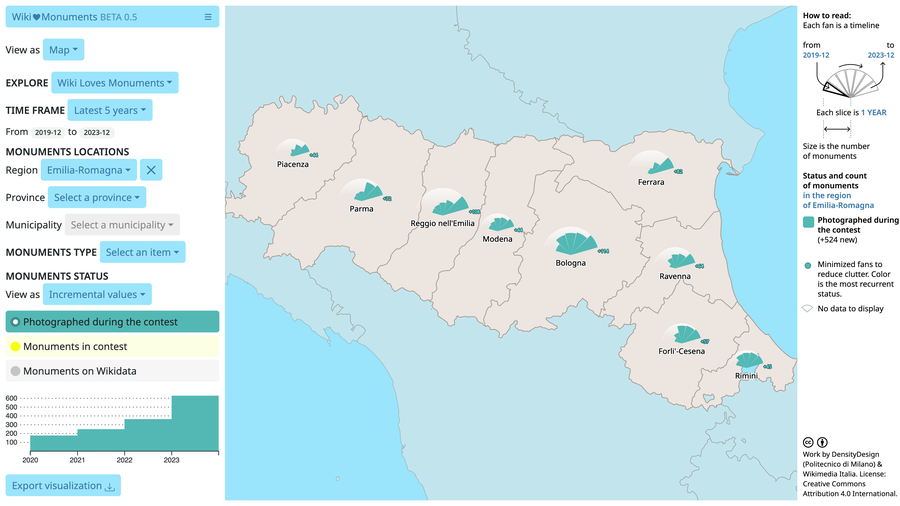 File:Emilia-Romagna WLM Italy 2019-2023.png
Photo: Work by Densitydesign (Politecnico di Milano) & Wikimedia Italia via Wikimedia Commons, CC BY 4.0
File:Emilia-Romagna WLM Italy 2019-2023.png
Photo: Work by Densitydesign (Politecnico di Milano) & Wikimedia Italia via Wikimedia Commons, CC BY 4.0
Culture and History
In Ravenna, the UNESCO World Heritage site of the Early Christian Monuments comprises eight monuments. They represent the architectural and artistic development between the 5th and 6th centuries AD. The mosaics are among the defining elements: they are considered some of the best-preserved examples of this art form in Europe and combine Western and Eastern motifs and techniques. The mosaic tradition and technique are part of Ravenna’s cultural identity. Activities focused on communicating, teaching, preserving and promoting mosaic art keep it alive.
Modena, too, preserves distinctive evidence from various periods. Piazza Grande is located on the historic Via Emilia in the medieval city centre. The cathedral and the Torre Civica together are considered an outstanding example of early Romanesque art, combining exceptional architectural and sculptural quality. Ferrara, in turn, was the first Renaissance city to be developed according to a complex urban plan. In the Ferrara section of the Po Delta, the original Renaissance landscape can still be recognised in the region’s landscape design in the 21st century.
Food and Craftsmanship
The regional cuisine can also be discovered through its production history. Cheese dairies, ham producers and balsamic vinegar producers in Emilia-Romagna organise tours that end with a tasting. The Rocca Sforzesca in Dozza houses a permanent exhibition featuring more than 1,000 wines, spirits and balsamic vinegars.
At the Enoteca Regionale dell’Emilia-Romagna in Dozza, visitors can taste and buy every label in the on-site wine bar. Regular meetings with producers are also held there. Across the region, there are 24 museums dedicated to typical local products, presenting their history, people and production techniques. At Casa Artusi, the “Mariette” teach visitors how to prepare piadina romagnola and Sfoglia, as well as fresh egg pasta, kneaded by hand and rolled out with a rolling pin.
Nature
Emilia-Romagna’s protected-area network extends from the Apennine ridge to the Adriatic coast. It comprises 2 national parks, 1 interregional park, 14 regional parks and 17 nature reserves. These areas protect and preserve 73 different habitats, more than 2,700 plant types and over 350 vertebrate species.
A distinctive landscape is formed by the Emilia-Romagna Regional Park in the Po Delta. It lies south of the Po, opposite the Veneto Regional Park north of the river. The landscape of the Ferrara section of the Po Delta extends from the River Po to the Valli di Comacchio. The Po Delta Regional Park offers special birdwatching routes, equipped areas and observation points.
Coast and Cycling
The region’s maritime side includes the Riviera Romagnola. Its beaches stretch for more than 110 kilometres. The Ciclovia dei Gessi di Gaibola can be started from San Lazzaro di Savena railway station or Ozzano dell’Emilia railway station, is approximately 21 kilometres long and is recommended for mountain bikes because of its considerable climbs.
Other Regional Destinations
The regional selection includes Bologna, Ferrara, Forlì-Cesena, Modena, Parma, Piacenza, Ravenna, Reggio Emilia and Rimini.
For the higher-level travel overview: Italy.

