
Holiday apartment in Taranto: Coast and cultural heritage
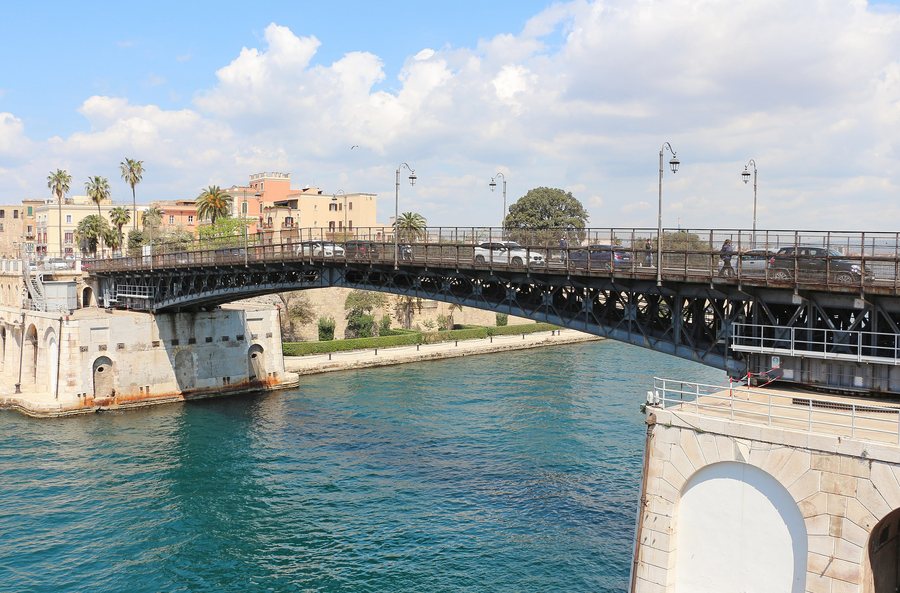
Taranto lies between the Mar Grande and the Mar Piccolo, thus connecting two clearly defined bodies of water. On the west coast, wide beaches characterise the landscape, while the east coast combines high dunes, Mediterranean maquis, low rocks and numerous bays. Mussel farming has been carried out on a large scale in the Mar Piccolo for centuries. Coastal scenery, maritime tradition and the history of the city are closely intertwined here.
Culture and history
The MArTA exhibition traces the history of Taranto and its surrounding area from prehistoric times to the early Middle Ages. The Castello Aragonese is a prominent part of the historical heritage. It occupies the southernmost tip of the island on which Taranto’s old town is located and has a square floor plan with a large inner courtyard. The complex was inaugurated in 1492; the four named towers San Cristoforo, San Lorenzo, dell’Annunziata and della Bandiera have been preserved. The Castello Aragonese can only be visited as part of free guided tours, which must be reserved in advance.
The Basilica Cattedrale di San Cataldo is the oldest cathedral in Apulia. Its central nave contains Greek and Roman columns and capitals, traces of a medieval floor mosaic, and a magnificent wooden coffered ceiling with gold decoration. Also located in Taranto’s historic centre is the Museo Etnografico Alfredo Majorano, housed in the eighteenth-century Palazzo Pantaleo.
The MuDi, the Museo Diocesano di Taranto, is located in Taranto’s old town behind the Basilica Cattedrale di San Cataldo. Its permanent exhibition is divided into seven thematic areas across three levels and displays more than 350 works. On view are silver and gold objects, most of which come from the so-called Tesoro di San Cataldo. Different forms of ecclesiastical, civic and regional heritage thus stand side by side in the old town.
The Ipogeo Funerario is also one of Taranto’s special historical monuments. It is generally visited as part of guided tours organised following registration. The hypogeum consists of two rooms that reuse areas hewn from the rock during the Greek period. The walls of the second room contain openings that probably served an early Christian or Byzantine burial purpose.
The Colonne del Tempio Dorico are the surviving remains of a Magna Graecia temple dating from the early sixth century BC. They are located outdoors, are freely accessible and have no fixed visiting hours. The San Domenico monastery dates in its present form from the mid-fourteenth century. Its cloister preserves the foundations of a Greek temple built in the sixth century BC on the acropolis of the Greek colony of Taranto.
City and water
Several structures make Taranto’s relationship with the water visible. The Ponte di Pietra, also called Ponte Sant’Egidio Maria da Taranto or Ponte di Porta Napoli, is a 115-metre-long stone bridge with three arches and was built in 1883. It offers views of the Mar Piccolo and the Mar Grande. City buses stop a short distance from the Ponte di Pietra. The Ponte Girevole was inaugurated in 1887 and operated from inside the Castello Aragonese.
Nature
The natural side of Taranto includes the Palude La Vela. It is home to numerous resident and migratory bird species, including herons, flamingos, ospreys and the rare black-winged stilt. In the centre of Taranto are the Giardini di Piazza Garibaldi, a green space with free access. They can be reached on foot from the historic centre; public transport stops nearby.
The nearby Parco Archeologico di Saturo lies in the area around Taranto on the Ionian coast. There are two routes where visitors can explore the history of Saturo from the 2nd millennium BC to interventions in the present day.
Experiences and traditions
The Museo Dal Mare offers interactive workshops and educational activities on seafaring and navigation for adults, children, students and anyone interested. Another defining tradition is the pilgrimage of Taranto. It begins at 3 p.m. on Maundy Thursday: the members of the brotherhood walk barefoot to the churches of the Borgo and the Città Vecchia and return to the Carmine Church around midnight. The pilgrimage of the Brotherhood del Carmine in Taranto has existed since at least the sixteenth century and, since immediately after the Second World War, has been the only tradition of this kind preserved by Taranto’s brotherhoods.
Further places
You can find further places in this destination area here: Martina Franca, Avetrana, Mottola, San Pietro In Bevagna, Torricella, Marina Di Pulsano, Sava, Maruggio, Manduria, Taranto, Pulsano, Palagiano, Leporano, Ginosa, Marina Di Ginosa, Crispiano, Uggiano Montefusco, Specchiarica, Castellaneta, Talsano, Massafra, Lido Azzurro, Lizzano, Castellaneta Marina, Grottaglie, Librari, Palagianello, San Giorgio Ionico, Torre Columena, Monteparano, Laterza, San Marzano di San Giuseppe, Lido Chiatona-stazione di Palagiano, Monteiasi, Monacizzo, Marina di Lizzano, Roccaforzata, Faggiano.
To the higher-level travel overview: Apulia.
Check prices, availability and amenities for your travel dates directly on Booking.com.
View accommodation and offersAdvertisement · Affiliate link to Booking.com
_01.jpg)